Farmhouse Sink Grid Sizing: Measure the Bowl Floor, Not the Rim
Size a sink grid from the flat bowl floor, not the rim. Measuring steps, gap rules, drain cutouts and double-bowl fit with real NOZLOO specs.

In this guide View sections +
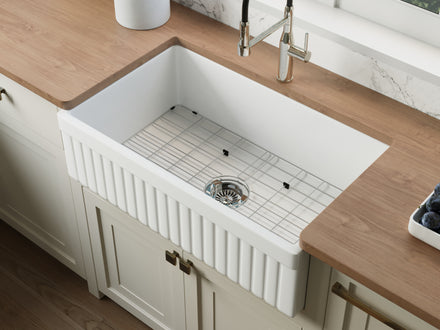
A farmhouse sink grid should be sized from the bowl floor, not the rim. Measure wall to wall just above the floor, where the grid's frame will sit, then choose a grid a little smaller on every side. Match the drain cutout to your drain and the corner shape to your corners, and the grid will sit flat without rocking.
A listing for sink grids usually gives one size for one sink model. This guide shows where to put the tape in a fireclay bowl, how much gap to leave, and how drain position and double bowls change the answer. Real NOZLOO spec-sheet numbers serve as worked examples.
What size farmhouse sink grid do you need?
You need a grid that fits the usable floor of your kitchen sink bowl, which is always smaller than the opening at the top. The interior size on a spec sheet is a starting point, not the grid size. Use it to rule grids out, then confirm with your own floor measurement.
Here are the published interior sizes for NOZLOO farmhouse kitchen sinks. Each one is either 33 x 20 x 10 or 30 x 20 x 10 inches outside. Look how much the inside still varies.
| Model | Outside | Inner length x width | Bowl depth at drain | Drain |
|---|---|---|---|---|
| 33" Fluted Workstation (NZ-103W3320) | 33 x 20 x 10 in | 31 x 18-1/16 in | 8-3/4 in | Center |
| 33" Smooth Workstation (NZ-3320S) | 33 x 20 x 10 in | 31 x 18-1/16 in | 9 in | Center |
| 33" Thick-Edge Standard (NZ-3320T) | 33 x 20 x 10 in | 30-3/4 x 17-3/4 in | 8-3/4 in | Center |
| 33" Double Bowl (NZ-103W3320D) | 33 x 20 x 10 in | Two bowls, each 15 x 18-1/16 in | 8-3/4 in | Center of each bowl |
| 30" Reversible Workstation (NZ-103W3020) | 30 x 20 x 10 in | 27-13/16 x 18-1/16 in | 8-3/4 in | Center |
| 30" Grooved Workstation (NZ-105W3020) | 30 x 20 x 10 in | 27-13/16 x 18-1/16 in | 8-7/8 in | Right-offset |
Two lessons stand out. First, "33-inch" describes the outside, not the bowl. On paper, the Standard model is 1/4 inch shorter and 5/16 inch narrower inside than the workstation models. Its sheet lists nominal values, so measure your own bowl.
Second, the two 30-inch bowls are the same size but drain in different places. So they need different bottom grids.
Why rim size isn't grid size
The rim is the widest part of the bowl, and sink grids never sit there. A fireclay bowl curves at the bottom corners, and the floor slopes gently toward the drain. The space where the grid sits, just above that floor, is shorter and narrower than the top opening.

Spec sheets also measure in specific places. Five of the six NOZLOO sheets state that inner length is taken at the rim and inner width below the workstation ledges. The Thick-Edge Standard sheet lists nominal interior values.
Bowl depth is measured at the drain. None of those points is where a grid rests.
A grid sized to the rim number will be too long. Its ends ride up onto the curved corners. Then it rocks every time you set a pot down, and the frame can rub the glaze in the same spot again and again.
- Rim length: the widest point, used for countertop and cabinet planning.
- Grid-height length: wall to wall, measured level just above the floor where the grid frame sits. This is your grid number.
- Floor slope: the floor drops toward the drain, so the feet near the drain sit lower than the feet at the ends.
How to measure for sink grids
Measure wall to wall at the height where the grid frame will sit, in three places each way, and keep the smallest number. Fireclay is shaped and finished by hand. NOZLOO spec sheets list a tolerance of plus or minus 1/8 inch, so your kitchen sink can differ a little from the published size.
You need a tape measure, a short straightedge or ruler, a pencil, and a sheet of thin cardboard if you want a template. A metal tape can mark glaze, so lay a soft cloth under it.
- Clean and dry the floor. Water hides where the curve starts. Take out the drain basket.
- Set your measuring height. Hold the tape level just above the floor, at about the height a grid frame sits. If you already have a grid in mind, use its listed frame height. Rest the tape on the straightedge to keep it level over the sloped floor.
- Measure the length. Measure wall to wall at that height along the front, the center and the back. Write down the smallest.
- Measure the width. Do the same front to back at the left, center and right. Again, keep the smallest.
- Check where the feet land. The feet must rest on the floor, not on the corner curve. Listed grid sizes usually describe the outer frame. The feet sit inset from it.
- Measure the corners. Hold a ruler across one corner on the floor. Note roughly how far the curve runs in from each wall. You need this to judge a grid's corner shape.
- Locate the drain. Measure from the left wall and from the front wall to the center of the drain opening. Note the outer diameter of the drain flange.
- Make a template (optional). Press thin cardboard onto the floor and trace the walls and the drain. Trim it until it drops in with no curl at the edges.
Write down your numbers as length x width, plus the drain position. For example: 29-1/2 x 16-1/2 inches at grid height, center drain. Those are sample figures to show the format, not measured NOZLOO values. Your own bowl sets the real numbers.
Many listings for sink grids are in millimeters. Use a reliable converter such as the NIST unit conversion page, and remember that 25.4 mm equals 1 inch. A 1 mm rounding error on each side rarely matters. A 10 mm error does.

How much smaller should the grid be?
Leave a small gap on every side, so the grid drops in without touching the walls. Grid sellers do not agree on one number. One listing asks for at least 1/2 inch on all sides. Another sizes grids about 0.3 inch under the sink.
A practical target is about 1/4 to 1/2 inch of gap per side, measured against your grid-height numbers. That gives room for the ±1/8 inch hand-finished tolerance and for the grid frame itself. It still covers almost all of the floor.
- Too tight (under 1/4 inch per side): the frame can bind on the curve and rock. It is also hard to lift out for cleaning.
- About right (1/4 to 1/2 inch per side): sits flat, slides slightly, and leaves a clean channel for water.
- Getting loose (1/2 to 1 inch per side): works, but the grid slides more when you scrub.
- Too loose (over 1 inch per side): the grid slides around, and pans can land on bare glaze at the edges.
If a grid falls between two sizes, pick the smaller one. A slightly loose grid still protects the floor. A slightly large one rocks, and that is the problem you are trying to avoid.
Match the drain cutout
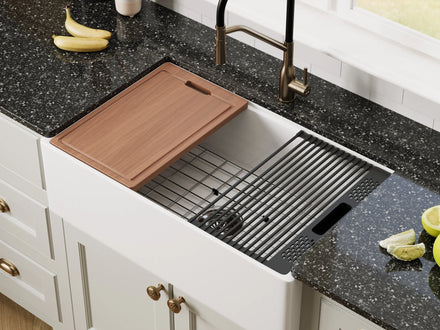
The drain cutout must sit right over your drain, or the grid will block the basket. This is the most common reason bottom grids with the right outside size still do not work.

Every NOZLOO kitchen sink uses a standard 3-1/2 inch drain. The 30-inch Grooved model places it off center, toward the right side. The other single bowls center it. Same bowl size, different cutout.
For more on why sinks offset the drain, see our guide to offset drain kitchen sinks.

Check these three things against your drain measurements:
- Position: the cutout center should line up with the drain center within about 1/4 inch.
- Size: the opening must clear the drain flange, so you can lift the basket out with the grid in place.
- Handedness: an offset cutout only works one way. Spin the grid end for end and the cutout lands in the wrong spot. A right-offset grid will not fit a left-offset drain.
If you added a garbage disposal, check that its flange and stopper also clear the cutout. Our standard sink drain size guide explains the 3-1/2 inch opening.
Bottom grids for a double bowl
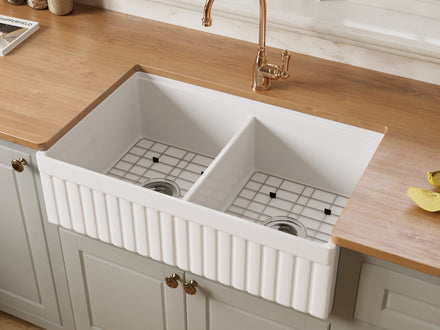
A double bowl kitchen sink needs one grid per bowl, each sized to its own floor. A single long grid cannot cross the divider, and a grid meant for a 33-inch single bowl is about twice as long as each bowl.

On the NOZLOO 33-inch double bowl, each bowl is 15 x 18-1/16 inches with a drain in the center of each. Each bowl ships with its own stainless bottom grid and drain assembly. The divider stops 2 inches below the rim, but it still runs down to the floor, so grids stay on their own side.

Measure both bowls, even on a 50/50 sink. Because fireclay is hand-finished, the two bowls can differ by a small amount. Buy two bottom grids of the same size only if both floors pass the measurement. If you are still choosing a layout, our single vs double bowl guide compares how each one works day to day.
Corners, feet and height
Length and width are only part of the fit. A grid with the right size can still rock if its corners or feet do not match your bowl.
- Corner shape: the grid's corners should be as round as, or rounder than, your bowl's floor corners. Square corners push into the curve and lift the grid.
- Feet: check that every foot lands on the floor and has a rubber or silicone cap. Bare steel feet can scuff glaze and leave marks.
- Height: check the listing for foot height. Taller feet lift pans higher but leave less depth for soaking. Our farmhouse sink depth guide compares common bowl depths. NOZLOO bowls are 8-3/4 to 9 inches deep.
Stainless sink grids resist rust, but chlorides such as bleach and salty water can pit them, especially at wire joints and other tight spots, as the Specialty Steel Industry of North America explains. Rinse the grid after it sits in bleach or salty water. For why a grid protects fireclay and how to care for it, see the farmhouse sink accessories guide.
Model-specific, universal or custom grids?
Buy the grid made for your exact kitchen sink model whenever one exists. It was sized to that bowl's floor, corners and drain. Use a universal grid only when your floor measurement fits its listed size with the right gap. Go custom when neither works.
| Your situation | Best choice | Why |
|---|---|---|
| You know the sink model, and its maker sells a grid | Model-specific grid | Matches floor, corners and drain without guesswork |
| Unknown or older sink, center drain | Universal grid sized to your floor | Many stock sizes exist for center drains |
| Offset or rear drain, no model grid | Custom grid | Stock offset grids rarely match your exact drain spot |
| Double bowl with unequal bowls | Two grids sized separately | Each bowl has its own floor and drain |
Can you cut stainless sink grids to fit? It is not a good idea. Cutting leaves sharp wire ends that can scratch glaze, and it removes the frame that keeps the grid square. A custom order is the cleaner fix.
If you own a NOZLOO sink, every model ships with a bottom grid, and the double bowl ships with two bottom grids. For a replacement, contact our support team with your model number; replies come within a few hours. On workstation models, the kit accessories, including the bottom grid, carry a 1-year accessory warranty. The sink body carries a Limited Lifetime Warranty for the original purchaser in residential use.
How to check the fit
Test new sink grids in a dry, empty bowl before you load it with dishes. Five quick checks tell you whether the size is right.
- Rock test. Press each corner of the grid. It should not tip or click. If it rocks, the grid is too long or its corners are too square.
- Gap check. Look along each side. The gap should be even, about 1/4 to 1/2 inch, with no wire touching a wall.
- Drain check. Lift the drain basket out through the cutout without moving the grid.
- Flow check. Run water and watch it reach the drain. Water should not pool under the grid frame.
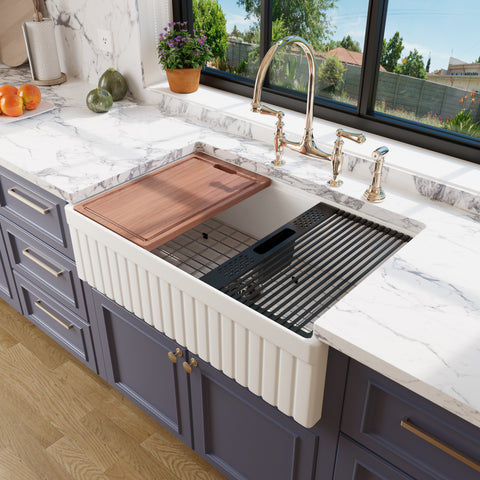
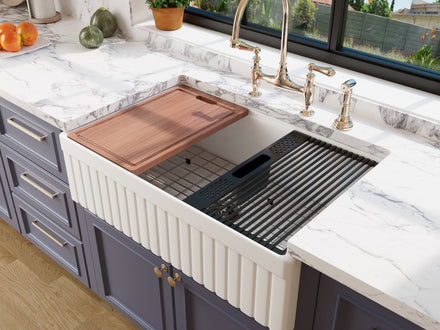
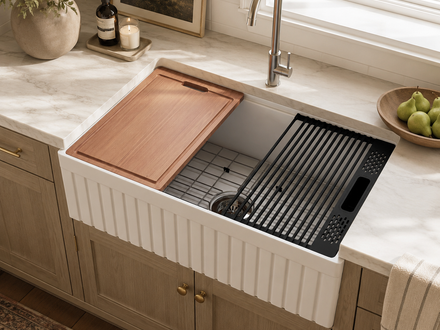
- Accessory check. On a workstation sink, slide the cutting board and drying rack along the ledges. Tall items on the grid should not hit them.

Then build a short cleaning habit. Lift the grid out once a week and wash it and the floor under it. Food and soap film collect where the feet sit.
For the glaze itself, follow our fireclay cleaning guide for safe products and methods.
Common sizing mistakes
Most problems with sink grids come from using the wrong number. These are the ones to watch for:
- Buying by sink width. A "33-inch grid" may be sized for a different 33-inch sink. Interiors vary, as the table above shows.
- Using the rim measurement. The rim is the widest point. The grid needs the size just above the floor.
- Ignoring the drain. Check the cutout's position, size and direction, not just the outer size.
- Measuring once. Hand-finished bowls vary slightly. Measure three times each way and keep the smallest result.
- Skipping the foot caps. A perfect size with bare feet can still mark the glaze.
Sink grids are one part of a full workstation setup. For how the grid works with a cutting board and drying rack, see the farmhouse sink accessories guide. For other ways to protect the finish, read fireclay sink problems and how to prevent them.
Frequently asked questions
How do I measure for a sink grid?
Measure the bowl just above the floor, not at the rim. Hold the tape level at about the height a grid frame sits, and measure wall to wall in three places each way. Keep the smallest number. Check that the grid's feet will land on the floor, not the corner curve, and note the drain position from the left and front walls. Choose a grid about 1/4 to 1/2 inch smaller on each side.
Are farmhouse sink grids universal?
No. Sink grids are sized for a bowl's floor, corners and drain, and those vary even between sinks with the same outside size. Two NOZLOO 33-inch models differ on paper by 1/4 inch in length and 5/16 inch in width inside, so measure your own bowl. A universal grid can work on a center-drain sink if its listed size fits your measurement with the right gap.
Can you use a sink grid with an offset drain?
Yes, but the cutout must match the drain's exact position and direction. An offset cutout only works one way, so a right-offset grid will not fit a left-offset drain. Measure from the left and front walls to the drain center and compare with the grid's drawing. If no stock grid lines up, a custom grid is the better choice.
Ready to compare bowls, drains and included bottom grids side by side? Browse the full NOZLOO fireclay farmhouse sink collection, where each product page lists its interior size and kit contents.