Over the Sink Cutting Board: How to Pick One That Fits Your Sink
Over-the-sink cutting boards rest either on the rim or on workstation ledges. Learn which your sink needs and how to measure for a board that fits.

In this guide View sections +
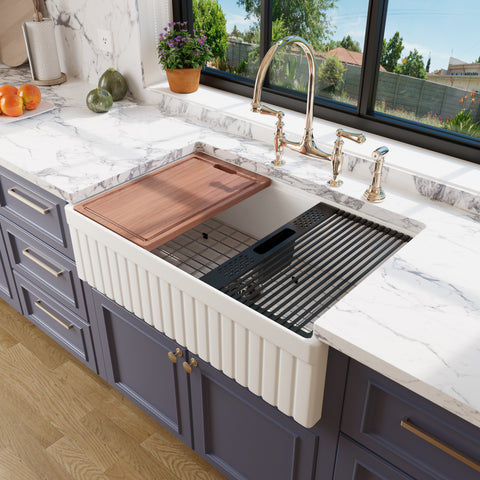
An over the sink cutting board is a board that sits above the bowl, so you can chop and let scraps and juice fall straight into the sink. There are two kinds. A span board rests on the rim or the countertop and fits almost any sink. A ledge board rides on rails built into a workstation sink and fits only sinks with matching ledges.
So the first question is not wood or bamboo. It is what your board will sit on. This guide shows how to tell, how to measure, and what the numbers look like on real fireclay farmhouse sinks.
What is a sink cutting board?
A sink cutting board is any cutting board that bridges the open bowl instead of sitting on the counter. You may also see it called a sink cover cutting board, a workstation cutting board, or a sink board. The name matters less than how it is held up.
- Span boards are wider than the sink opening. They rest on the rim, the countertop, or both. Many have feet, a lip, or rubber strips on the underside so they do not slide.
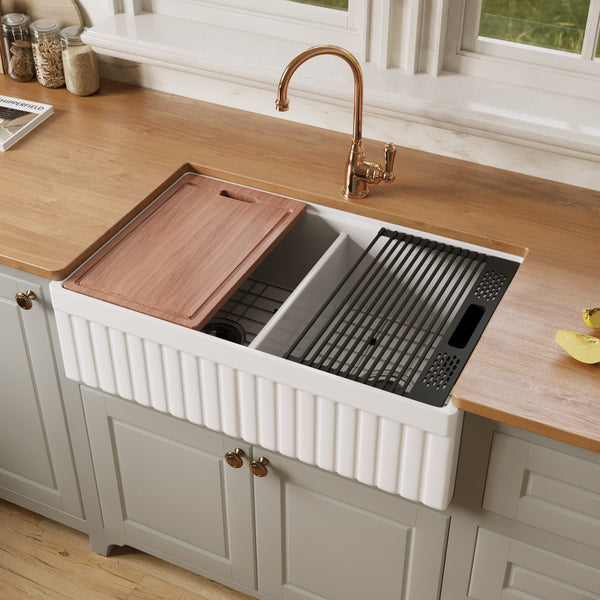
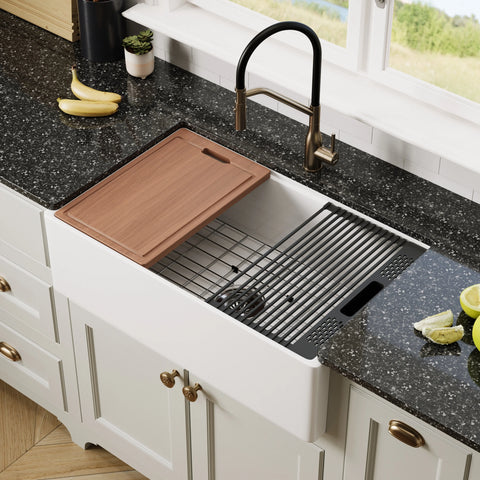
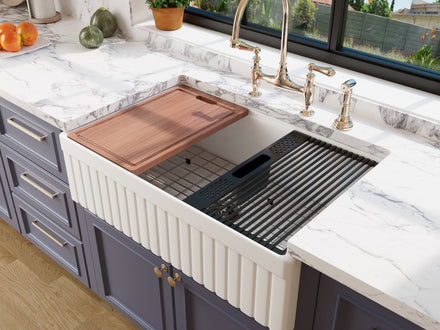
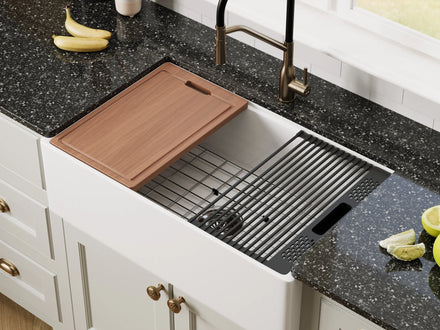
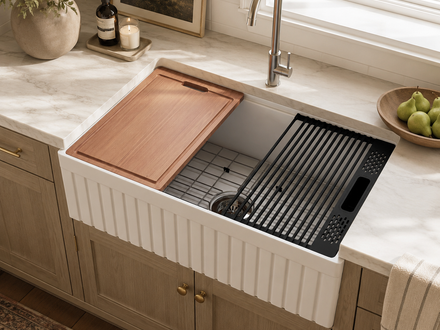
- Ledge boards are cut to fit between two rails, or ledges, molded into the sink wall a little below the rim. The board sits lower, close to the water, and slides along the rails.
Both do the same job. You prep right where the water is, push trimmings into the bowl, and free up counter space.
The difference is fit. A span cutting board needs flat support on both sides. A ledge cutting board needs the right width to the fraction of an inch.
Span board or ledge board: which one does your sink need?
Check your sink wall first. If you see a step or rail running along both long sides of the bowl, you have a workstation sink, and a ledge cutting board is the better fit. If the wall runs smooth from rim to bottom, you need a span board.
| Your sink | Board that fits | What holds it up |
|---|---|---|
| Workstation sink with ledges on both sides | Ledge board made for that ledge | The two built-in rails |
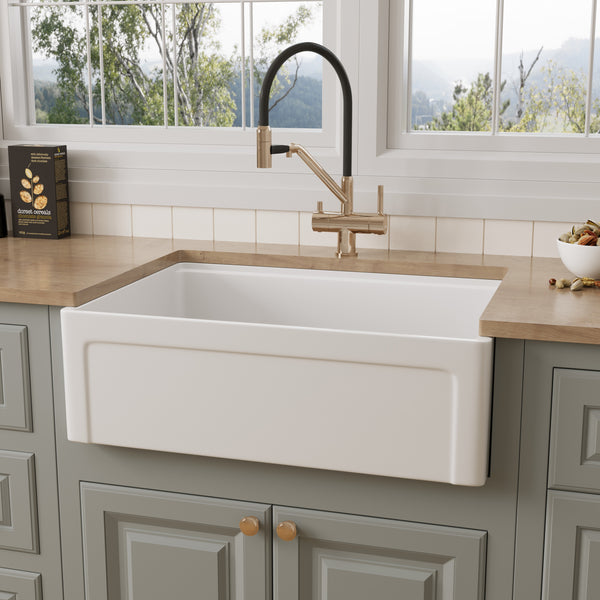
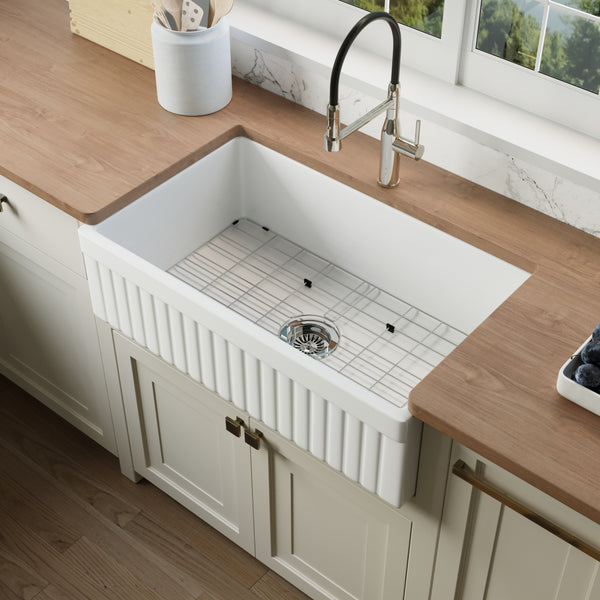
| Farmhouse or undermount sink with no ledge | Span board | Countertop edges or the sink rim |
| Drop-in sink with a raised rim | Span board with a recess or feet | The sink rim itself |
Here is why this matters. A ledge board placed on a sink with no ledge will drop into the bowl. A span board placed on a workstation sink sits high on the rim and doesn't use the rails. It works, but you lose the slide and the lower working height.

How to measure for a sink cutting board
Measure the support, not the bowl, before you buy any sink cutting board. The bowl width tells you where the board must not fall. The support tells you where it will rest. Use a steel tape and write each number down to the nearest 1/16 inch.
For a ledge board
- Measure across the ledges. Run the tape from the inner edge of one ledge to the inner edge of the other. A board narrower than this drops in.
- Measure across the rim above the ledges. This is the most the board can be. A board wider than this will not sit down on the rails.
- Measure the inner length. This is how far the board can slide end to end.
- Check the faucet. Note how far the faucet spout and base reach over the bowl. A board pushed under the spout blocks the stream.
- Check the corners. Make sure the board can tilt up and lift out without hitting the faucet or backsplash when it sits at either end of the bowl.
For a span board
- Measure the opening. Measure the sink opening front to back and side to side at the countertop.
- Add bearing room. The board needs at least a little flat surface on each side. Wider is steadier.
- Check the surface. A raised rim, a tile edge, or a lip of caulk can make the board rock. Feet or a rubber strip helps it sit flat.
- Check the faucet and backsplash. A deep span board can hit the faucet base at the back.
One more rule applies to both. Fireclay shrinks as it is fired, so each sink can differ a little from the drawing. Measure the sink you have, not the catalog page. Our guide on how to measure for a farmhouse sink covers the cabinet side of the same job.
What the numbers look like on real farmhouse sinks
A ledge cutting board depends on the exact ledge width, and the spec sheets show which numbers matter. Below are the inside sizes from NOZLOO spec sheets. Inner width is measured below the ledges, and bowl depth is measured at the drain. (For the ledge-free NZ-3320T, inner width is the nominal interior.) Sizes are nominal; fireclay can vary slightly from piece to piece, so measure your own sink.
| Model | Outside size | Inner length | Inner width | Bowl depth | Ledge |
|---|---|---|---|---|---|
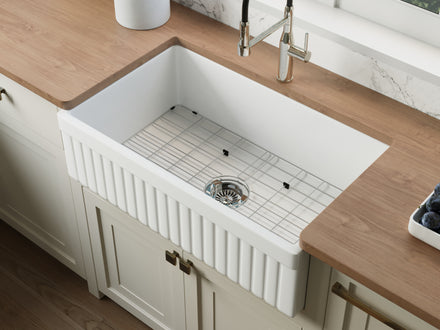
| 33" Fluted Workstation (NZ-103W3320) | 33 x 20 x 10 in | 31 in | 18-1/16 in | 8-3/4 in | Yes |
| 33" Smooth Workstation (NZ-3320S) | 33 x 20 x 10 in | 31 in | 18-1/16 in | 9 in | Yes |
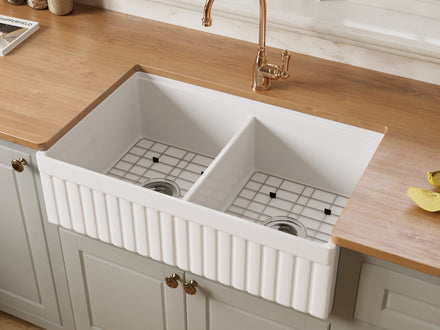
| 33" Double Bowl Workstation (NZ-103W3320D) | 33 x 20 x 10 in | Two 15 in bowls | 18-1/16 in | 8-3/4 in | Yes |
| 30" Reversible Workstation (NZ-103W3020) | 30 x 20 x 10 in | 27-13/16 in | 18-1/16 in | 8-3/4 in | Yes |
| 30" Grooved Workstation (NZ-105W3020) | 30 x 20 x 10 in | 27-13/16 in | 18-1/16 in | 8-7/8 in | Yes |
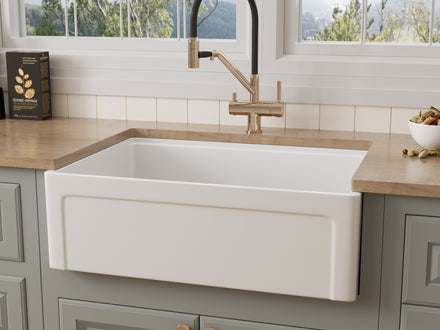
| 33" Thick-Edge Standard (NZ-3320T) | 33 x 20 x 10 in | 30-3/4 in | 17-3/4 in | 8-3/4 in | No |
Three things stand out.
- The width is shared. Every workstation model above has the same 18-1/16 inch width below the ledges. A cutting board must be wider than that to rest on the rails.
- The slide length is not. On a 33 inch single bowl, the board can travel along 31 inches of bowl. On a 30 inch model, it has 27-13/16 inches. The shorter sink leaves less room beside the board for the rack or a pot.
- The rail span is not printed. The sheets give the width below the ledges, not the distance across the ledge tops. That is why a third-party cutting board needs a tape on your actual sink before you buy.
The easy path on a workstation sink is the board made for it. Every NOZLOO workstation model includes a sapele cutting board cut for its ledges, along with the roll-up drying rack and bottom grid.


Where does the board go on a double bowl?
On a single bowl, the cutting board slides to whichever end you need. On a double bowl with ledges on both rims, it can park over either bowl. That gives you a simple split: prep on one side, rinse on the other.
The 33" double bowl workstation has two equal 15 inch bowls. Its ledge runs along both rims, so the sapele board and the drying rack slide across and stop over the left or right bowl. The ledge runs the full length, so the board slides past the divide. The divide sits 2 inches below the rim, so a sheet pan can also lie flat across both bowls.

A good daily routine looks like this:
- Board over the left bowl for chopping. Scraps go straight into that drain.
- Right bowl open for rinsing produce or filling a pot.
- Swap sides when one bowl fills with soaking pans.
If you are still choosing a layout, see whether a 33 inch double bowl is worth it.
Which cutting board material works best over water?
Hardwood is a popular choice for a cutting board that lives on a sink. It is kind to knife edges, it is heavy enough to stay put, and it looks at home next to a white fireclay bowl. The trade-off is care. Wood needs drying and oil, and a wood cutting board is not dishwasher safe.
| Material | Over the sink | Watch for |
|---|---|---|
| Hardwood (sapele, maple, walnut) | Steady, quiet, easy on knives | Needs to dry fully and get oiled; do not soak |
| Bamboo | Hard and light | Glued strips; harder on knife edges |
| Plastic | Most are dishwasher safe; good for raw meat | Deep knife grooves hold bacteria; replace when scarred |
| Composite or fiber | Thin and stiff | Check the edge fits the ledge and does not slip |
Whatever the material, look at the edge too. A juice groove helps most on a board you use for fruit, tomatoes or carved meat.
Many cooks keep two. The wood cutting board stays on the ledge for produce and bread, and a plastic cutting board comes out for raw meat. That matches common food safety advice. Illinois Extension recommends a separate cutting board for raw meat and a new board once deep cut marks appear.
How do you keep juice and scraps in the sink?
Push toward the open side of the bowl. The whole point of a sink cutting board is that the mess has somewhere to go. Set the board so there is a gap beside it, then sweep scraps off that edge with the back of your knife.
- Leave a gap. Slide the board to one end so part of the bowl stays open.
- Use a juice groove. A juice groove is a shallow channel cut around the edge of the face. It holds tomato or citrus juice until you tip it into the sink.
- Add a strainer. Some boards have a cut-out for a colander. On a workstation sink, you can do the same thing by setting a colander on the ledge next to the board.
- Mind the groove side. If a board has a juice groove on one face only, keep that face up for juicy prep and flip to the flat face for bread.
- Protect the drain. Keep the basket strainer in place so peels do not wash into the trap.
Not every board has a juice groove, so check the listing or the board itself before you rely on one. Rinse the cutting board and wipe the bowl when you are done. Our guide on how to clean a fireclay sink covers the glaze side of cleanup.
How do you care for a wood board over the sink?
Treat it like any good wood cutting board, but expect more splashes. The board sees steam and water every day. The goal is to let it dry fast and keep it oiled.
- Wash by hand. Wood is not dishwasher safe. Use hot, soapy water and a brush. Do not leave it soaking in the bowl.
- Sanitize after raw meat. Use a dilute unscented bleach solution or another sanitizer from the UMaine bulletin linked below, then rinse and air-dry. Better yet, keep raw meat on a separate plastic cutting board.
- Dry it on edge. Stand it up so air reaches both faces. Do not leave it flat in a wet bowl overnight.
- Oil it. Rub in food-grade mineral oil or board cream when the wood looks pale or dry.
- Lift it between tasks. When you run the faucet hard or fill a big pot, slide the board away or lift it off.
The University of Maine Extension bulletin on safe cutting boards lists sanitizer options and stresses drying the board fully before you store it. On NOZLOO workstation sinks, the sapele board and other kit pieces carry a 1-year accessory warranty. The sink body has a Limited Lifetime Warranty for the original purchaser in a home.
Is a sink cutting board worth it?
Yes, for most people who cook every day. It moves prep to the water and frees counter space. It also cuts down on trips between board and sink. The value is highest in small kitchens and on long single-bowl sinks.
It is less useful in two cases:
- Small sinks. If the cutting board covers most of the bowl, there is little room left to rinse.
- Busy two-cook kitchens with one bowl. One person chops while the other needs the whole sink. A double bowl or a second prep spot helps more.
Working height also changes. A ledge cutting board sits just below the rim, so it is lower than a span board on top of the counter. A lower surface can be easier on the shoulders during long chopping jobs. See workstation sink vs regular sink for how that plays out day to day.
When does a separate span board make sense?
Buy a span board when your sink has no ledge.
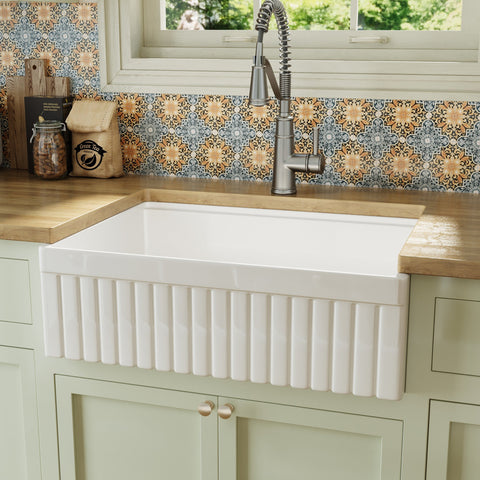
The 33" Thick-Edge Standard is a good example. It has no workstation ledge and comes with no cutting board, only a bottom grid and drain. Its bowl interior is 30-3/4 by 17-3/4 inches. Measure your countertop cutout too, since the board rests on the counter, not the bowl.
Skip a span board when you already have a workstation sink with its own cutting board. A second cutting board on top of the rim adds bulk and covers the ledges you would use for the rack. If you want more surface, slide the drying rack next to the board instead of adding a second board on the rim.
Span boards also suit renters and anyone with an existing sink they plan to keep. They need no tools and can come off in a second. If you plan to remodel soon, read about farmhouse sink accessories first. A ledge sink builds the board, rack and grid into one system.
Frequently asked questions
How do I know what size cutting board fits my sink?
Measure what the board will rest on. For a ledge sink, measure across the ledges and across the rim above them; the board must fall between those two numbers. Then measure the inner length to see how far it can slide. For a sink without a ledge, measure the opening and add flat bearing room on each side. Measure your own sink, since fireclay sizes can vary slightly.
Can you use any cutting board on a workstation sink?
Not for the ledges. A ledge board must be cut to the width between that sink's rails, so a board made for another brand's sink may drop in or sit too high. You can still lay a large span board across the rim, but it covers the ledges and does not slide. The board made for your sink is the simplest fit.
Is wood or plastic better for an over-the-sink cutting board?
Hardwood is the usual choice for a board that stays on the sink. It is stable, gentle on knives, and handles daily use if you dry and oil it. Plastic is handy for raw meat because most plastic boards are dishwasher safe. Many cooks keep a wood board on the ledge for produce and use a separate plastic board for meat.
Can you put a cutting board over a double bowl sink?
Yes. If the sink has ledges on both rims, the board can slide and park over either bowl. On the NOZLOO 33" double bowl workstation, the ledge runs the full length, so the board slides past the divide, which sits 2 inches below the rim. A common setup is prep over one bowl while the other stays open for rinsing.
Ready to plan around the board instead of fighting it? Browse our fireclay farmhouse sinks and compare which workstation models include a sapele ledge board, and which leave the bowl wide open for a span board of your choice.