Standard Kitchen Sink Drain Size: 3.5 vs 1.5 Inches
Most U.S. kitchen sinks pair a common 3.5-inch basin opening with 1.5-inch waste fittings. Learn what to measure for a strainer, disposal, trap, or double-bowl setup.

In this guide View sections +
Specifications reviewed: August 21, 2026 · Dimensions checked against current NOZLOO specifications, official model-code sources, and waste-fitting references.
Quick answer: Most U.S. kitchen sinks use a 3.5-inch drain opening in the basin and 1.5-inch waste fittings below it. Both numbers are correct: 3.5 inches describes the opening that accepts a basket strainer or disposal flange, while 1.5 inches describes the common kitchen-sink outlet, tailpiece, and P-trap size. Verify the exact sink and local plumbing requirements before buying parts.
“Kitchen sink drain size” can describe several parts. Measure the wrong one and a replacement strainer, trap, or disposal mount may not fit.
This guide separates those measurements for single- and double-bowl sinks. For overall dimensions and cabinet fit, use our standard kitchen sink sizes guide.

Kitchen Sink Drain Sizes at a Glance
| Part | Common size | What the number describes | What to verify |
|---|---|---|---|
| Sink drain opening | 3.5 in. on many U.S. kitchen sinks | The bare hole through the basin | Exact sink specification and actual opening |
| Basket-strainer top flange | Often about 4–4.5 in.; varies | The visible rim that covers the opening | Do not use this as the drain-hole measurement |
| Strainer or disposer outlet connection, tailpiece, and P-trap | 1.5 in. for a typical kitchen setup | The waste path below the basket strainer or disposer mount | Connection style, component markings, and local code |
| Disposal sink flange | Commonly made for a 3.5-in. opening | The mount through the basin | Sink thickness, flange length, and approved mounting system |
| Fixed DWV pipe | Nominal size set by the plumbing design | Pipe downstream of the trap adapter | Pipe markings, adopted code, load, slope, and venting |
The rim can be wider than the hole, while the outlet is smaller. A 4-inch flange, 3.5-inch opening, and 1.5-inch connection can belong to one assembly.
What the Plumbing Codes Actually Size
The 2024 International Plumbing Code requires a sink waste outlet of at least 1.5 inches and a strainer or crossbar. A domestic food-waste disposer also connects to a drain of at least 1.5 inches. The 2024 International Residential Code tailpiece section sets a 1.5-inch minimum for sink tailpieces.
The 2024 International Residential Code trap table lists a 1.5-inch minimum trap for a kitchen sink with one or two traps, with or without a dishwasher or disposer. Local editions and amendments still control fixed piping.
These are minimum waste-outlet, tailpiece, drain, and trap requirements; they do not establish a universal 3.5-inch bare basin opening. That measurement must come from the exact sink and fitting specifications. Waste fittings are covered by standards including ASME A112.18.2/CSA B125.2. Fixed downstream pipe is a separate question.
How to Measure a Kitchen Sink Drain Correctly
For a basket strainer or disposal flange
- Identify the part. A removable basket, complete strainer assembly, and disposal flange are different products.
- Expose the opening. Use the sink specification, or remove the old assembly to see the bare hole.
- Measure straight across the center. Record the bare opening edge to edge. If it is hand-finished or not perfectly round, measure in at least two directions and record both the minimum and maximum. Do not measure only the visible top flange.
- Record sink thickness at the opening. This is especially important for fireclay, stone, and other thick materials because a standard flange may be too short.

For a tailpiece or P-trap
Read the molded or stamped size, check the tubular part's outside diameter, and note the connection style. A typical kitchen tailpiece and tubular P-trap are labeled 1.5 inches.
Fixed Schedule 40 pipe uses a different convention. Nominal 1.5-inch pipe is larger than 1.5 inches across its outside, so read its marking or a dimensional chart.
Basket Strainer vs. Garbage Disposal
Without a disposal, a basket strainer seals to the opening and connects to the 1.5-inch waste path. Check the opening, sink thickness, supported thickness, and outlet before ordering.
With a disposal, its approved flange and mount replace the basket strainer. A 3.5-inch opening is only the first check: the flange must pass through the sink, engage correctly, and leave room for the outlet, P-trap, support, and service access.
Fireclay can be thick around the drain, so some installations need an approved extended flange. Never remove required gaskets or force a short flange to fit. Our fireclay sink and garbage disposal guide covers flange depth, support, and clearance.

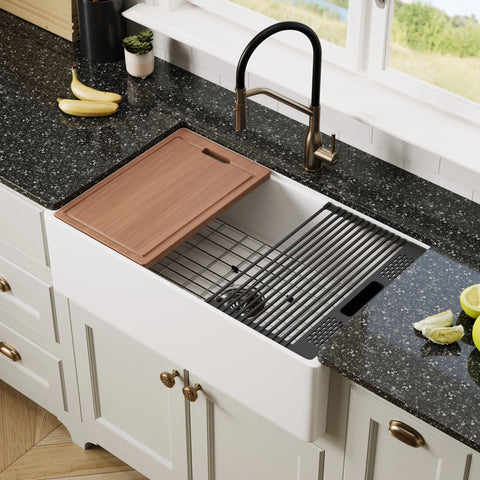
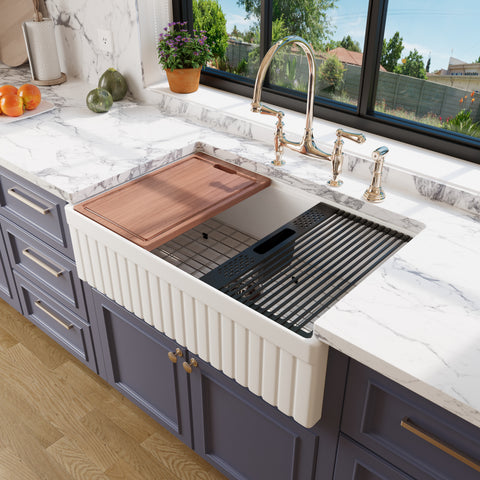
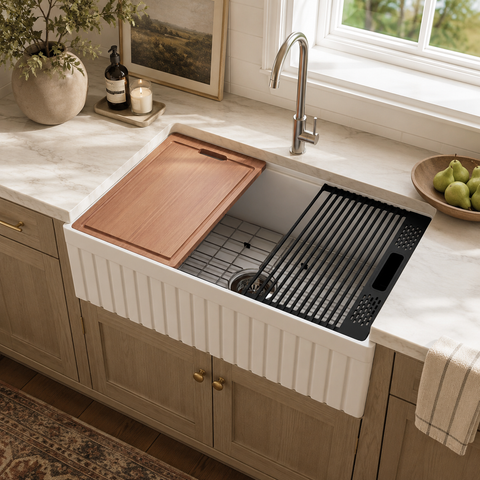
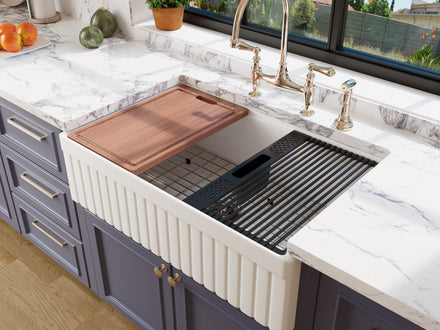
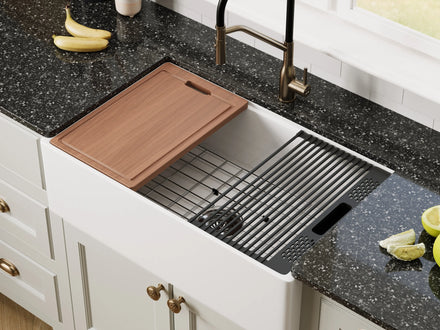
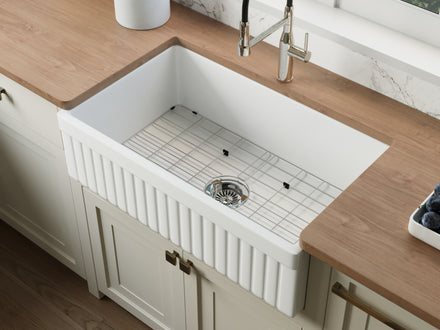
The NOZLOO NZ-103W3320 provides a clear example: its product specification calls for a 3.5-inch center drain opening. The included 3.5-inch basket strainer is used for a conventional drain setup; it is removed if a compatible disposal and its approved flange are installed.

What About a Double-Bowl Kitchen Sink?
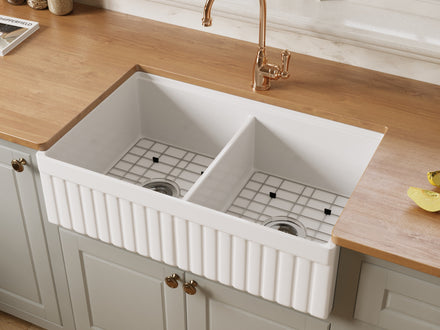
A double-bowl sink normally has one opening per bowl. It may use two strainers or one strainer and one disposal flange. Verify both openings on a vintage or specialty sink.
The outlets can feed a continuous-waste assembly and one P-trap where code and layout allow; some layouts use two traps. The current IRC recognizes both and lists a 1.5-inch minimum trap size. Two bowls do not automatically require a 2-inch trap.
Replacement Checklist
| Project | Measure or check | Common mistake |
|---|---|---|
| Replace a basket strainer | Bare opening, sink thickness, and outlet style | Measuring only the visible flange |
| Add a disposal | Opening, drain-area thickness, approved flange and mount, outlet height, and cabinet clearance | Assuming a 3.5-in. opening guarantees complete fit |
| Replace a tailpiece or P-trap | Part markings, tubular outside diameter, connection type, and wall adapter | Treating tubular and Schedule 40 dimensions as identical |
| Plumb a double bowl | Both openings, outlet spacing and height, disposal side, and waste route | Assuming two bowls always require a 2-in. trap |
| Move the wall rough-in | Stub-out size and height, trap arm, slope, vent, and adopted code | Copying a generic diagram without the actual sink and disposal |
Where This Guide Stops
The sink opening does not determine wall-drain height, trap-arm length, slope, vent, or branch size. Use our farmhouse sink plumbing rough-in guide for that planning sequence, and check the adopted code before changing fixed pipe.
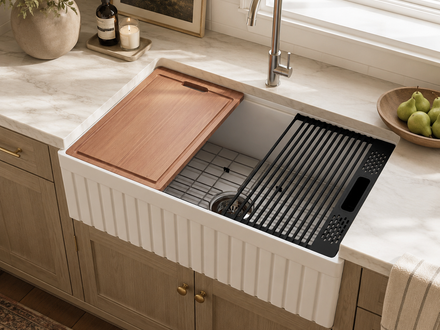
Drain location is another separate decision. A center drain—like the NZ-103W3320—places the strainer or disposal near the cabinet center. A rear or side position changes storage and pipe routing, not the standard opening diameter. Compare those tradeoffs in our center vs. offset drain guide.
Frequently Asked Questions
Is a standard kitchen sink drain 3.5 inches or 1.5 inches?
Both measurements can be correct. A common kitchen-sink basin opening is 3.5 inches, while the waste outlet, tubular tailpiece, and P-trap below are commonly 1.5 inches.
Are all kitchen sink drain openings 3.5 inches?
No. It is common in U.S. kitchens and is the specified size on NOZLOO sinks, but vintage, custom, commercial, and specialty fixtures can differ. Check the exact model or measure the bare opening.
How do I measure a kitchen sink drain opening?
Remove the drain fitting when practical and measure straight across the center of the bare hole, edge to edge. Also record the sink's thickness at the opening. Do not substitute the wider top-flange diameter.
Will any garbage disposal fit a 3.5-inch opening?
No. The opening may fit the general mount size, but the approved flange length, sink thickness, mounting system, outlet position, and cabinet clearance must also work together.
Does a double kitchen sink need a 2-inch drain?
Not automatically. The current IRC lists a 1.5-inch minimum trap for a kitchen sink with one or two traps. Fixed branch piping still depends on the adopted code and complete layout.
Can a 1.5-inch P-trap connect to a 2-inch wall pipe?
A listed trap adapter or transition is often used where the approved layout changes size. The wall connection, slope, venting, and branch sizing must comply with local requirements, so confirm them before altering fixed pipe.
The Bottom Line
For replacement parts, check three interfaces separately: the sink opening, the strainer or disposal outlet, and the fixed plumbing connection. On a typical U.S. kitchen sink, that often means a 3.5-inch basin opening paired with 1.5-inch waste fittings—not one number competing with the other.