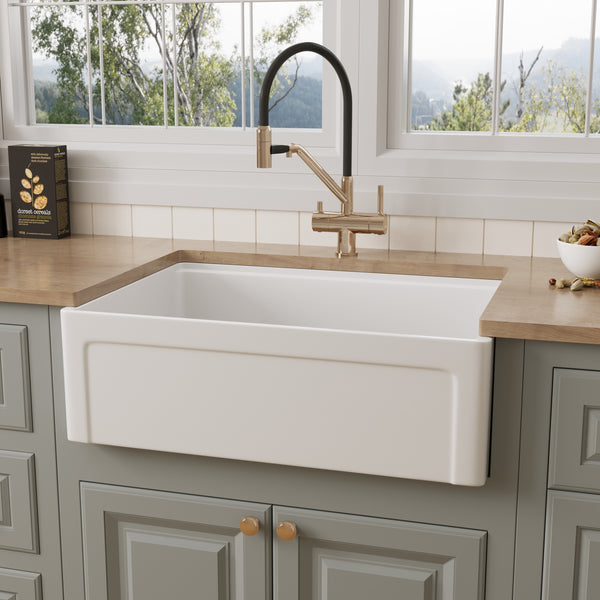
Fireclay Sink Problems — 7 Issues and How to Prevent Them

Fireclay sinks can crack, chip, craze, show metal marks, and demand more installation planning than a light drop-in sink. The useful question is not whether problems are possible; it is which risks come from manufacturing, which come from installation or impact, and what you can prevent before buying.
| Problem | Most likely cause | Best prevention | Typical warranty treatment |
|---|---|---|---|
| Structural crack | Material defect, uneven support, severe impact | Inspect before install; use a level cradle | Manufacturing defect may be covered |
| Chip | Dropped cookware or edge impact | Use a bottom grid; protect apron corners | Accidental impact is usually excluded |
| Crazing | Glaze/manufacturing issue or thermal stress | Inspect glaze; avoid extreme temperature swings | Manufacturing glaze defect may be covered |
| Gray marks | Metal transfer, not necessarily a scratch | Grid plus gentle cleaning | Care issue, not structural failure |
| Water spots | Mineral residue | Rinse and dry; follow care guidance | Normally maintenance |
No warranty replaces careful handling. Read the written coverage and exclusions for the exact sink before installation.
Before You Call a Mark a Defect
Start by cleaning gently and identifying what changed. Gray lines left by cookware are often metal transfer sitting on the glaze; hard-water film can make a glossy surface look dull; a glaze line may be cosmetic crazing; a line that crosses the body or leaks is a different level of concern. Do not use steel wool or aggressive powder to “test” the mark. Photograph the area in good light, note whether it changes when wet, and compare it with the manufacturer’s care instructions. If the line grows, leaks, or was visible before installation, stop and ask the manufacturer to review it.
1. Cracking
The risk: Fireclay is rigid. Uneven cabinet support, a shifting base, severe impact, or a qualifying material defect can create stress that a flexible metal sink would handle differently.
What firing temperature does—and does not—prove: NOZLOO publishes a 2,200°F firing temperature for its own sinks. That is a product specification, not a universal scientific cutoff separating “real” fireclay from ceramic, and it is not a substitute for glaze inspection, wall construction, installation support, and warranty terms.
A crack should be documented before anyone guesses at the cause. Before installation, photograph the full body, apron corners, drain opening, and any line visible in the glaze. Confirm that the delivered dimensions match the cutout plan. After installation, record when the crack appeared, whether the cabinet or support moved, and whether there was a known impact or extreme temperature event. Those details separate a possible manufacturing defect from installation or use damage.
How to reduce the risk:
- Inspect the entire body and glaze before installation.
- Support the sink on a level wood cradle or steel frame; do not hang its weight from the countertop.
- Follow the model’s cutout and drain-tightening instructions.
- Avoid deliberately moving a very cold basin through an extreme temperature change.
When to stop using the sink: a line that passes through the body, leaks, grows, or changes when the basin is loaded needs prompt inspection. A surface line in the glaze may be cosmetic, but the manufacturer—not a photograph alone—should determine whether it is a covered glaze defect.
Do fireclay sinks crack easily? Causes and a prevention checklist
No. Under normal kitchen use, a properly supported fireclay sink is not likely to crack. Washing dishes, filling stockpots, and rinsing cookware are not what cracks a fireclay sink. When a crack does appear, the cause is almost always outside the basin: shipping, support, installation, a hard impact, or a sudden temperature swing.
What actually causes a fireclay sink to crack
Most cracks trace back to one of six things.
- Shipping damage that no one caught. Hairline cracks on a corner, the underside, or the drain area are easy to miss. Inspect the sink within 48 hours of delivery, before the installer arrives.
- Weak or uneven support. A NOZLOO fireclay farmhouse sink weighs 100 to 115 lbs (45 to 52 kg) before water and dishes. The countertop should never carry that weight alone. Without a level support frame, stress builds in the sink body.
- A forced fit. If the cabinet opening is tight, or the sink is not level, stress concentrates at the corners, rim, and apron. Adjust the cabinet, not the sink.
- Countertop pressure. Fired clay has slight dimensional variation. Template the countertop to the actual sink, not to a drawing. A slab that presses on one corner turns a sound sink into a stressed one.
- Heavy impact. A cast-iron pan or Dutch oven dropped on an edge or the drain area can chip or crack the glaze. A bottom grid reduces direct impact on the basin floor.
- Thermal shock. Pouring boiling water into a cold basin, or setting a hot pan in a cold sink, creates far more stress than everyday use. Damage from thermal shock is not covered by the warranty, so treat it as a habit to avoid.
Crack prevention checklist
- Open the box and inspect every side, including the underside, within 48 hours of delivery.
- Build a level support frame inside the cabinet, sized for the sink's full weight plus water and dishes.
- Have the physical sink on site before final cabinet cuts and countertop templating.
- Set the sink level on its frame. Do not force it into the opening.
- Keep a bottom grid in the basin.
- Let hot cookware cool for a moment, and do not pour boiling water into a cold basin.
What to check before the countertop goes on
This is the last cheap moment to fix a problem. After the slab is set, a sink swap means plumbing, countertop, and labor again. Confirm the sink sits level with no rocking, nothing presses against the sink body, and the cutout was templated to this exact sink. If support is still an open question, the fireclay farmhouse sink cabinet size guide covers the frame and opening before you order.
2. Chipping
The risk: A sharp impact from cast-iron cookware or a hit to an exposed rim or apron corner can chip a glazed fireclay sink. No fireclay sink is impact-proof.
How to reduce the risk: use a fitted bottom grid, lower heavy cookware rather than dropping it, and protect the apron during delivery and cabinet work. A repair may make a small chip easier to clean, but it may remain visible.
Location matters. Chips on the basin floor usually follow cookware contact; chips on the apron corner often occur during carrying, cabinet cutting, or countertop work. Inspect those exposed edges before the installer leaves. If a chip is present on delivery, do not install the sink first and ask questions later—installation can make the original condition harder to establish.
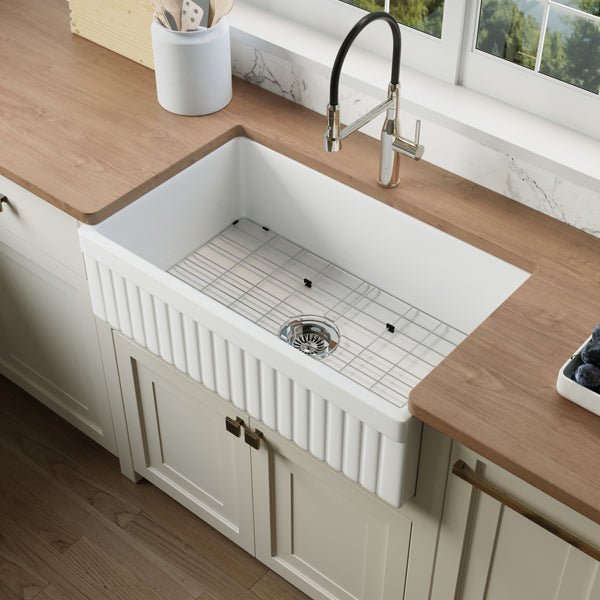
Bottom grids reduce direct contact and help keep cookware above residue in the basin. They do not protect the rim or apron, so installers should pad exposed edges and households should avoid resting cast-iron pans on a corner.

3. Crazing
The risk: Crazing is a network of fine lines in the glaze. It can be associated with a manufacturing glaze issue, stress around fittings, or repeated extreme temperature changes. A photo alone cannot establish the cause.
How to reduce the risk: inspect the glaze under good light before installation, follow drain-fitting instructions, avoid extreme thermal changes, and document new surface defects promptly.
Crazing is different from a through-body structural crack. Fine glaze lines may initially be cosmetic, but they can hold residue and become more visible. Clean gently, photograph the pattern dry and wet, and contact the manufacturer instead of attacking the lines with abrasive powder. Aggressive cleaning can create a second problem and complicate a warranty review.
During installation, do not use the drain fitting to force an uneven sink into alignment. The sink should already sit level on its support. Follow the drain and sealant instructions for the exact model rather than applying maximum torque.
4. Scratches
The worry: The glossy white surface gets scratched up from daily use.
What actually happens: Fireclay is actually more scratch-resistant than most people expect — significantly more so than stainless steel, and on par with or better than porcelain and cast iron sinks. The fused glaze is hard enough that normal kitchen activity — washing pots and pans, using utensils, scrubbing with a soft sponge — doesn't leave marks.
What does happen is metal transfer. Dragging an aluminum pot or stainless steel pan across the basin can leave gray or dark marks on the white surface. These look like scratches but they're actually metal deposits sitting on top of the glaze, not cuts into it. They come off with a non-abrasive cleanser like Bar Keeper's Friend or a melamine eraser sponge.
True scratches — where the glaze itself is scored — are rare and typically caused by abrasive cleaning products (steel wool, scouring powders) or dragging something genuinely sharp across the surface.
How to prevent it:
- Clean with non-abrasive products only — no steel wool, no harsh scouring powders
- Remove metal marks promptly; they're easier to clean when fresh
- Use a sink grid to prevent direct pot-to-basin contact
- For a full cleaning routine, our guide to cleaning fireclay sinks covers what products to use and which to avoid
5. Staining and Discoloration
The worry: The white sink turns yellow, gray, or splotchy over time.
What actually happens: Fireclay is a non-porous material, which means liquids don't absorb into the surface. Coffee, wine, turmeric, tomato sauce — they sit on top of the glaze and wipe off. In terms of stain resistance, fireclay outperforms porcelain sinks, standard ceramic, and even some cast iron sinks with enamel coatings.
But "stain-resistant" doesn't mean "self-cleaning." If you leave food residue, coffee grounds, or cast iron cookware sitting in standing water overnight, you'll get surface deposits that require some effort to remove. Hard water minerals can also leave a buildup over time that dulls the glossy finish.
None of this is permanent damage. It's surface grime, and it comes off. But it does require more attentiveness than, say, a stainless steel sink where stains are less visible against the metallic finish.
How to prevent it:
- Rinse the sink after each use — takes five seconds and prevents 90% of staining issues
- Don't leave cast iron pans soaking overnight (rust rings from the pan are the #1 stain complaint)
- Clean hard water buildup periodically with a mild acidic cleaner (white vinegar works)
- Wipe the basin dry if you want it to remain bright white between uses
6. Weight and Installation Complexity
The worry: The sink is too heavy for your cabinets and installation is a headache.
What actually happens: This isn't a "problem" in the defect sense — it's a characteristic of the material. A fireclay farmhouse sink typically weighs 80–100 pounds. That's 3–5x heavier than a comparable stainless steel sink. Standard base cabinets aren't designed for that kind of load without reinforcement.
Apron front installation adds another layer of complexity. The sink sits partially forward of the cabinet, which means the countertop needs a custom cutout, the cabinet face may need modification, and a support structure (wood or steel cradle) has to be built to carry the weight.
If you're doing a new build or full kitchen remodel, this is straightforward — your cabinet maker sizes everything to fit. If you're retrofitting an apron front fireclay sink into an existing kitchen, expect more labor, more cost, and more coordination.
Replacement down the road is also harder than with other materials. Because each fireclay sink has slight dimensional variations from the handcrafted firing process, a new sink won't drop into the old cutout perfectly. Plan for some countertop adjustment.
How to handle it:
- Order the sink before cabinets are built, so everything can be sized to fit
- Use a dedicated support cradle — not just the countertop edges
- Budget for professional installation, especially if retrofitting into existing cabinetry
- Keep your sink's model number and dimensions on file for future reference
7. Cost
Fireclay prices vary widely by size, brand, distribution, and included parts. Current NOZLOO models sit in the direct-to-consumer midrange, but the installed project cost also depends on cabinet reinforcement, countertop work, plumbing, and labor.
Compare the total package: sink, grid, drain, optional workstation accessories, delivery inspection terms, and written warranty. Avoid unsupported “cost per year” promises; service life depends on product quality, installation, care, and impact.
Build a project budget in five lines: the sink package; cabinet cutting and support; countertop templating and fabrication; drain, disposal, and plumbing changes; and delivery or replacement timing. A lower sink price can be erased by a late cabinet redesign, while an included grid and drain can reduce the accessory bill. Get the exact sink on site and inspected before the final countertop cut whenever the fabricator requires it.
Also price the consequence of choosing the wrong dimensions. Fireclay bodies can have model-specific tolerances, and an apron-front replacement is not as simple as dropping a new stainless basin into a standard opening. Written dimensions and installer coordination are part of the purchase, not optional paperwork.
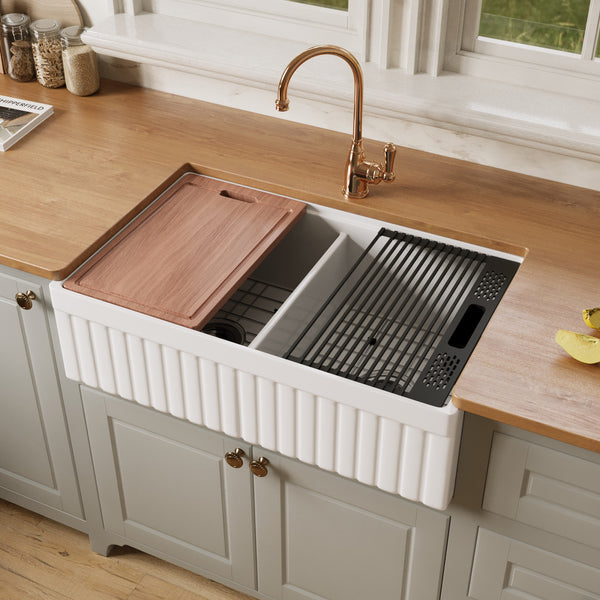
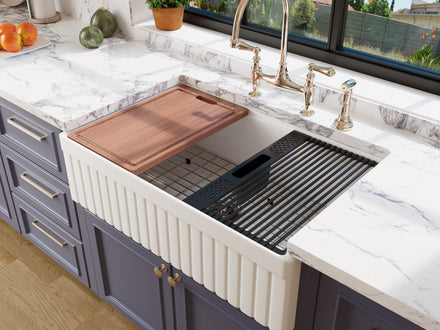
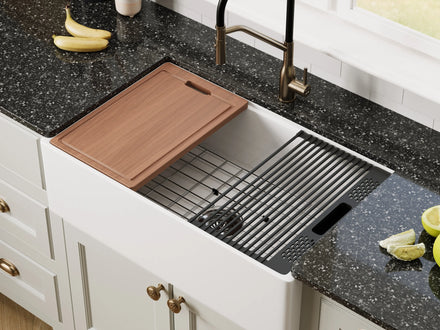
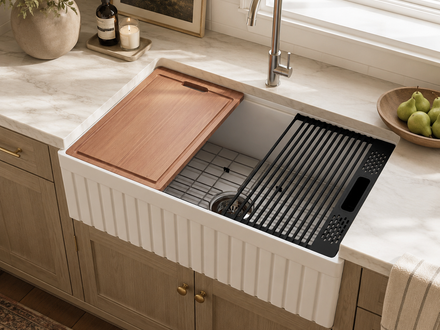
Choose by what you will use: the classic 33″ model includes the sink essentials; the 33″ workstation adds a cutting board and roll-up rack for over-sink prep.
Compare current prices and availability →What to Actually Look for When Buying a Fireclay Sink
- Material and construction: require a clear fireclay specification; treat firing temperature as one fact, not the whole quality test.
- Cabinet support: confirm weight, apron height, cutout, and a level support cradle before countertop templating.
- Delivery inspection: check the body, glaze, corners, drain opening, and dimensions before installation.
- Written warranty: separate manufacturing defects from impact, installation, cleaning, thermal-shock, labor, and accessory exclusions.
A credible product page should let the buyer answer practical questions without calling for basic facts: What is the body material? What are the outer dimensions and bowl depth? How much does the sink weigh? Which cabinet width is recommended? What arrives in the box? When must shipping damage be reported? Who pays shipping on an approved claim? What damage is excluded?
Use those answers with the installer. Confirm the cabinet face can accept the apron, the support can carry the filled sink, the drain and disposal fit below, and the countertop fabricator has the physical sink or the manufacturer-approved template. Even a well-made fireclay body can fail when it is forced into an uneven opening or supported only at the rim.
To check those points on real spec sheets, start with our 33-inch fireclay farmhouse sinks. Wall thickness, weight, and warranty are listed for each model.
Frequently Asked Questions
Do fireclay sinks crack easily?
No material is failure-proof, but structural cracking should not be treated as normal wear. Inspect before installation, provide level support, avoid extreme impact and temperature changes, and document a suspected manufacturing defect for warranty review.
Can a fireclay sink crack?
Yes. Possible causes include a material defect, uneven support, cabinet movement, overtightened fittings, severe impact, or thermal stress. The cause determines whether a warranty applies.
What are the downsides of fireclay sinks?
The main downsides are higher upfront cost ($400–$2,000+), heavy weight requiring cabinet reinforcement, limited color options (mostly white/off-white), the possibility of chipping from heavy impacts, and the fact that dishes break more easily when dropped into the hard basin. Most of these are manageable with proper installation and a sink grid.
Do fireclay sinks hold up well?
A well-made fireclay sink can provide long-term daily use when it is supported correctly, protected from hard impact, and cleaned according to the manufacturer’s instructions. Performance depends on the specific product, installation, care, and household use; a generic lifespan number is not a warranty.
Will a fireclay sink scratch?
Fireclay is more scratch-resistant than stainless steel and most porcelain sinks. Normal kitchen use doesn't leave marks on the glaze. Gray marks from metal pots are surface deposits, not scratches — they clean off with a non-abrasive cleanser. True scratches are rare and usually caused by abrasive cleaning products.
Related guides: fireclay vs ceramic sinks · fireclay vs cast iron vs porcelain sinks · fireclay sink pros and cons.
For sizing, installation, and what to look for, read our complete fireclay farmhouse sink buyer’s guide.
Related guides: what a fireclay sink is