Farmhouse Sink Depth: Is 7, 8, 9, or 10 Inches Right for Your Kitchen?

Farmhouse sink depth decides how the sink feels in daily use. It affects reach, splash control, bowl capacity, apron front appearance, cabinet proportions, and how much the user needs to lean during cleanup.
Width matters for cabinet fit, but depth is what the user feels every day. A farmhouse sink can look right in a product photo and still feel too shallow for large pots or too deep for comfortable washing.
This guide focuses only on depth: bowl depth, apron height, cabinet comfort, countertop height, and ergonomics.
What Farmhouse Sink Depth Actually Means
A farmhouse kitchen sink has several vertical measurements. They are related, but they are not the same.
Bowl depth is the usable inside depth of the sink, measured from the top edge of the basin to the bottom. Bowl depth affects washing, rinsing, splash control, and how easily the sink handles pans, prep bowls, and large pots.
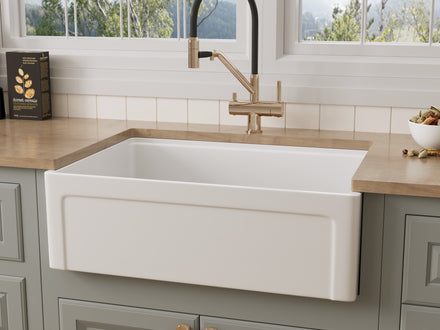
Apron height is the visible front panel of the apron front sink. The exposed apron creates the classic farmhouse look, but apron height does not always equal usable bowl depth.
Overall sink height is the full vertical body of the sink. It matters for cabinet planning, but it is not the same as the usable basin.
For example, a NOZLOO 33-inch double bowl farmhouse sink lists a 9-inch bowl depth and a 10-inch apron height. This example is useful for terminology because it shows why bowl depth and apron height should not be treated as the same measurement.
In simple terms: bowl depth affects function; apron height affects cabinet appearance and front clearance.
Is a 7 Inch Deep Farmhouse Sink Enough?
A 7 inch deep farmhouse sink works for light kitchen use. It suits smaller households, shorter users, bar-style prep areas, or kitchens where the sink is used mostly for plates, cups, and small cookware.
The main advantage is reach. A 7-inch basin keeps the sink bottom closer to the countertop, so the user does not lean as far during washing.
The limitation is capacity. To compare sink depths fairly, the length and width of the bowl need to stay fixed. A wider or narrower sink changes the volume calculation, so the only clean way to compare 7, 8, 9, and 10 inches is to use one consistent bowl footprint.
For the volume example, use NOZLOO’s 33-inch smooth apron single bowl footprint: about 30-7/8 inches by 16-3/4 inches inside the bowl. In that footprint, every extra inch of bowl depth adds about 517 cubic inches, or roughly 2.2 gallons, of usable vertical volume.
That means:
- Moving from 7 inches to 8 inches adds about 2.2 gallons
- Moving from 7 inches to 9 inches adds about 4.5 gallons
- Moving from 7 inches to 10 inches adds about 6.7 gallons
This does not mean the deepest sink is automatically better. It shows the real tradeoff: a shallower basin improves reach, while each extra inch adds meaningful working space.
A 7 inch deep farmhouse sink is comfortable, but it is not the strongest choice for a cooking-heavy kitchen that regularly handles stockpots, baking sheets, or stacked dishes.
Who Should Choose an 8 Inch Deep Farmhouse Sink?
An 8 inch deep farmhouse sink is a comfort-first middle option. It gives more room than a 7-inch basin while keeping the bottom of the bowl easier to reach than a 9-inch or 10-inch sink.
This depth works well for smaller households, shorter users, and kitchens where everyday cleanup is moderate. It also makes sense when the countertop already feels slightly high for the primary user.
Using the same bowl footprint above, an 8-inch basin gains about 2.2 gallons over a 7-inch basin and gives up about 2.2 gallons compared with a 9-inch basin. That is the practical middle ground: more capacity than 7 inches, less reach demand than 9 or 10 inches.
An 8 inch deep farmhouse sink suits comfort-focused kitchens. For frequent cooking, large pans, and heavier prep, the next inch of depth gives better everyday flexibility.
Why a 9 Inch Deep Farmhouse Sink Is the Most Balanced Starting Point
A 9 inch deep farmhouse sink balances capacity and reach for most kitchens. It is deep enough for large cookware, prep bowls, and daily cleanup, while staying practical for users who do not want to lean into an oversized basin.
This depth works especially well for a farmhouse kitchen sink because the apron front already creates a strong visual presence. The sink does not need excessive bowl depth to feel substantial.
A 9-inch bowl also improves splash control compared with 7-inch or 8-inch kitchen sinks. The water line sits lower, and there is more vertical wall between the bottom of the basin and the countertop edge. That helps when rinsing pans, filling bowls, or cleaning larger items.
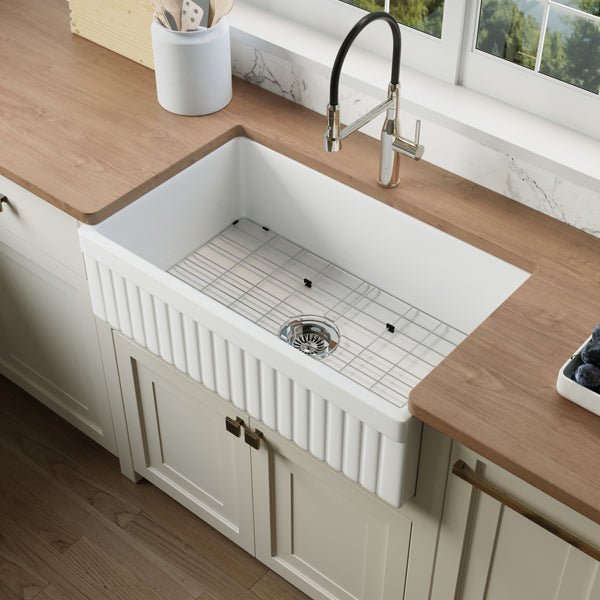
NOZLOO fireclay farmhouse sinks are designed around a practical everyday depth for large cookware, prep, and cleanup. The NOZLOO fireclay farmhouse sink collection includes 30-inch and 33-inch apron front models with single bowl, double bowl, and workstation sink options.
For most homeowners, 9 inches is the best depth to start with because it gives meaningful capacity without turning comfort into a major compromise.

Is a 10 Inch Deep Farmhouse Sink Too Deep?
A 10 inch deep farmhouse sink is not automatically too deep. It is the right choice when the kitchen handles heavy cooking, oversized cookware, soaking, and frequent cleanup.
The benefit is capacity. A 10-inch basin gives one more inch of vertical room than a 9-inch sink, or about 2.2 gallons more capacity in the same example footprint. That extra depth helps hide dishes below the countertop line and gives large pots more clearance.
The comfort question depends on the user and countertop height. A deeper sink lowers the working surface inside the bowl. For a tall user, that feels natural. For a shorter user, it creates more forward lean during washing.
This is where depth should be judged as an ergonomic decision, not just a capacity decision. A 10 inch deep farmhouse sink suits users who prioritize maximum bowl space. A 9-inch bowl suits more kitchens because it keeps the reach more balanced.
How Sink Depth Affects Comfort and Ergonomics
Sink depth changes posture. The deeper the basin, the farther the user reaches below the countertop.
Three measurements matter together:
- User height: Taller users handle deep bowls more comfortably. Shorter users benefit from shallower reach.
- Countertop height: A high countertop makes any deep basin feel lower.
- Bowl depth: Each additional inch moves the sink bottom one inch farther from the user’s hands.
Professional kitchen-planning references treat sink height and surrounding work areas as ergonomic planning details, not just style choices. The NKBA Kitchen Planning Guidelines are a useful non-competitor reference because NKBA is a kitchen and bath industry association rather than a sink retailer.
For accessibility-sensitive kitchens, the U.S. Access Board’s Chapter 6: Lavatories and Sinks explains sink-related height, reach, knee space, toe space, and clearance principles.
These sources are not farmhouse sink product guides, and a standard residential kitchen is not automatically an accessibility-code project. They are useful because they support the same planning principle: the sink, countertop, cabinet, and user must work together.
Farmhouse Sink Depth and Cabinet Fit
A farmhouse sink changes the cabinet face because the apron front is exposed. That makes depth planning different from standard kitchen sinks.
The bowl depth affects reach inside the basin. The apron height affects how the sink front meets the cabinet doors and surrounding cabinetry. A tall apron creates a stronger exposed apron front, but it also requires enough front cabinet space to look balanced.
This page should not replace a full cabinet-size or dimensions guide. Width, minimum base cabinet, support framing, and cutout planning belong on a dedicated size page. For that topic, use the fireclay farmhouse sink cabinet size guide.
For depth planning, confirm only the details that affect comfort and front proportion:
- bowl depth
- apron height
- overall sink height
- countertop height
- user reach
- cabinet door clearance below the apron
Do not choose a farmhouse sink by width alone. The apron, bowl, countertop, and cabinet work as one system.
If your base cabinet is 33 inches wide, our 30-inch fireclay farmhouse sinks are built for that opening with the same 8¾–9 inch bowl depth.
How Bowl Layout Changes the Feel of Depth
Bowl layout changes how depth feels.
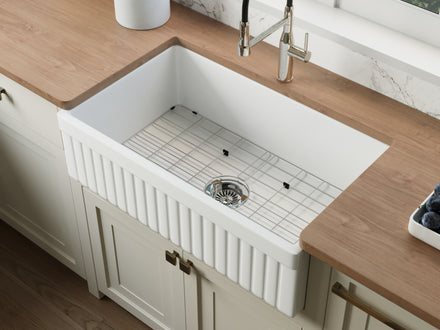
A single bowl farmhouse sink feels more open at the same depth because the full basin is available for large pots, baking sheets, and prep tools.
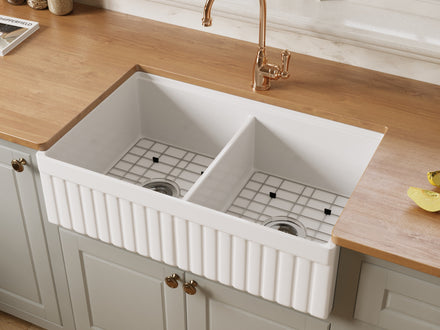
A double bowl farmhouse sink divides the same overall sink width into two bowls. That helps separate washing and rinsing, but each bowl feels smaller than a single bowl of the same depth.
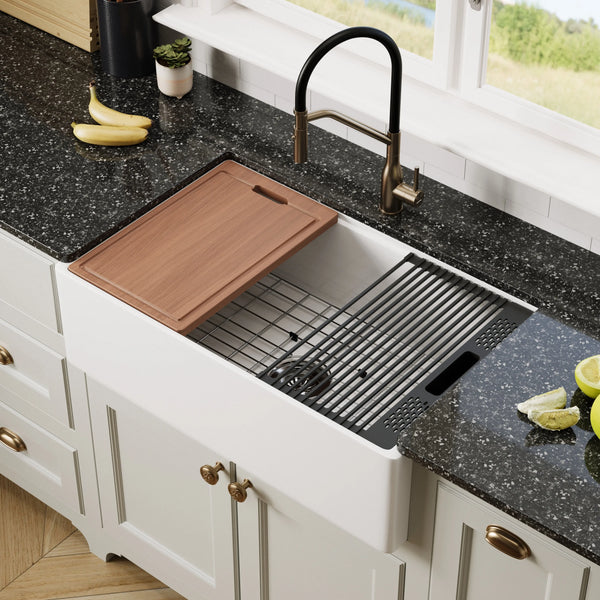
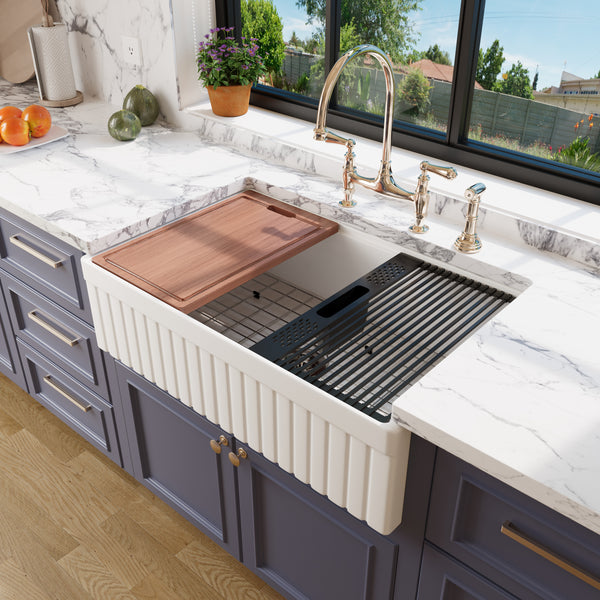
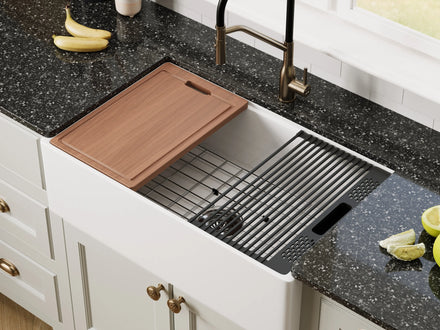
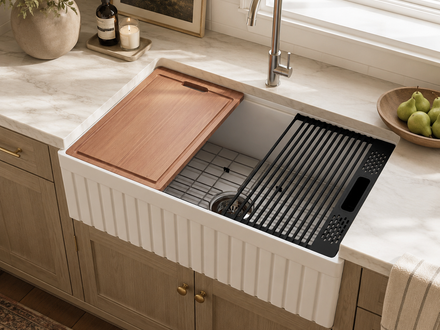
A fireclay workstation sink changes the experience again. Accessories such as cutting boards, colanders, and drying racks sit above the basin, so depth matters below the work surface. A 9-inch bowl leaves room for rinsing and cleanup under the accessories without making the sink feel unnecessarily deep.
Depth should always be judged with bowl configurations, not as an isolated number.
Simple Farmhouse Sink Depth Guide
| Depth | Best For | What Changes |
|---|---|---|
| 7 inch | Light use, shorter users, easy reach | Lowest reach demand, but least vertical capacity |
| 8 inch | Comfort-focused kitchens and moderate cleanup | About 2.2 gallons more capacity than 7 inches in the example footprint |
| 9 inch | Most everyday kitchens, large cookware, prep, and cleanup | Adds another inch of working depth while keeping reach practical |
| 10 inch | Heavy cooking, soaking, oversized cookware | Adds maximum capacity, but also increases downward reach |
FAQs
Is a 9 inch farmhouse sink deep enough?
Yes. A 9 inch farmhouse sink is deep enough for most everyday kitchens because it balances large-pot capacity, splash control, and comfortable reach.
Is a 10 inch deep farmhouse sink too deep?
A 10 inch deep farmhouse sink is not too deep for heavy cooking or oversized cookware. It becomes less comfortable when the user is shorter, the countertop is high, or long cleanup sessions require too much forward lean.
What is the difference between bowl depth and apron height?
Bowl depth is the usable inside depth of the basin. Apron height is the visible front panel of the apron front sink. A sink can have a 9-inch bowl depth and a 10-inch apron height.
Does a deep farmhouse sink make you bend more?
Yes. A deeper bowl places the sink bottom farther below the countertop, so the user reaches lower during washing and cleanup.
What farmhouse sink depth is best for everyday use?
For most kitchens, 9 inches is the best everyday depth. It gives enough room for large pots, pans, dishes, and prep without making the sink feel too deep for regular use.
Related guides: how to measure your cabinet and opening