Offset Drain Kitchen Sinks: Are They Better Than Center Drains?

An offset drain kitchen sink can keep large cookware away from the drain opening and change how the plumbing occupies the cabinet below. However, moving the drain away from the center does not automatically improve drainage or create more storage.
The better drain placement depends on how you use the basin, where the existing wall drain is located, whether you plan to install a garbage disposal, and how the P-trap, sink supports, filtration equipment, and accessories fit underneath.
What Is an Offset Drain Kitchen Sink?
An offset drain kitchen sink has a drain opening that is not located at the geometric center of the basin. The opening may be positioned near the back wall, slightly to one side, or clearly within the left or right area of the bowl.
Terms used in product listings are not always consistent. These are practical shopping descriptions rather than universally standardized product categories:
- Rear-center drain: Located near the back wall but centered from left to right.
- Rear off-center drain: Located near the back and shifted toward one side.
- Side drain: Positioned noticeably within the left or right section of the basin.
- Left or right drain: An orientation that must be confirmed from the dimensional drawing.
A rear offset drain kitchen sink is therefore not necessarily a true side drain kitchen sink. The specification drawing is more reliable than terms such as “rear drain,” “left drain,” or “off-center drain” alone.
Offset Drain vs Center Drain Kitchen Sink
The center drain vs offset drain decision affects both the basin workspace and the plumbing footprint below it.
|
Comparison Point |
Offset Drain |
Center Drain |
|---|---|---|
|
Basin workspace |
May leave a more continuous working area through the center |
Provides a balanced, symmetrical layout |
|
Large cookware |
Pans and baking sheets may be less likely to cover the opening |
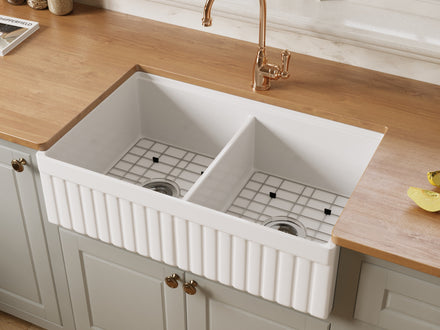
Cookware may sit directly above the drain |
|
Garbage disposal |
Can move the disposal toward the rear or one side |
Often places the disposal near the cabinet center |
|
Plumbing connection |
Depends more heavily on the wall-drain position |
May provide a more direct route in an existing centered layout |
|
Cabinet organization |
Can change the shape of the usable space, but does not add cabinet volume |
Central plumbing may divide the open area |
|
Bottom grid |
Requires a grid made for the exact drain placement |
Center-drain grid options may be easier to find |
The better layout is the one that coordinates basin use with the wall drain, disposal footprint, cabinet supports, and matching accessories.
Advantages of an Offset Drain Sink
The main advantage of an offset drain is that it may keep the center of a single bowl less obstructed.
Large pots, skillets, and sheet pans are less likely to sit directly over the opening. Water and small food debris may continue moving toward the drain while cookware remains in the basin.
The drain offset may also shift the garbage disposal and P-trap away from the middle of the cabinet. Depending on the complete layout, this can leave a more continuous area for a narrow pull-out organizer, compact filter, or cleaning supplies.
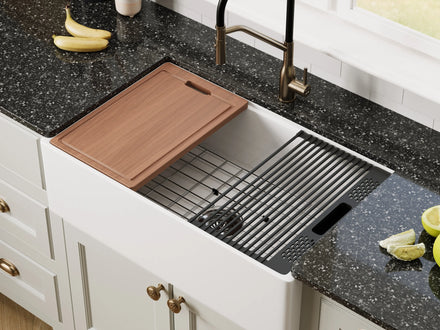
In a workstation sink, placing the drain away from the primary prep area may also help keep the opening clear while a cutting board or drying rack is being used above the bowl.
Disadvantages of an Offset Drain Sink
An offset drain can require plumbing adjustments when replacing a kitchen sink that previously had a center drain. The new outlet may not align directly with the wall connection, especially when a disposal or filtration system is added.
Choosing the wrong orientation can also create clearance problems. A left-corner drain may clear the cabinet center but interfere with a filter, fixed shelf, hinge, drawer, or sink support on the left side.
Replacement accessories may be more model-specific. A fitted bottom rack or drain cover must align with the actual opening and basin dimensions.
Some buyers also prefer the symmetrical appearance of a center drain. Drain location is partly a functional decision, but the visible layout can still affect the overall kitchen design.
Rear Offset Drain vs Side Drain
A rear offset drain sits close to the back wall and is shifted away from the centerline. This arrangement may preserve a wide central basin area while keeping much of the plumbing toward the rear of the cabinet.
A side drain is positioned farther into the left or right section of the bowl. This can move the disposal and trap more noticeably toward one side, which may help one cabinet layout while causing conflicts in another.
Do not determine left or right orientation from the product name alone. Check the drain centerline on the specification drawing and compare it with:
- The wall-drain position
- The disposal body
- Faucet and water-supply lines
- Sink support rails
- Filters or reverse-osmosis equipment
- Fixed cabinet storage
A slightly off-center rear drain and a true left-corner drain can create very different plumbing footprints.

Does an Offset Drain Create More Under-Sink Storage?
An offset drain can improve the shape of the available cabinet space, but it does not automatically create more total storage. It does not create cabinet volume; it redistributes the plumbing footprint.
Moving the disposal and P-trap away from the center may leave a more continuous zone on one side while making the opposite side more crowded. The final amount of usable space depends on:
- Garbage disposal diameter and height
- Disposal discharge position
- P-trap location
- Wall-drain height and horizontal position
- Farmhouse or fireclay sink support frame
- Faucet supply lines and shutoff valves
- Water-filter housing or storage tank
- Cabinet hinges, drawers, and fixed shelves
Use the actual dimensions of the disposal body, discharge outlet, P-trap, and required removal clearance when planning the cabinet. Looking only at the drain opening can make the available space appear larger than it will be after installation.
Can You Install a Garbage Disposal on an Offset Drain Sink?
A garbage disposal can usually be installed on a compatible offset drain sink. An offset opening is not required, however, and drain placement alone does not determine compatibility.
Confirm:
- Drain opening diameter
- Actual sink-wall thickness
- Required flange length
- Disposal body height and width
- Cabinet support structure
- P-trap and wall-drain position
- Clearance for installation and future removal
For a fireclay model, verify that the flange and mounting components can accommodate the actual sink thickness. See the complete guide to using a garbage disposal with a fireclay sink for material-specific compatibility and installation planning.

How Does an Offset Drain Affect Plumbing?
An offset drain changes where the sink outlet, disposal, and P-trap sit in relation to the wall drain. It does not necessarily make the plumbing difficult, but the existing connection cannot be assumed to align.
Before purchasing the sink, compare the drain centerline with the wall outlet and confirm that the planned route leaves enough space for the disposal, trap, cabinet supports, and other equipment.
Horizontal drainage and trap-to-vent geometry are governed by plumbing requirements such as the International Plumbing Code and the Uniform Plumbing Code. The locally adopted code and any regional amendments determine the final installation requirements.
For wall-drain height, trap-arm planning, support framing, and complete rough-in considerations, see the Farmhouse Sink Plumbing Rough-In guide.
Is an Offset Drain Better for a Workstation Sink?
An offset drain can be useful in a single bowl workstation sink because it may keep the central basin area open while accessories occupy the ledge above.
A cutting board or drying rack sits over the bowl, while cookware and rinsed food remain below. Moving the opening toward the rear or one side may reduce the chance that a large pan completely blocks the drain.
However, drain placement alone does not determine performance. Basin slope, floor geometry, accessory placement, and grid alignment also affect how water and debris reach the opening.
The bottom grid must be made for the specific drain offset. A center-drain grid may cover the opening, interfere with the drain cover, or sit incorrectly in the bowl.
For broader guidance on fitted grids, cutting boards, drying racks, and other sink accessories, see the Farmhouse Sink Accessories Guide.
Who Should Choose an Offset Drain Kitchen Sink?
An offset drain kitchen sink may be suitable when you:
- Frequently wash baking sheets, stockpots, or wide pans
- Prefer a less obstructed center in a single bowl
- Plan to move a disposal away from the middle of the cabinet
- Need to coordinate plumbing with a filter or pull-out organizer
- Are already changing the cabinet or plumbing during a remodel
- Can obtain an accurate specification drawing
- Are purchasing a matching grid and drain cover
A center drain may be the more practical choice when you:
- Want to retain an existing centered wall connection
- Prefer a symmetrical basin layout
- Have fixed storage that conflicts with one-sided plumbing
- Cannot verify the exact left or right drain position
- Need widely available replacement accessories
For a replacement project, start with the least movable constraint: usually the existing wall drain and cabinet structure. For a full remodel, begin with the planned disposal, storage, and filtration layout before deciding where the drain should sit.
A Rear Off-Center Fireclay Sink Option
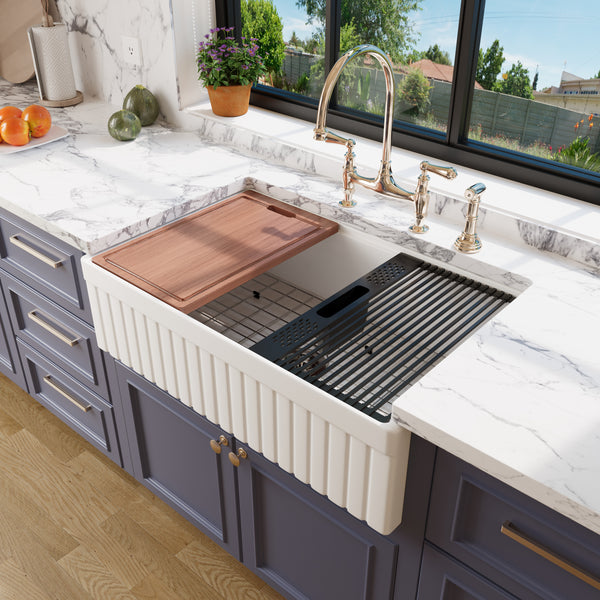
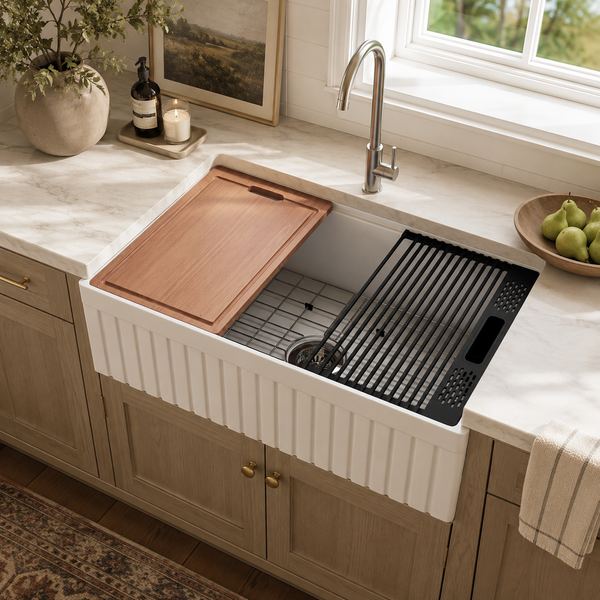
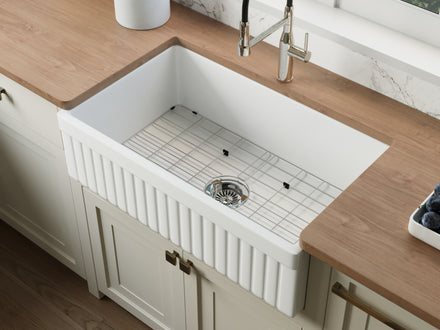
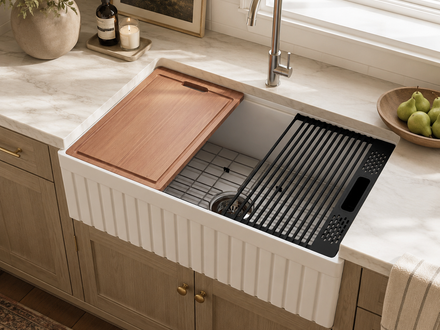
The 30-Inch Grooved Apron Fireclay Farmhouse Workstation Sink is an example of a rear-right, off-center configuration.
This 30-inch single bowl sink combines genuine fireclay construction, an apron-front design, a workstation ledge, and a standard 3.5-inch drain opening. It includes a cutting board, roll-up rack, drain components, and a stainless steel bottom grid made for the model’s rear off-center drain.
The matching grid matters because a generic center-drain version may not align with the opening. The offset position may also move compatible plumbing away from the cabinet center, but it does not guarantee more storage.
Before ordering, compare the product drawing with the wall drain, minimum cabinet dimensions, disposal body, support frame, and remaining space underneath.

That model sits in our 30-inch fireclay farmhouse sink collection, next to the center-drain reversible version for the same 33-inch cabinet.
Final Verdict
An offset drain is better than a center drain only when its location supports the way the kitchen sink will be used and the way the plumbing must fit below it.
Choose an offset drain kitchen sink when you want a less obstructed central basin and can coordinate the drain with the disposal, wall connection, support frame, and cabinet organization. Choose a center drain when symmetry, existing plumbing alignment, and broader accessory compatibility are more important.
The specification drawing—not the product name alone—should determine whether a rear, side, left, or right drain will fit your kitchen.