What Is a Belfast Sink? Belfast vs Butler vs Farmhouse

Reviewed: August 23, 2026 · This guide translates historical sink names into modern buying checks. Product labels vary, so the current specification sheet, delivered sink, cabinet plan, plumbing, and installation instructions control the project.
Quick answer: A Belfast sink is a historical British and Irish name commonly associated with a deep glazed-ceramic service sink and an exposed front. A traditional distinction often links Belfast models with a molded overflow or weir, while Butler sinks are often described without one. Modern sellers do not use those names consistently. In the US, farmhouse or apron-front is the broader shopping category, so verify the actual overflow, material, dimensions, drain, cabinet minimum, and support instead of buying from the name alone.

What “Belfast Sink” Means Today
The useful part of the name is its history: it points toward a substantial sink made for working spaces, usually with a deep ceramic bowl and a front intended to remain visible. The unsafe part is treating that history as a modern technical standard.
The term has a long practical record. A Bedford Borough Council archive transcribes historic property records that list a Belfast sink in a pub kitchen. That tells us the name belonged to real working spaces; it does not prove the dimensions, drain, or overflow of a sink being sold today.
Modern technical documents do the same translation. A current UK government technical manual names enamelled fireclay Belfast sinks, then separately supplies standards and indicative sizes. That separation is the buying lesson: the label starts the search; the specification finishes it.
Belfast vs Butler vs Farmhouse
| Term | What the name usually signals | Overflow clue | What it does not prove |
|---|---|---|---|
| Belfast | A historical place-based term, commonly used for a deep glazed-ceramic sink with a visible front | Traditional accounts often associate it with a molded overflow or weir | That every current model has an overflow, one bowl, a fixed size, or a particular installation |
| Butler | A historical service-pantry term, commonly used for a rectangular ceramic sink with a visible front | Traditional accounts often describe it without an overflow | That every product using the name omits an overflow or follows one historical proportion |
| Farmhouse / apron-front | A broad modern US category in which the front wall of the sink is exposed | Varies by model | Material, bowl count, depth, drain position, overflow, cabinet fit, support, or accessories |
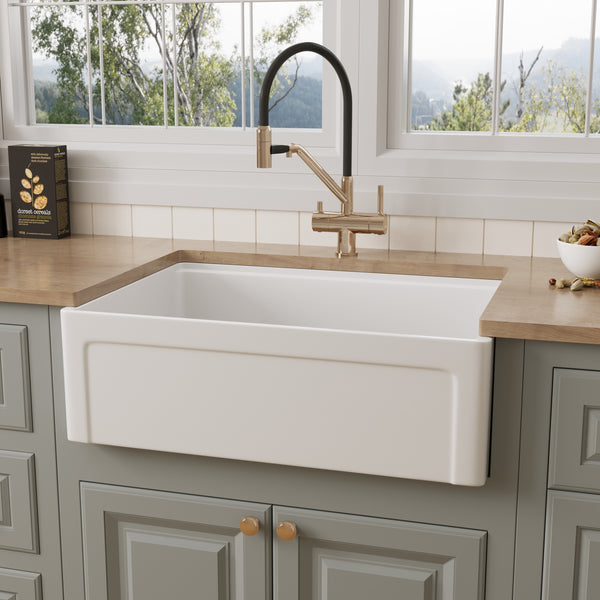
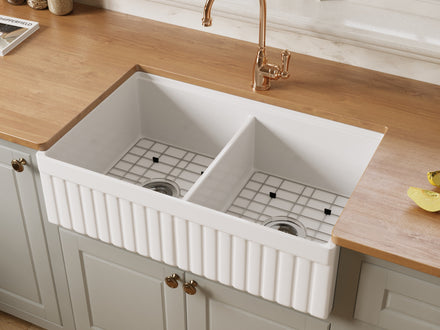
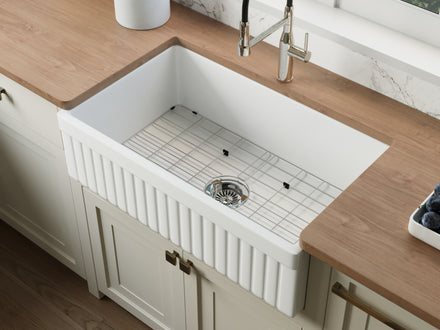
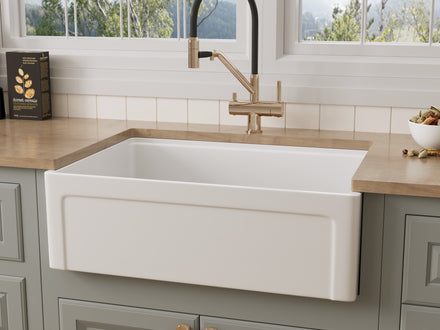
The three labels can overlap in retail language, but they are not interchangeable specifications. A product may look “Belfast-style” in a photograph and still differ in its waste connection, rim, bowl count, or mounting detail. Likewise, a modern farmhouse sink may be fireclay, cast iron, stainless steel, copper, stone, or another material; the category does not make it a Belfast or Butler sink.

Why the Overflow Is a Clue, Not a Universal Test
A traditional Belfast overflow may be described as a weir: a molded high-level passage that gives rising water another route toward the waste. That detail is useful when reading design history. It is not safe to assume that every modern product called Belfast includes the same construction—or that every product called Butler omits it.
Retailers may combine the names, update a historical form, or apply the familiar term to a new material. An overflow may be visible as a slot, opening, cover, or integrated passage, and its connection can affect the compatible waste assembly. Check the drawing and installation instructions for the exact model. If the product page is silent, ask the seller to identify the overflow and waste parts in writing before ordering.
Translate Any Sink Name Into Eight Specifications
- Model and market label: record the exact SKU; do not combine dimensions from similarly named sinks.
- Overflow: confirm whether one is present, how it is built, and which waste assembly it requires.
- Material and finish: care, weight, tolerances, impact risks, and installation can change with the material.
- Overall dimensions: exterior width, front-to-back length, and total height drive the cabinet and counter plan.
- Interior dimensions: usable bowl width and length answer a different question from exterior fit. The standard kitchen sink size guide explains the distinction.
- Depth endpoint: ask whether the number is measured from the rim to the lowest point or vertically at a side wall.
- Drain: verify diameter, location, strainer or disposal compatibility, and any overflow connection.
- Cabinet and support: follow the model-specific minimum cabinet and support instructions; do not let the countertop carry a heavy bowl.

What Changes in a US Kitchen Plan
UK articles often discuss 600 mm or 800 mm sink units. Do not translate those labels directly into a US cabinet order. Use the sink manufacturer's stated minimum cabinet, then confirm the face frame or frameless opening, side clearances, door layout, support platform, plumbing, and countertop detail.
For fireclay, plan around the delivered sink rather than a photograph or nominal family name. The fireclay farmhouse sink installation guide explains independent cabinet-tied support and on-site templating. Reveal is a separate decision covered by the farmhouse sink reveal guide.
Also coordinate the faucet before cutting. A deep bowl does not guarantee enough rear deck space, correct spout reach, handle clearance, or service access. The practical order is sink, cabinet/support, faucet, plumbing, and countertop on one approved drawing.
NZ-103W3320: A Modern US Apron-Front Example
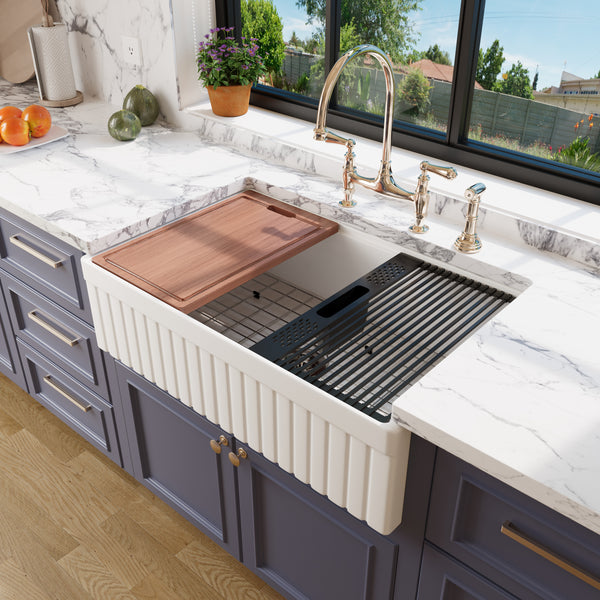
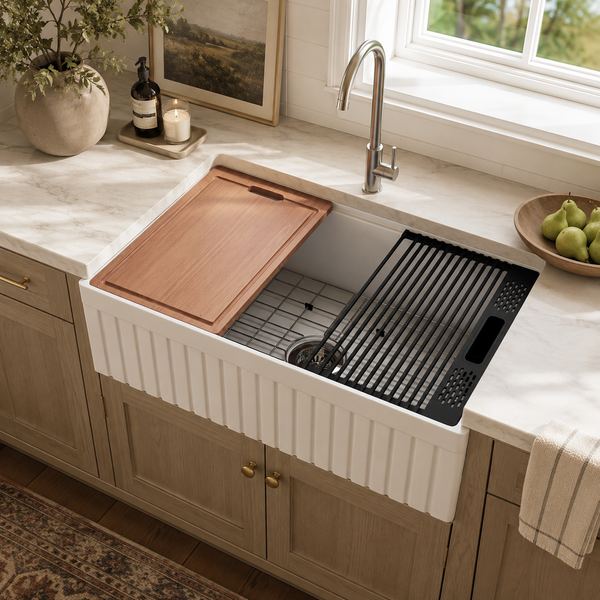
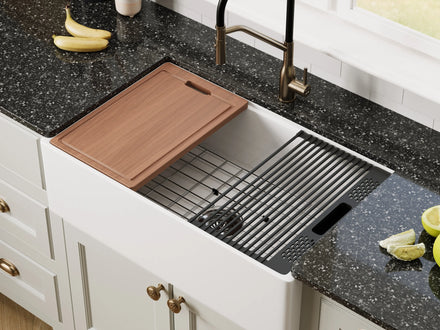
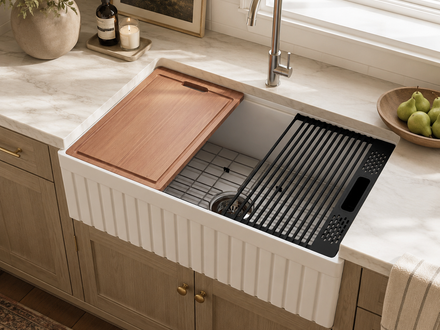
NOZLOO does not identify the NZ-103W3320 as a Belfast or Butler sink. It is a modern American fireclay apron-front workstation sink. Its value here is showing how a clear model specification replaces a historical label.
The NZ-103W3320 measures 33″ × 20″ × 10″ overall and 31″ × 17¾″ inside. Its 9-inch interior depth is measured vertically from the rim to the lowest point at the centered drain, not at a side wall. It has a centered 3.5-inch drain, requires a 36-inch minimum cabinet, and weighs about 105 lb. Those facts do not classify it as Belfast or Butler, and no overflow conclusion should be inferred from either historical name.
Its workstation ledges and accessories are a separate modern feature set. Compare that workflow in workstation sink vs regular sink; use the fireclay sink buying guide for the broader material decision.

Buying Checklist
| Ask for | Why it matters | Do not substitute |
|---|---|---|
| Dimensioned model drawing | Confirms exterior, interior, rim, corners, drain, and any overflow | A lifestyle photo or family name |
| Minimum cabinet and support instructions | Protects the sink, cabinet, and countertop | A generic “Belfast base” recommendation |
| Compatible waste information | Matches the drain and any overflow construction | A drain chosen only by appearance |
| Delivered-sink template approval | Accounts for the actual body and project tolerances | A nominal online outline |
| Exact faucet dimensions | Checks reach, base, hole, handle travel, and backsplash space | “Farmhouse faucet” as a style label |
Frequently Asked Questions
Is a Belfast sink the same as a farmhouse sink?
Not exactly. Belfast is a historical regional name with traditional ceramic and overflow associations. Farmhouse or apron-front is the broader modern US category defined primarily by the exposed front. Retail language overlaps, so compare the current model specifications.
What is the difference between a Belfast and Butler sink?
The traditional distinction often given is a Belfast overflow or weir versus a Butler sink without one, sometimes with different historical proportions. Modern sellers may use the names together. Verify the overflow, dimensions, material, and fitting method rather than enforcing the historical rule on every current product.
Do all Belfast sinks have an overflow?
No universal product-label rule guarantees that. A visible overflow is a useful traditional clue, but confirm the exact model drawing and compatible waste.
Do all Butler sinks have no overflow?
No. That is a common historical distinction, not a promise about every modern catalog listing. Read the current specification.
Are Belfast sinks always fireclay?
Traditional examples are strongly associated with glazed ceramic or fireclay, but modern marketing can apply familiar names more broadly. Material must be confirmed model by model.
Can a Belfast-style sink go in any sink cabinet?
No. The sink's real exterior size, weight, support method, plumbing, door layout, and countertop detail must fit the cabinet. Use the manufacturer's minimum cabinet and installation instructions.
Is the NOZLOO NZ-103W3320 a Belfast or Butler sink?
No. NOZLOO identifies it as a modern American fireclay apron-front workstation sink. Choose it from its verified dimensions, centered drain, cabinet minimum, weight, installation, and workflow—not by applying a historical label.
How We Checked This Guide
NOZLOO reviewed the Google US top results and related questions on August 23, 2026. The article separates repeated SERP conventions from model-specific facts, checks historical working-space usage against a local-government archive, checks current technical usage against a UK government manual, and uses owner-approved NZ-103W3320 data. Competing sink retailers informed the intent analysis but are not linked or used as product authorities in the article.
The Bottom Line
A Belfast sink is best understood as a historical name, not a cabinet-cutting instruction. Use the traditional overflow distinction to understand the vocabulary, then set it aside: the actual overflow, material, dimensions, depth endpoint, drain, cabinet, support, faucet, and delivered template decide whether a sink belongs in your kitchen.