Quartz Composite Sink Pros and Cons: What to Verify

Reviewed: August 22, 2026 · Material terminology, care cautions, US search questions, and NZ-103W3320 specifications checked against the research record.
Quick answer: A quartz composite sink can be a good choice if you want a dense, quieter-feeling bowl with a matte, solid-color look. The trade-offs are model-specific heat and cleaning limits, more installation weight than many steel sinks, and a surface that can show mineral haze, soap film, or metal transfer even when it is not permanently stained. Verify the exact material, care guide, weight, cabinet requirement, and warranty before buying.
First, the name: a quartz composite sink is molded from mineral aggregate plus a polymer/resin binder and usually pigment. It is not a quartz countertop, not a basin carved from a solid slab, and not fireclay. Formulas and finishes vary, so one brand's heat limit or cleaner list does not automatically apply to another.
Quartz Composite Sink Pros and Cons at a Glance
| Decision point | Practical advantage | What to verify |
|---|---|---|
| Sound | Dense material usually has less metallic ring than an untreated steel bowl | Do not assume “silent”; cabinet, faucet stream, disposal, and mounting still matter |
| Everyday knocks | It does not dent like thin sheet metal | Edges can still chip and a severe impact or installation stress can damage a bowl |
| Color and finish | Often available in matte, coordinated colors | Dark colors may show light mineral haze; light colors may show metal transfer |
| Heat | Many lines are sold as heat resistant | The exact limit and hot-pan rule belong to the model manual |
| Care | Routine soap-and-water cleaning can be simple | Abrasives, acids, alkalis, bleach, and drain cleaners are model-specific |
| Installation | Available in common single- and double-bowl formats | Check actual weight, minimum cabinet, mounting hardware, support, and countertop rules |

What “Quartz” and “Granite Composite” Actually Mean
Both labels are used for molded mineral-filled sinks, but the mineral blend, particle size, resin system, pigment, texture, and surface treatment may differ. Some sellers use the terms loosely. Do not choose on the front-of-box word alone; find the material declaration and care guide for the exact model.
This also prevents a common category error: a quartz countertop with a separate sink is not a quartz composite sink. If you are comparing materials broadly, start with our kitchen sink material guide. If material, mount, and bowl layout are getting mixed together, separate them with our types of kitchen sinks guide.
The Benefits That Matter in Daily Use
- A quieter feel: the dense molded body tends to damp the sharp ring associated with bare metal, although a disposal and cabinet can still transmit noise.
- No sheet-metal denting: a dropped utensil will not create the same kind of dent as it might in thin steel. This is resistance, not immunity to chips or cracks.
- Matte color choices: black, gray, brown, and light neutral finishes can coordinate with a countertop without the reflective look of stainless steel.
- Simple conservative care: for many models, prompt rinsing, mild dish soap, a soft cloth, and drying handle routine soil.
Common Problems: Diagnose Before You Scrub
| What you see | Possible cause | Low-risk first response |
|---|---|---|
| Chalky or cloudy haze | Hard-water minerals or soap residue | Rinse, dry, and check the model guide before using any acid or descaler |
| Gray lines after cookware contact | Metal transfer, not necessarily a cut into the sink | Use only the approved cleaner and soft tool in the care guide |
| Color change near a hot pan | Heat exposure affecting the binder or finish | Stop placing hot cookware directly in the bowl; ask the manufacturer about the mark |
| Visible groove | Actual scratch or abrasion | Do not sand or polish unless the manufacturer gives a repair method |
| Chip or crack | Severe impact, edge damage, or installation stress | Stop heavy use and have the sink and support inspected |
| Water remaining in spots | Bowl geometry, installation level, debris, or maintenance | Check level and drainage rather than blaming the material alone |
The USGS explanation of water hardness identifies calcium and magnesium as primary causes of hardness. Deposits can therefore sit on a sink surface without proving that the sink body has absorbed a permanent stain. If a care manual permits bleach, follow its exact directions; the EPA warns never to mix cleaning products or add bleach to other chemicals.

Seven Checks Before You Buy
- Read the material declaration. Confirm that the basin is a molded quartz/mineral composite, not a countertop description.
- Download the exact care guide. Search it for hot cookware, abrasives, acids, alkalis, bleach, drain cleaners, and metal marks.
- Verify dimensions. Match exterior size, bowl size, depth, drain location, and minimum cabinet. Our sink size guide explains the measurements.
- Confirm the support plan. Ask what supports the sink, which clips or frame are included, and whether a disposal changes the requirement.
- Choose color with your water in mind. Dark matte surfaces may make pale deposits easier to see; light surfaces may make gray transfer more obvious.
- Inspect the drain and accessories. Confirm opening size, disposal fit, strainers, grids, and replacement availability.
- Read the warranty exclusions. Heat, impact, chemicals, installation, and cosmetic marks may be treated differently.

Quartz Composite vs Fireclay: Choose the Surface and Shape
| If you prioritize… | Quartz composite direction | Glazed fireclay direction |
|---|---|---|
| Visual character | Matte, stone-like, often darker or colored | Smooth glossy glaze, commonly white |
| Typical design cue | Modern undermount or drop-in bowl | Farmhouse apron-front statement |
| Wear to expect | Haze, transfer, abrasion, or heat-related discoloration vary by model | Metal transfer can mark the glaze; severe impact can chip an edge |
| Installation reality | Heavy; follow the model's mounting and support instructions | Very heavy; apron-front fireclay needs independent cabinet-tied support |
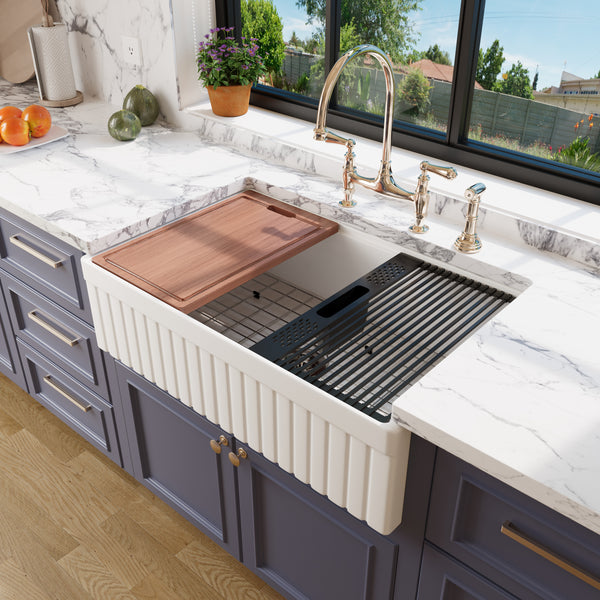
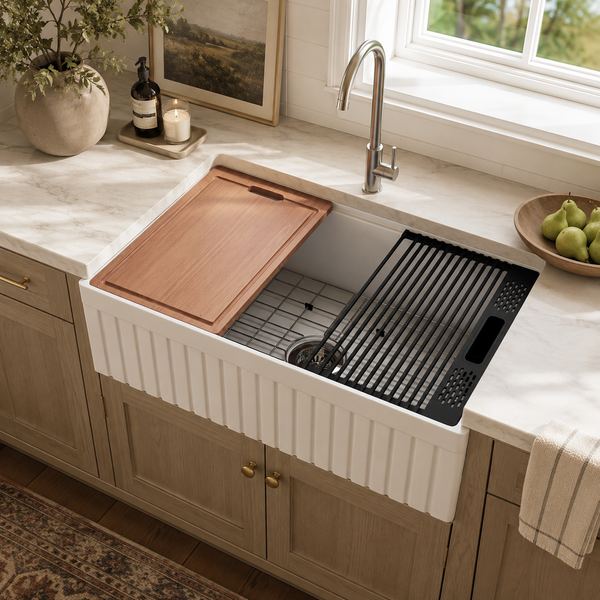
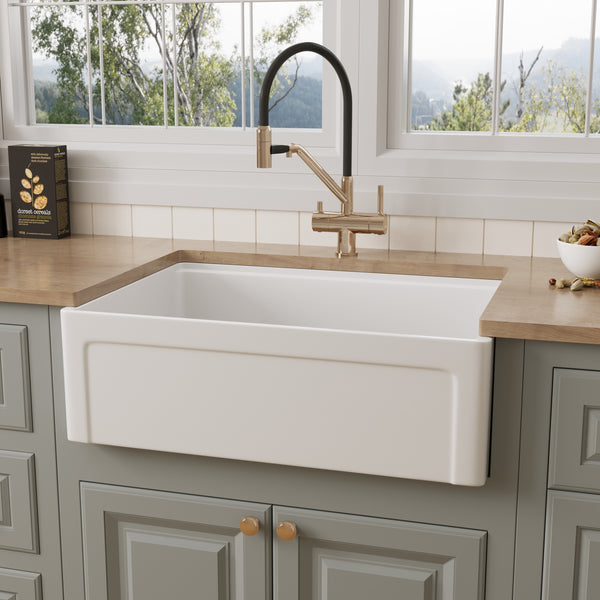
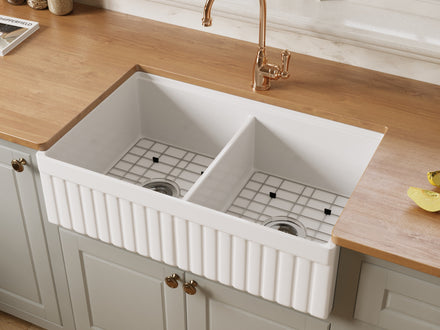
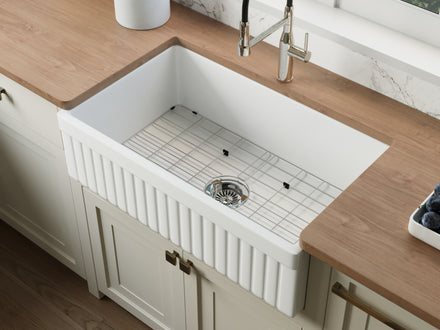
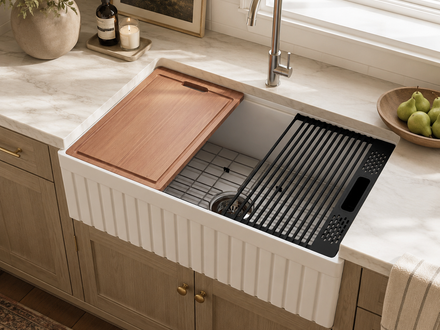
There is no universal winner. If a matte composite surface interests you, stay with the model-document checks above. If your goal is a white reversible fluted apron-front, compare the surface behavior in our fireclay vs granite composite guide. The product below is fireclay, not quartz composite.


NZ-103W3320 dimensions are nominal because fireclay is hand-finished. The 9-inch interior depth is the vertical rim-to-lowest-point measurement at the centered drain, not a side-wall measurement. Use the delivered sink for final cabinet and countertop work.
How We Checked This Guide
NOZLOO reviewed the live Google US result mix and PAA questions on August 22, 2026. We compared repeated claims with care and specification documents from multiple composite product lines, using differences between those documents as a reason to avoid universal heat limits and cleaner recipes. We also checked USGS water-hardness guidance and EPA cleaning-product safety guidance. The exact sink manual, delivered product, and qualified installer's instructions take priority over this general guide.
Frequently Asked Questions
What are the main downsides of a quartz composite sink?
It is heavier than many steel sinks, can show haze or metal transfer, and has model-specific limits for hot cookware and cleaners. Severe impact or poor support can also damage a bowl. Verify the exact manual rather than relying on the material name.
Which is better, a stainless steel or quartz sink?
Neither is universally better. Stainless steel is lighter, often simpler to support, and cannot chip like a brittle composite body, but it commonly shows scratches and water spots; sound also depends on pads, bowl geometry, and the cabinet. Quartz composite offers matte color, greater mass, a quieter-feeling bowl, and no thin-sheet denting, but it is heavier, can show haze or metal transfer, and has model-specific heat and cleaner limits. Choose by cabinet support, finish, acceptable wear, and the exact care guide.
Do quartz composite sinks stain or scratch?
They are commonly designed to resist everyday staining and abrasion, but they are not universally stain-proof or scratchproof. Mineral film, soap residue, and metal transfer can resemble damage. Identify the mark and follow the model's care guide.
Can I put a hot pan in a quartz composite sink?
Do not assume so. Heat limits and direct-hot-pan warnings differ by product line, and some manufacturers warn about discoloration. Use a trivet or approved accessory unless the exact model instructions clearly say otherwise.
Are quartz composite and granite composite sinks the same?
Not reliably. Both can be molded mineral-and-resin composites, and retail terminology overlaps, but mineral blend, resin, texture, pigment, and care rules vary. Compare the exact material declaration and documentation.
Is quartz composite better than fireclay?
Neither is universally better. Quartz composite suits buyers who prefer a matte, often colored, quieter-feeling bowl. Glazed fireclay suits buyers who want a smooth or fluted white apron-front look. Both are heavy, need correct support, and have different damage patterns.