Best Sink Material for Hard Water: Spots, Haze, and Scale

Reviewed: August 22, 2026 · Water-hardness definitions, deposit types, material tradeoffs, care limits, and NZ-103W3320 dimensions checked against the sources and product data below.
Quick answer: No sink material prevents hard-water minerals from reaching the basin. For lower visual contrast, a light glossy surface such as white glazed fireclay or white enamel can be forgiving of pale scale, but colored deposits still show. Brushed stainless often reveals dried droplets; dark matte composite can make white haze more obvious. Choose the surface you will rinse, wipe, and clean according to its exact care guide.
The best sink for hard water is not “the toughest” material. It is the surface on which your local deposits are acceptable—and for which the approved maintenance fits your routine.
Hard Water Is a Water Condition, Not a Sink Defect
The U.S. Geological Survey defines water hardness mainly by dissolved calcium and magnesium. When water evaporates, those minerals can remain as spots, film, or scale. USGS commonly classifies water as:
| Hardness as CaCO₃ | USGS classification | What to do with the number |
|---|---|---|
| 0–60 mg/L | Soft | Still check for iron, manganese, corrosion, or other deposits |
| 61–120 mg/L | Moderately hard | Expect some spotting depending on use and drying |
| 121–180 mg/L | Hard | Plan a regular rinse-and-dry routine |
| More than 180 mg/L | Very hard | Use local water data and material-approved care; consider whole-home water advice separately |
A national hardness map is useful context, not a property-level test. Use your water utility's current report or an appropriate local test when the decision matters.
Identify the Deposit Before Choosing a Surface
White or chalky residue often fits calcium/magnesium scale. Orange or reddish marks can involve iron; dark brown or black deposits can involve manganese or another water-quality issue. The EPA's secondary drinking-water guidance treats hardness, deposits, color, iron, manganese, and corrosion as related but distinct nuisance or aesthetic concerns.
If deposits suddenly change color, appear at multiple fixtures, or accompany plumbing symptoms, do not solve the problem by changing sink material alone. Check the water and plumbing cause.

Compare How Surfaces Show Hard-Water Residue
| Surface | What may be visible | Tradeoff to verify |
|---|---|---|
| White glossy fireclay or enamel | Pale scale has lower color contrast; gray transfer and orange/dark deposits can stand out | Impact/chip behavior, weight, support, and approved cleaner list |
| Brushed stainless steel | Dried droplet outlines, haze, and fingerprints may be visible in reflected light | Grain direction and finish-specific care; do not use random abrasives |
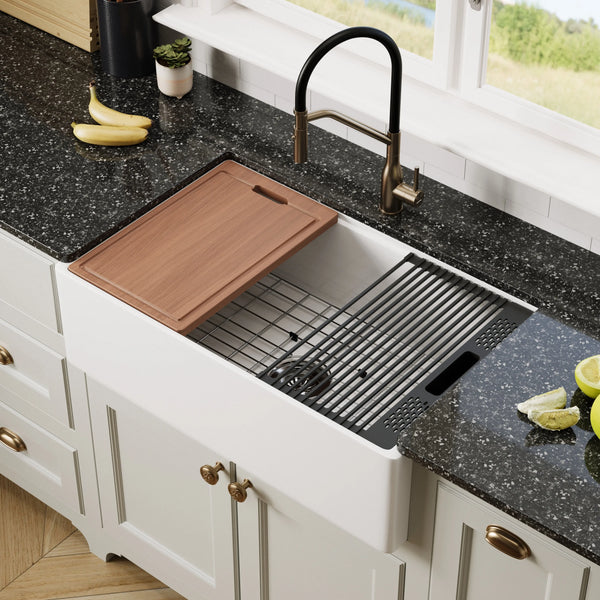
| Dark matte composite | White mineral haze can have high contrast, especially around the drain and water line | Model-specific formula, heat limits, and cleaner restrictions |
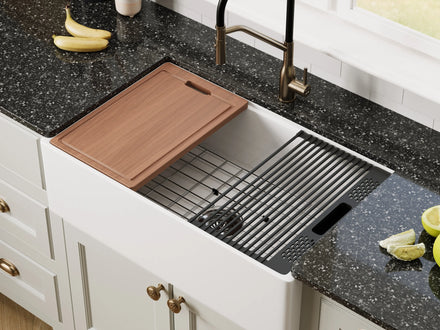
| Light speckled composite | Pattern may camouflage small pale spots but not prevent buildup | Texture can change wiping effort; verify exact care instructions |
| Copper or other reactive/patinated metal | Mineral residue interacts visually with a changing patina | Water chemistry and care can affect appearance; use maker-specific guidance |
This is a visibility comparison, not a durability ranking. A dark sink is not damaged because white scale is easy to see, and a white sink is not clean merely because pale residue blends in.
For the two most common adjacent decisions, compare the complete fireclay vs stainless steel tradeoffs or the focused quartz composite sink pros and cons. Those pages own impact, noise, finish, and model-selection questions that hard water alone cannot answer.

Choose by the Maintenance You Will Actually Do
- Rinse after messy use. Move food and cleaner residue toward the drain instead of letting it dry into the mineral film.
- Lift approved accessories. Rinse beneath a fitted grid where water can sit around feet or wires.
- Wipe the rim and bowl. A soft cloth removes droplets before evaporation leaves an outline.
- Dry the faucet base and counter seam. These horizontal pockets often show buildup before the bowl does.
A daily dry-down reduces visible residue; it does not change the mineral content of the water. Water treatment is a separate household decision. The EPA WaterSense technical sheet explains how cation-exchange softeners address calcium and magnesium, along with their operating considerations.

Vinegar Is Not a Universal Sink Cleaner
Acid can dissolve some mineral deposits, but a useful chemistry fact is not blanket product approval. Acid, contact time, concentration, abrasives, and existing chips can affect surfaces, binders, sealants, finishes, drains, and nearby countertops differently.
Use this order:
- Identify the exact sink material, model, and surface finish.
- Read the current manufacturer care instructions and warranty exclusions.
- Start with the approved mild routine.
- Use vinegar, an acid, or a descaler only if the maker approves it for that surface and specifies how.
- Stop if there is a chip, exposed substrate, unknown discoloration, or a changing texture.

When White Glazed Fireclay Makes Sense
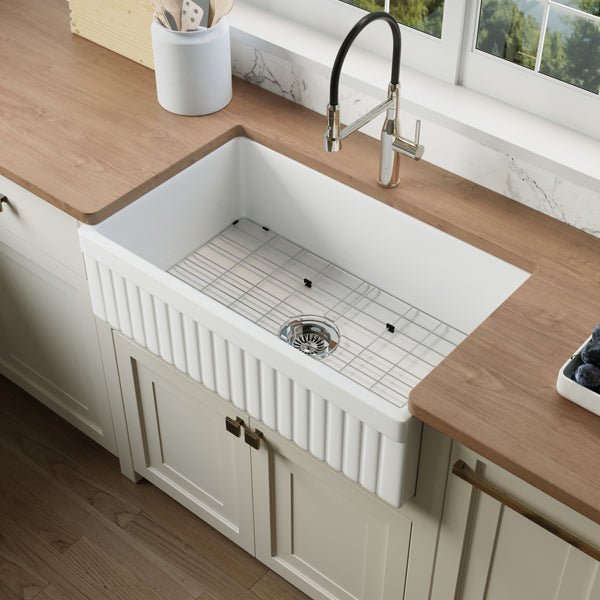
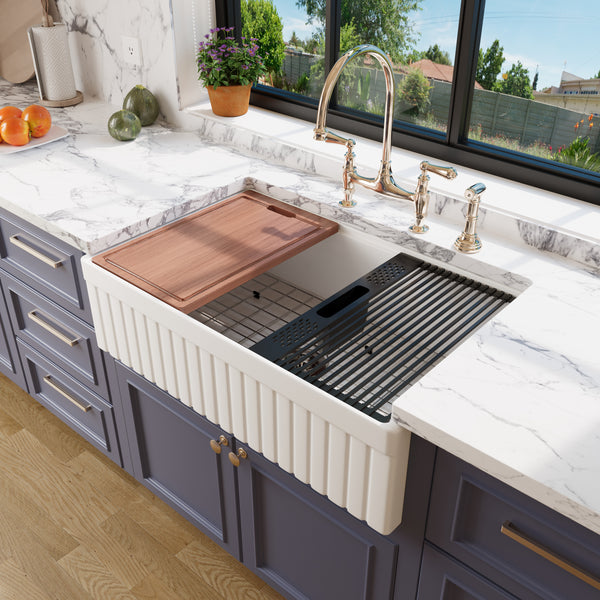
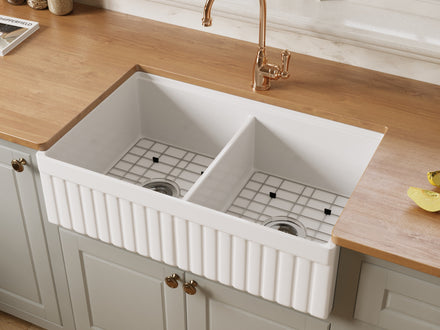
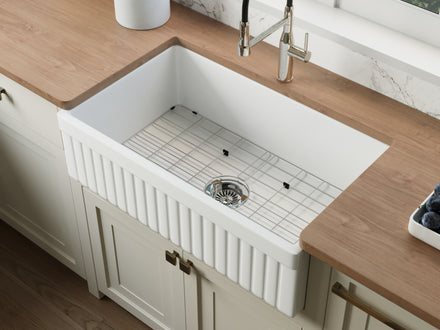
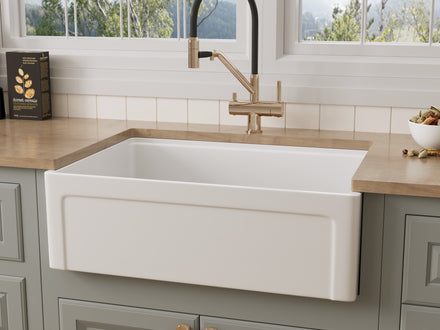
White glazed fireclay can reduce the color contrast of pale scale and offers a smooth surface, but it is not hard-water-proof. Orange or dark deposits can still be obvious, mineral buildup still needs removal, and heavy impact can chip the sink. Choose it for the white apron-front look and acceptable care pattern—not because of an immunity claim.
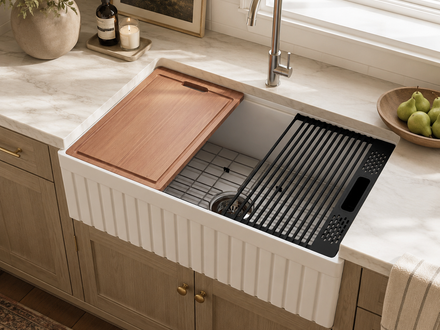
The NOZLOO NZ-103W3320 measures 33″ × 20″ × 10″ overall with a 31″ × 17¾″ interior. Its 9-inch interior depth is measured vertically from the rim to the lowest point at the centered drain, not at a side wall. It has a centered 3.5-inch drain, requires a 36-inch minimum cabinet, and weighs about 105 pounds. The centered drain supports bowl workflow; it does not prevent hard-water deposits.
Its apron belongs above the lower cabinet doors, with cabinet-tied independent support beneath the bowl. For exact daily and mineral-mark care, use the NOZLOO fireclay sink cleaning guide. If white appearance is the fixed requirement, compare white kitchen sink materials; if hard water is only one part of the decision, return to the kitchen sink material comparison.

How We Checked This Guide
NOZLOO reviewed live Google US results and related questions on August 22, 2026. USGS supports the hardness definition and ranges; EPA sources support the distinction among scale, water-quality deposits, and softening. Surface behavior and cleaner approval remain model-specific.
Frequently Asked Questions
What sink material is best for hard water?
No material blocks hard-water minerals. A light glossy surface often gives pale scale lower visual contrast; stainless can show dried droplets; dark matte surfaces can make white haze obvious. Choose based on visibility, approved care, installation, and the drying routine you will follow.
Will hard water ruin a stainless steel sink?
Hard water commonly leaves spots or haze on stainless steel. That does not automatically mean the steel is ruined. Use the sink's grain- and finish-specific care instructions, and investigate unusual corrosion or colored deposits instead of treating every mark as scale.
Does fireclay resist hard-water deposits?
Glazed fireclay does not prevent deposits. A white smooth glaze can make pale scale less conspicuous and may be straightforward to wipe under approved care, while orange, dark, or gray marks can show clearly. Regular rinsing and drying still matter.
Do dark composite sinks show hard-water spots?
White mineral haze often has strong contrast on a dark matte surface, but formula, texture, and color vary. Check actual samples in angled light and follow that model's care guide rather than assuming all composites behave alike.
Is vinegar safe for removing hard-water scale from every sink?
No. Vinegar is acidic, and approval varies by surface, binder, enamel condition, adjacent sealant, and countertop. Use it only when the current sink maker explicitly approves the product, concentration, contact time, and rinse method.