Sink Chip Repair: How to Fix a Chipped Fireclay Sink at Home
How to fix a chipped fireclay sink: when a chip is cosmetic, a step-by-step epoxy and glaze repair, apron fixes, warranty facts and prevention.

In this guide View sections +
Sink chip repair on a fireclay sink is a simple DIY job when the chip is small and dry. Clean it, sand only the chip, wipe with alcohol, then fill it in thin layers of epoxy filler and white touch-up glaze. Let it cure fully before use. The result is smooth and easy to clean, but it is a cosmetic fix, not an invisible one.
The same method works for a porcelain sink chip repair or a ceramic sink repair, since each one fills a chip in a hard, glossy surface. This guide also covers where farmhouse sinks chip, when to leave a chip alone, what to do about a chip found at delivery, how warranties treat chips, and how to rebuild a fluted apron edge.
Can you repair a chipped fireclay sink?
Yes. Most chips on a fireclay sink can be filled at home in an afternoon, plus cure time. What matters is how deep the damage goes.
A fireclay sink is a thick clay body with a glaze fused to it. On NOZLOO sinks the wall is a fireclay body about 1 inch (22–25 mm) thick. The glaze and body are fired together at about 2,200°F until they vitrify into one dense piece. That means a chip exposes more clay, not metal.
A porcelain sink and a fireclay sink look alike, but the body can differ. A porcelain sink may be solid porcelain or a porcelain enamel surface over another base. The basic fix for a chipped sink is the same: fill the pit, then glaze over it.
- Glaze-only chip: a shallow flake where the white surface is gone but the spot is barely recessed. Touch-up glaze alone often works.
- Chip into the body: a pit you can feel, with tan or gray clay showing. Fill it with epoxy putty in layers, then glaze on top.
- Through-body crack: a line that runs through the wall, grows, or leaks. This is not a chip repair. Stop and contact the maker.

Where do farmhouse sinks chip, and why?
Chips cluster in four places, and the cause is almost always a hard object meeting a hard edge. Knowing the zone tells you both the likely cause and the best repair.
| Chip zone | Usual cause | Repair notes |
|---|---|---|
| Apron top corners | Bumps during delivery, cabinet cutting or countertop work | Low wear; repairs last well. Shape the corner before the filler sets. |
| Top edge of the apron | Pans or tools set down on the edge; hits from stools or carts | Visible spot. Keep layers thin to match the curve. |
| Drain ring | Dropped knives or tools; over-tight drain work | Check it is not a crack first. Keep filler off the drain seal area. |
| Basin floor | Dropped cast iron or heavy pots | Highest wear. Expect to touch it up over time. |
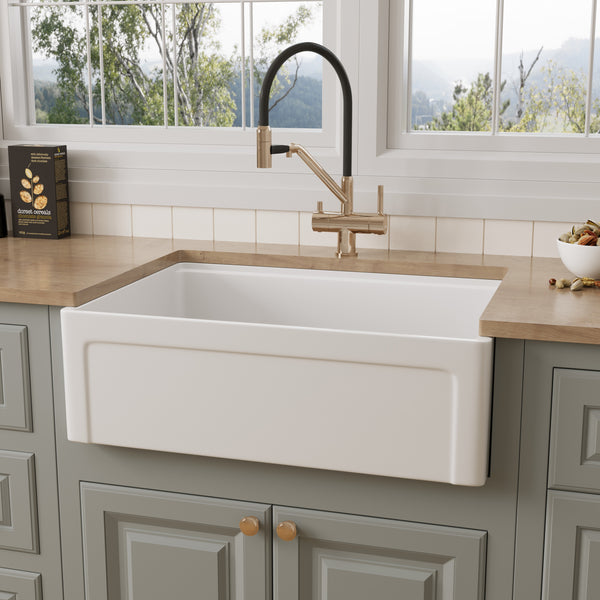
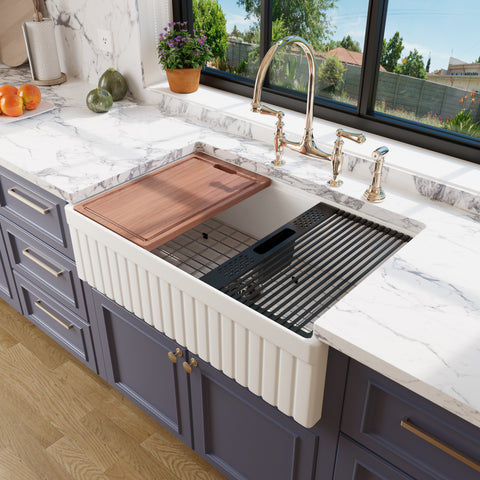
A farmhouse sink has a fully exposed apron. On a 33″ × 20″ × 10″ sink, that front face and its corners sit right where hips, carts and pans pass. Undermount sinks hide their edges under the counter, so they rarely chip there.


Should you fix a chip or leave it?
Fix a chip when it catches a fingernail, sits in standing water, or bothers you. Leave it for now if it is tiny, smooth and dry. Use this quick check:
- Run a fingernail across it. If the nail catches, the edge is sharp enough to hold grime and snag a sponge. Fill it.
- Look at where it sits. A chip in the path of draining water stays wet and collects residue. Fill it sooner.
- Check for a line. Wet the area and look in raking light. If a hairline runs out from the chip, photograph it before you do anything.
- Measure the size. A chip about the size of a pencil eraser or smaller is a normal DIY job. Larger damage can still be filled, but a pro refinisher may blend it better.
A common question is whether a 1 mm chip on the basin floor is OK to leave. That is usually cosmetic. Clean it, keep an eye on it, and fill it when you have a free weekend.
The same checks apply to a ceramic sink in a bathroom. A bathroom sink sees lighter use than a kitchen sink, so a small, smooth chip there can usually wait longer.
A fireclay chip is less urgent than a chip in enameled cast iron. Cast iron has a thin glass coating over iron, so an exposed chip can rust and stain under the enamel. Fireclay is clay all the way through, so a chip shows more clay, which can't rust.
Still seal a fireclay chip, because exposed clay is rougher than glaze and holds grime and stains more easily. Our fireclay vs cast iron vs porcelain comparison covers these differences in more detail.
What if the sink was chipped when it arrived?
Do not install it, and do not repair it. Photograph the chip and the packaging, and report it right away. Installing or patching the sink first makes it much harder to show the chip was there on arrival.
- Unbox and inspect the sink as soon as it is delivered. Check the apron corners and rim under bright light.
- Take clear photos of the whole sink, the chip up close, and the outer packaging.
- For a NOZLOO sink, email info@nozloo.com within 48 hours of delivery with your order number and photos. Our team replies within a few hours.
- Keep the sink and packaging as they are until you hear back. The return policy explains the 48-hour arrival-issue window.
Chips can also happen after delivery but before the sink is in use. Cabinet cutting and countertop work are common causes. Pad the apron with a moving blanket and painter's tape while trades work around it. Our fireclay sink installation guide shows the full sequence.
Does the warranty cover a chipped sink?
Usually not, when the chip comes from use. Most sink warranties cover manufacturing defects, not impact. NOZLOO's is written the same way.
The NOZLOO Limited Lifetime Warranty covers qualifying defects in materials and workmanship in the sink body. It applies to the original purchaser in residential use. It excludes impact and accidental damage, damage from dropped cookware, tools or heavy objects, and chips caused by external force.
Thermal shock and harsh cleaning are also excluded. The included accessories have a separate 1-year warranty.
One more point matters before you repair. The warranty also excludes alteration or modification. If you think a mark could be a manufacturing defect rather than an impact chip, send photos first and repair after. A patched spot is hard to assess.
What do you need to fix a chipped sink?
You need a sink repair kit or the same parts bought separately. A typical porcelain sink repair kit holds a two-part epoxy putty or filler and a touch-up glaze. Read the label to confirm it is made for a ceramic sink, porcelain sink or fireclay sink.
- Two-part epoxy putty or filler (resin and hardener) for chips you can feel
- White touch-up glaze with a fine brush, in a bright white shade
- Wet/dry sandpaper or emery paper in fine grits, such as 400 and 600
- Denatured alcohol or acetone, plus lint-free cloths
- Painter's tape, a plastic putty knife or old gift card, and a single-edge razor blade
- Nitrile gloves, a few toothpicks, and a small mixing surface
- Polishing compound for the final blend (optional)
Most kits give off fumes while they cure. Open a window and run a fan.
That follows what the EPA advises for products that release VOCs. Better airflow is one of the EPA's three basic ways to improve indoor air. Wear gloves while you mix and apply. Read the warnings on the label, and look up the product's safety data sheet (SDS) on the maker's website for ventilation and glove advice.
How to repair a chipped fireclay sink, step by step
The repair takes about an hour of hands-on time, plus cure time. Work in good light, and keep every product inside the chip.

- Clean and dry. Wash the area with dish soap and warm water. Pick out any grit with a toothpick or the corner of a putty knife. Let the chip dry fully; a hair dryer on low speeds this up.
- Tape and sand. Mask the glaze around the chip with painter's tape. Lightly sand inside the chip with 400-grit sandpaper or emery paper to roughen it. Do not sand the good glaze around it.
- Degrease. Wipe the chip with denatured alcohol or acetone. Let it flash off. Do not touch it with bare fingers after this step.
- Fill in thin layers. Wear gloves. Mix a small amount of epoxy putty or filler as the label says. Press it in with a toothpick or putty knife. On deep chips, build it up in two or three thin layers and let each set as directed.
- Level it. Leave the last layer slightly proud of the surface. Once firm, shave it flush with a razor blade held flat. If you need to sand, keep the tape on and sand only the filler with 600-grit or finer. Remove the tape before glazing.
- Glaze. Brush on a thin coat of touch-up glaze, just past the filler edge. Let it dry, then add a second thin coat if needed. Thick coats run and look like a blob.
- Cure, then polish. Follow the label cure time before using the sink; many products ask for 24–48 hours. After a full cure, a light polish helps the gloss blend in.
Made a mess? Most fillers wipe out while they are still wet. Clean it and start again rather than sanding a bad patch later.
Aftercare for a repaired chip
Epoxy and touch-up glaze are softer than fired glaze, so they wear faster. Treat the spot gently.
- Wait about a week before scrubbing the spot, or as long as the label says.
- Use a soft sponge and mild dish soap. Skip abrasive powders and scouring pads, which dull patches quickly. See how to clean a fireclay sink for safe products.
- Avoid pouring boiling water straight onto the repair, or into a cold sink in general.
- Touch up the glaze when the edge looks dull or starts to lift.
How do you match a bright white glaze?
Color matching starts with a test before you commit. Bright white fireclay glaze and off-white kits can look very different side by side.
- Brush a dab of glaze onto a piece of white tape stuck to the sink. Let it dry and compare in daylight and under your kitchen lights.
- If the kit is too warm or gray, try a brighter white. Some kits include tints you can blend.
- Apply thin coats. Thin layers keep the gloss even and reduce visible edges.
- Set your goal as "less visible," not "invisible." A good repair disappears at arm's length and shows only up close.
How do you repair a chip on a fluted or grooved apron?
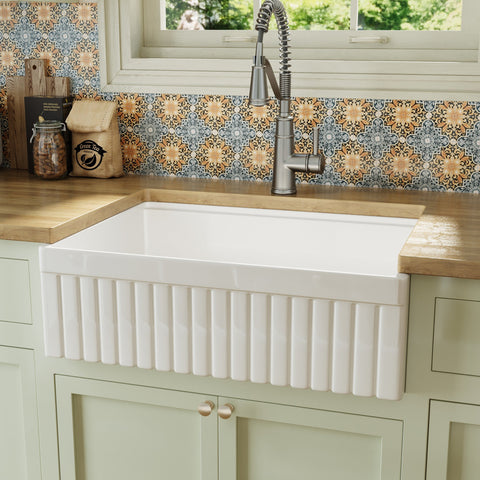
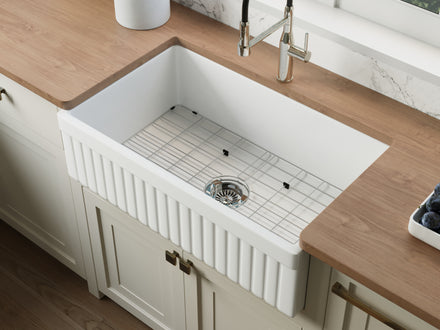
Rebuild the shape first, then the color. On a textured apron, a chip removes part of a rib or groove edge, so the filler has to restore a profile, not just fill a flat pit.
- Tape both sides of the damaged rib to mark its edges.
- Fill the chip slightly proud, using a thicker epoxy putty if the chip is on an edge. Press it in with a plastic putty knife.
- When it is firm but not hard, shape it with a razor blade to follow the neighboring rib.
- After it cures, refine the curve by wrapping 600-grit emery paper around a pencil or dowel and sanding along the rib.
- Glaze in thin coats, as above.
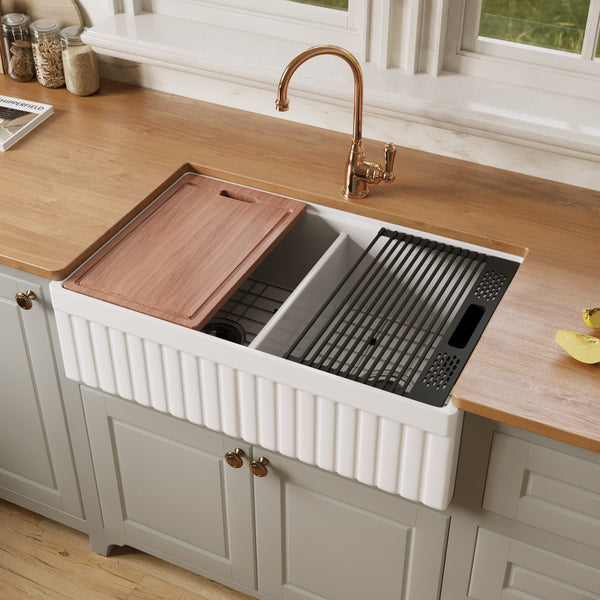
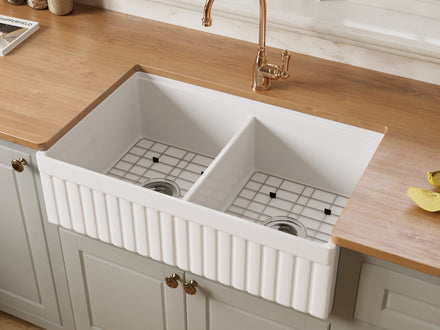
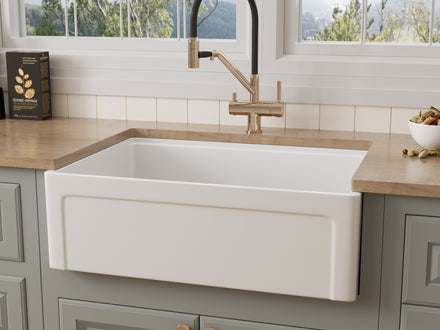
Grooved aprons work the same way, in reverse. Keep the groove clean by running a toothpick through it before the filler sets. Our guide to apron styles shows how smooth, fluted and grooved fronts differ.
How do you stop the next chip?
Keep heavy cookware off the glaze and protect the apron edge. Those two habits prevent most chips.
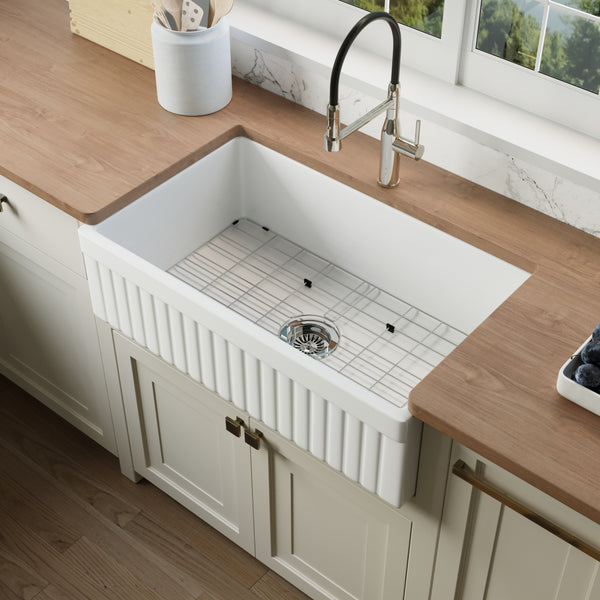
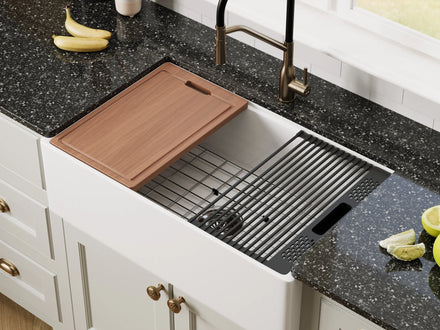
- Use the bottom grid. A stainless bottom grid holds pans above the basin floor, so a dropped pot lands on steel instead of glaze. Every NOZLOO sink ships with one, and the 33″ double bowl has one per bowl.
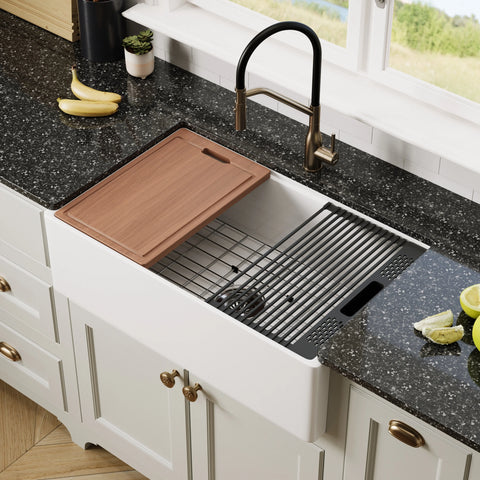
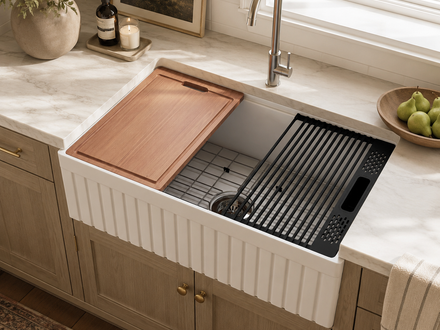
- Lower cast iron; don't drop it. Set heavy pans down, or rest them on the cutting board or rack on a workstation ledge.
- Keep tools off the rim. The apron top edge is not a shelf for pans, cans or knife blocks.
- Pad the apron during work. Cover it with a blanket during cabinet, countertop or plumbing work.
The grid protects the floor, not the rim or the apron. Habits cover the rest. The farmhouse sink accessories guide explains how the grid and ledge pieces work together, and fireclay sink problems covers other surface issues.


Frequently asked questions
Can a chipped fireclay sink be repaired?
Yes, in most cases. A chip in the glaze or a shallow chip into the clay can be filled with a two-part epoxy filler and a white touch-up glaze. The repair restores a smooth, cleanable surface. It is cosmetic, though, and is usually still visible up close. A crack that runs through the sink wall or leaks is not a DIY repair.
Is a small chip in a sink a problem if I leave it?
A small, dry chip on the basin floor is usually cosmetic. On a fireclay sink the clay under the glaze can't rust, so there is no rush. Still, rough edges hold grime and can catch a sponge. If a fingernail catches on it, or it sits where water pools, fill it within a few weeks. Watch it for any spreading line.
Can you use nail polish to fix a chipped sink?
It is not a good fix. Nail polish is thin, so it can't fill a chip, and it is not made for constant water, soap and scrubbing. It tends to yellow and peel. A touch-up glaze sold for sinks looks similar in the bottle but is made for this job. For anything deeper than a scratch, use an epoxy filler first.
How long does a sink chip repair last?
A well-prepped repair can last for years on a low-wear spot such as an apron corner. On the basin floor it wears faster because pans and scrubbing hit it daily. Plan to touch it up when the edge looks dull or lifts. Clean, dry prep, thin layers and a full cure matter more than the brand of kit you choose.
Does the warranty cover a chipped sink?
Usually not, if the chip came from use. NOZLOO's Limited Lifetime Warranty covers qualifying manufacturing defects in the sink body for the original purchaser in residential use. Impact, dropped cookware and chips caused by external force are excluded. A chip found at delivery is different: report it within 48 hours, before installation, with photos.
Glazed fireclay resists chipping in normal use, and a small chip is fixable when it happens. If you are still choosing a sink, compare sizes, apron styles and included grids in our fireclay farmhouse sink collection.