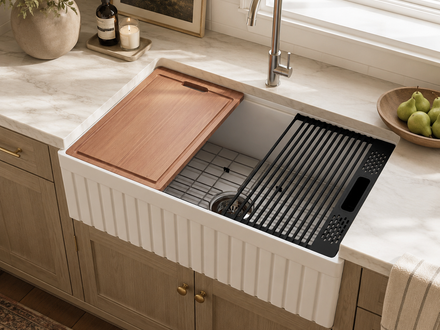
Faucets for Farmhouse Sinks: How to Choose Reach, Height, Style and Splash Control

Quick Answer
Most faucets for farmhouse sinks fail for the same reason: the water lands in the wrong place. There is no single best faucet for a farmhouse sink — only the one whose reach matches your bowl.
For most single-bowl apron-front kitchens, a swiveling pull-down faucet is the right starting point. The exceptions are a low window, which calls for a pull-out, and a deliberately traditional design, which calls for a bridge faucet.
A fixed spout reach of roughly 8 to 9.5 inches is a useful first shopping filter. The correct number comes from three things you can work out on paper before anything is installed: where the faucet hole will sit, how deep the bowl runs front to back, and where you want the stream to land.
Do all of it before the countertop template is approved. A faucet can be replaced. A misplaced hole in stone cannot.
Why This Guide Comes From a Sink Company, Not a Faucet Seller
NOZLOO makes fireclay farmhouse sinks. We do not sell faucets.
There is no ranking, no sponsored model and no brand recommendation here — only the geometry that decides whether a faucet actually works over an apron-front sink.
What Farmhouse Sink Faucets Work Best?
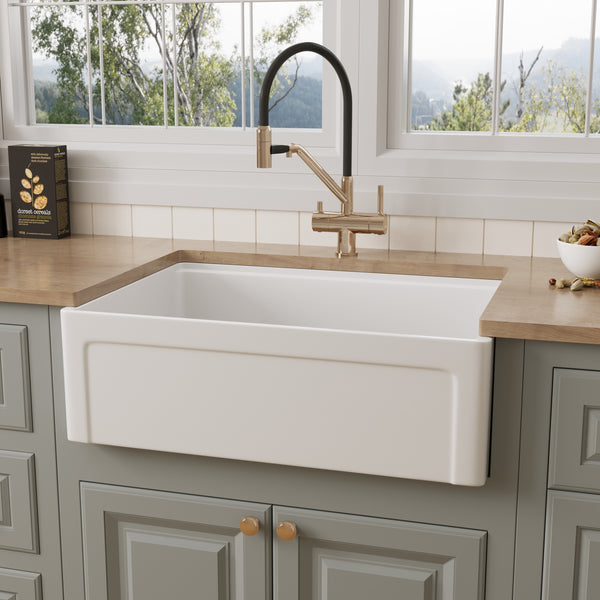
For most wide single-bowl sinks, start with a pull-down farmhouse kitchen faucet: swiveling spout, secure docking, one-handed control.
- Pull-out is the practical exception beneath a low window.
- Bridge is the design-led exception for a traditional or rustic kitchen.
A farmhouse sink faucet with sprayer functionality is especially useful in a deep single bowl. But the hose should extend the faucet's range — not compensate for a bad default landing point. That distinction drives everything below.
A product photo can confirm style. It cannot confirm fit.
Fixed Spout Reach vs. Hose Reach
| Measurement | What it controls | When it matters |
|---|---|---|
| Fixed spout reach | Where the stream lands with the spray head docked | Washing hands, filling a glass, rinsing produce — most of your day |
| Usable hose reach | How far the head travels beyond that | Corners, oversized cookware, filling a pot beside the sink |
You should not have to pull out the sprayer to rinse a cup.
The hose solves the last few inches of an occasional problem. It cannot fix a stream that strikes the rear bowl wall every single time the faucet is opened.
If your calculation lands above about 9.5 inches, do not hunt for an unusually long spout. Move the faucet hole slightly forward, shift the landing zone rearward, or accept the hose for occasional long-reach tasks.
How to Measure Faucet Reach
Spout reach is the horizontal distance from the faucet centerline to the water outlet. It is not the same as overall height or spout height.
Required fixed reach ≈ (faucet centerline → inside rear wall) + (desired forward landing distance)
The second term is your choice. The first term is the one nobody tells you how to get.
The Number You Can't Measure Yet
Before the sink and countertop exist, there is nothing to put a tape measure on. You derive it from the plan.
| Where it comes from | |
|---|---|
| B — Backsplash → sink's rear outer edge | Cabinet depth minus the sink's exterior front-to-back |
| A — Backsplash → faucet-hole center | Your decision, marked on the countertop template |
| C — Sink's rear wall thickness | Exterior front-to-back minus interior, split across the two walls |
Faucet centerline → inside rear wall = (B − A) + C
Worked example — any NOZLOO sink, standard 24-inch-deep base cabinet:
- Every NOZLOO farmhouse sink is 20 inches front to back, 30-inch and 33-inch models alike. With the apron roughly flush to the cabinet face, the rear outer edge lands about 4 inches from the finished backsplash (B).
- The faucet hole realistically lands 3 inches off the backsplash (A) — about the practical minimum once you allow for the faucet base and a full handle swing behind it.
- Most models are 17¾ inches inside, so the two walls account for 2¼ inches. Budget about 1⅛ inches for the rear (C).
(4 − 3) + 1.125 ≈ 2⅛ inches.
Add a 6½-inch landing distance and you need roughly 8⅝ inches of fixed reach — squarely in mainstream pull-down territory.
Use the farmhouse sink faucet reach calculator to run this geometry with measurements from your own countertop, faucet-hole centerline and received sink. It provides a planning estimate only; compare the result with the faucet manufacturer's technical drawing and have the installer approve every drilled hole before cutting.
Run the same math on the one model with a 17-inch interior and the answer shifts by about ⅜ of an inch. It barely moves — which is exactly why the 8-to-9.5-inch shopping band works. The geometry is more forgiving than it looks, as long as you don't skip the step.
The Number That Should Actually Worry You Is the 4 Inches
A 20-inch-deep sink in a 24-inch-deep cabinet leaves four inches of countertop between the bowl and the backsplash. The faucet hole, the faucet base and the entire swing of the handle all have to live inside that strip.
This is why rear clearance fails so often on farmhouse sinks — and it is the strongest practical argument for a side handle over one mounted directly behind the spout.
Two levers if it gets tight:
- Set the apron proud of the cabinet face. Common and often deliberate. The sink moves forward and you get that much room back behind it.
- Move the faucet hole forward. Every inch of A is an inch of reach you don't have to buy — but the hole must stay in solid stone behind the sink cutout.
Two shortcuts if you'd rather not do arithmetic. Ask your fabricator for the template drawing: the distance from the faucet-hole center to the rear edge of the sink cutout is close enough for planning. Or cut the sink's 20-inch-deep footprint out of cardboard, tape it down, mark the hole and measure. Fifteen minutes, and it catches handle-clearance problems at the same time.
Already have the sink installed? Skip all of this and measure from the existing faucet hole to the inside rear wall directly.

NOZLOO Sink Dimensions for the Calculation
| Model | SKU | Overall | Interior bowl | Bowl depth | Drain | Weight | Type |
|---|---|---|---|---|---|---|---|
| 30″ Grooved Apron | NZ-105W3020 | 30 × 20 × 10″ | 27¾ × 17 × 9¾″ | 9¾″ | Rear-right | 100 lb | Workstation |
| 30″ Reversible Apron | NZ-103W3020 | 30 × 20 × 10″ | 27½ × 17¾ × 8¾″ | 8¾″ | Center | 100 lb | Workstation |
| 33″ Reversible Apron | NZ-3320T | 33 × 20 × 10″ | 30¾ × 17¾ × 9⅞″ | 9⅞″ | Center | 100 lb | Standard |
| 33″ Smooth Apron | NZ-3320S | 33 × 20 × 10″ | 30¾ × 17¾ × 9″ | 9″ | Center | 110 lb | Workstation |
| 33″ Fluted Apron | NZ-103W3320 | 33 × 20 × 10″ | 31 × 17¾ × 9″ | 9″ | Center | 105 lb | Workstation |
| 33″ Double Bowl | NZ-103W3320D | 33 × 20 × 10″ | 15 × 17¾ × 9″ (each bowl) | 9″ | Center ×2 | 115 lb | Workstation |
Four things matter for a faucet decision.
Every model is 20 inches front to back, with a 10-inch apron. That is the number the reach formula runs on, and it does not change across the range. Work the calculation once and it holds for any NOZLOO sink in a given cabinet.
Interior depth barely moves. Five of six bowls run 17¾ inches front to back; the 30″ Grooved runs 17. That ¾-inch spread shifts required reach by well under half an inch. One reach number effectively covers the whole line.
Bowl depth is the figure that does move — from 8¾ inches on the 30″ Reversible up to 9⅞ inches on the 33″ Reversible. Depth has nothing to do with reach, but it sets how far the water falls. See the splash section below.
Drain position moves the target. The 30″ Grooved is the only model with an off-center drain — rear-right — which leaves the middle of the bowl completely open. A stream landing there misses the flange entirely. Every other model drains from the center, so a landing zone set slightly off the flange will splash less.
Before you template, measure the sink you actually received. Fireclay is hand-finished. NOZLOO ships no paper template and states that fired dimensions vary by ±⅛ inch. Use your 48-hour inspection window to check the physical sink against the plan before the countertop is cut.
30-Inch vs. 33-Inch: Width Doesn't Change Reach
The 30-inch and 33-inch models differ by 3 inches side to side. Front to back they are identical: 20 inches exterior on both.
Width changes swivel range and hose coverage. It does not change projection. A 33-inch sink does not need a longer spout than a 30-inch sink. For cabinet fit and usable side-to-side space, see the 30 vs. 33 inch farmhouse sink comparison.
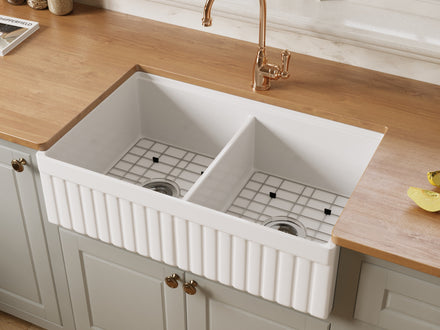
The Double Bowl Adds a Divider, Not Reach
The 50/50 double bowl runs the same 17¾ inches front to back as the 33-inch single bowls, so the reach math is unchanged.
What it adds is a divider and a second drain. The faucet needs enough swivel to serve both bowls, and the fixed stream must not sit so close to the divider that water rebounds into the neighboring basin or onto the counter.
Where Should the Water Stream Land?
In an open part of the bowl where the stream doesn't hit anything hard. Avoid aiming the fixed stream directly at the rear wall, the drain flange, a bottom-grid bar, the divider, a steep bowl transition or a workstation board.
The faucet does not need to line up with the drain. Alignment only helps when it also produces a comfortable working area — and a stream landing squarely on a metal flange will rebound.
Dead Center Is the Worst Place to Park the Spout
Run the numbers on a center-drain bowl and the problem shows up immediately.
A NOZLOO bowl is 17¾ inches front to back, so a center drain sits about 8⅞ inches from the inside rear wall. The 3½-inch opening puts the near edge of the flange at roughly 7⅛ inches.
Now bring in the reach. An 8⅝-inch spout — the figure the worked example produced — lands the stream 6½ inches into the bowl. That is barely ⅝ of an inch behind the flange. Push the reach to 9½ inches, the top of the shopping range, and the stream lands at 7⅜ inches: directly on the metal.
Fireclay is hand-finished to ±⅛ inch, and an aerated stream spreads as it falls. In practice, a spout parked dead center over a center-drain sink is aiming at the flange. Check your own sink's drawing, too — the closer the drain sits to the rear, the tighter this gets.
The fix costs nothing. Swivel the spout about 25 degrees off center. The landing point moves roughly three inches clear of the flange and into open floor, and the reach itself never changes. This is the cheapest thing you can do about splash, and it is why "line the faucet up with the drain" is bad advice.
The 30″ Grooved sidesteps the problem altogether: its drain sits rear-right, so the middle of the bowl is already open.

Window, Handle and Apron-Front Clearance
Keep four dimensions separate:
| Measurement | What it means |
|---|---|
| Overall height | Countertop to the faucet's highest point |
| Spout height | Countertop to the water outlet |
| Fixed reach | Faucet centerline to the outlet |
| Rear clearance | Room for the body and full handle travel |
Measure to the lowest obstruction — sash, crank, sill, blind, shutter, trim or shelf — and confirm how the window opens. A faucet can fit under a closed sash and still block it from opening inward. And with only four inches of counter behind the bowl, a handle can hit the backsplash before reaching full hot or cold even when the faucet body itself clears.
The Apron-Front Problem Nobody Mentions
An apron-front sink removes the countertop strip that normally separates you from the bowl, which brings the sink closer. But the faucet stays at the back — behind a 20-inch-deep sink and above a 10-inch apron.
- Prefer a side handle over a control mounted directly behind the spout
- Don't set the faucet farther back than necessary
- Check that the docked spray head is reachable without leaning over the bowl
- Consider touch or sensor operation if reach is a real constraint — but read the cabinet-space warning below first
This matters far more than visual height for shorter users, children, older homeowners and accessible kitchens.
Pull-Down vs. Pull-Out vs. Bridge
| Faucet type | Best fit | Main advantage | Main tradeoff |
|---|---|---|---|
| Pull-down | Most wide or deep single bowls | Best balance of default stream and extended rinsing | Needs vertical clearance and reliable docking |
| Pull-out | A sink beneath a low window | Low profile, strong horizontal movement | Less clearance for tall cookware; reads more contemporary than traditional |
| Bridge | A traditional or rustic farmhouse kitchen | Distinctive two-handle design with timeless appeal | Two holes at widespread spacing, a sprayer adds another, and no one-handed temperature control |
For most farmhouse sink faucets, pull-down is the default. Prioritize secure magnetic or positive docking, smooth retraction and a spray head that doesn't feel unnecessarily heavy. Over fireclay, docking matters more than a long list of spray settings.
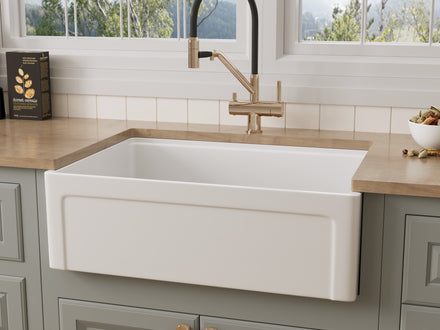
A pull-out's contemporary look can suit a modern farmhouse kitchen faucet scheme, but it will fight a strictly traditional room. A bridge faucet pairs naturally with white fireclay and brass — choose it for a deliberate design reason, not because "farmhouse" implies traditional. And remember that a bridge faucet's two holes and both handles have to fit inside the same four-inch strip.
Will a Pull-Down Sprayer Chip a Fireclay Sink?
Controlled everyday use should not. The risk is concentrated impact: fireclay's glaze is hard and rigid, and a heavy metal spray head dropped into an empty bowl or swung against the rim can chip it.
Choose reliable docking, smooth retraction, a head that isn't unnecessarily heavy, and use the bottom grid — every NOZLOO sink ships with one. Then guide the head back into its dock instead of releasing it above the bowl.
If Your Sink Is a Workstation Model
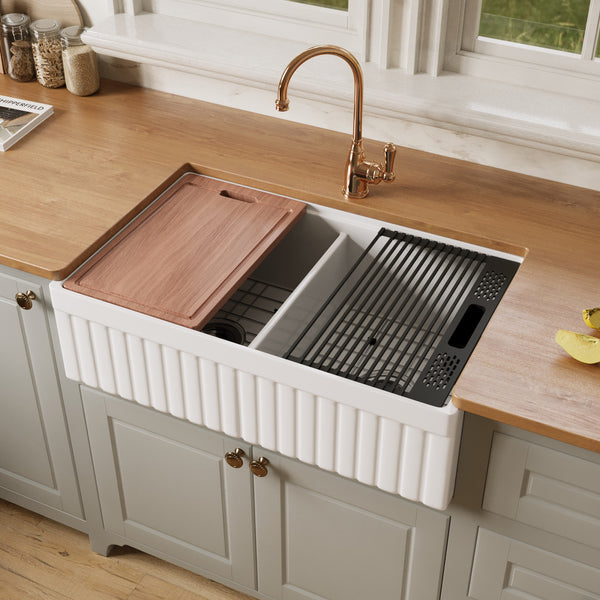
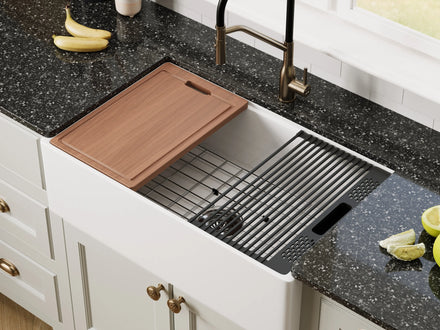
Five of the six NOZLOO models are workstations, and a workstation ledge puts a second working surface between the spout and the basin floor. It changes every faucet variable at once. Before committing to a spout height:
- Confirm the docked spray head clears the ledge and its track
- Check that the cutting board or roll-up rack doesn't sit directly under the fixed stream
- Make sure accessories can be lifted straight up and out without hitting the spout
- Verify the hose reaches far enough to rinse the ledge itself
The farmhouse sink accessories guide covers how grids, boards and racks affect everyday use.
Deck-Mount vs. Wall-Mount
A deck-mount faucet installs through the countertop or faucet deck. It is easier to specify, service and replace, and it is the right default for most kitchens.
A wall-mount keeps the counter clear — genuinely appealing when there is only four inches of it — but the rough-in height and spout projection must be fixed before the wall is closed. Insufficient projection sends water straight into the rear bowl wall, and correcting it later can mean opening the finished backsplash. Choose wall-mount only when the sink, wall and faucet are being planned together.
Installation Access Under a Farmhouse Sink
NOZLOO sinks run 100 to 115 pounds and are specified as a two-person lift. Once one is in, it takes most of the sink base. Support rails, shutoff valves, drain piping, a disposal, faucet hardware and the pull-down system all share what's left.
Install what you can before access disappears. Where the countertop and mounting sequence allow, attach the faucet or pre-connect its supply lines before the sink is raised into position. Reaching a faucet nut behind an installed fireclay sink is genuinely difficult. The correct order depends on the countertop material, so coordinate it with the fabricator rather than treating it as a universal rule.
Give the hose weight a clear vertical path. It can catch on support rails, countertop clips, shutoff valves, drain piping, a garbage disposal or a soap-dispenser bottle. Pull the spray head out fully and let it retract several times before the cabinet fills with cleaning products.
Check maximum deck thickness — and supply-line length. A 3-centimeter stone countertop plus a plywood buildup can exceed a faucet's listed mounting capacity, so compare the complete buildup, not just the visible stone. While you're there, confirm the supplied lines actually reach your shutoff valves around a sink that fills the cabinet. Both are cheap to solve in advance and miserable to discover on installation day.
If you want touchless, find the box a home first. Touch and sensor faucets add a control module, battery pack or power connection inside a cabinet the sink has already consumed — while the hose weight still needs a clear path through what remains. Confirm module dimensions, mounting orientation, cable length and battery access before choosing the faucet. Don't mount the box where the hose weight will strike it, or where batteries can't be changed without removing plumbing.
For the full cabinet-support and installation sequence, see How to Install a Fireclay Farmhouse Sink.
Splash Control: Why a Deep Farmhouse Sink Still Splashes
Depth alone is not the answer. A deep bowl can still splash. What matters is how far the water falls and what it hits.
The Total Water Drop
Total drop ≈ spout height + countertop thickness + bowl depth
An undermounted bowl hangs below the stone, so the countertop counts. NOZLOO bowls run from 8¾ inches on the 30″ Reversible to 9⅞ inches on the 33″ Reversible — a 1⅛-inch spread between sinks with the same 20-inch footprint.
Take a 10-inch spout height over 3cm stone:
- Over the 8¾″ bowl: 10 + 1.2 + 8.75 ≈ 20 inches of drop
- Over the 9⅞″ bowl: 10 + 1.2 + 9.875 ≈ 21.1 inches
A plywood buildup adds more. This doesn't predict splash on its own — water often strikes dishes or standing water first. But it lets you compare two faucets honestly. A higher outlet gives the stream more distance to gain speed before it reaches a hard surface. It is the single best reason not to buy the tallest faucet you can find.
Why Fireclay Rebounds
Fireclay sinks are molded with drainage pitch, but they have a broad usable floor and a hard glazed surface. Water arriving at speed on that glaze — or on a metal drain flange — rebounds more than it would off a steeper, softer wall.
The problem is usually the collision point, not insufficient depth.
A Bottom Grid Helps — and Hurts
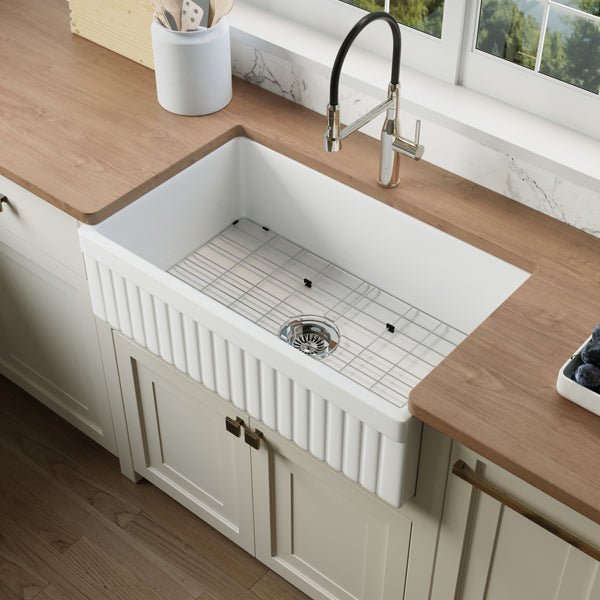
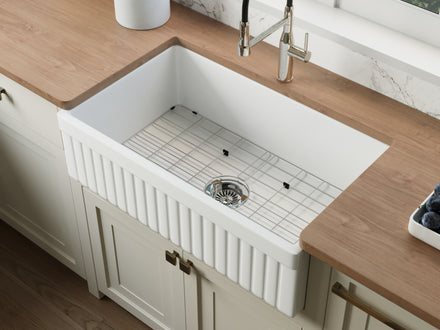
Every NOZLOO sink includes a fitted stainless grid. It protects the glaze from cookware and dropped utensils, and interrupts some impacts before they reach the basin floor.
But a stream aimed squarely at a metal bar breaks into fine spray. If a sink is already installed and splashing: before blaming the faucet, try reducing the flow, switching from a wide spray to an aerated stream, or shifting the landing zone between the bars.
Where Flow Rate Actually Fits
Flow is the last variable, not the first.
Under 10 CFR §430.32, the federal ceiling for a kitchen faucet is 2.2 gallons per minute at a flowing pressure of 60 psi. California's Title 20 Appliance Efficiency Regulations set a lower limit: 1.8 gpm at 60 psi, with an optional temporary increase to 2.2.
These are compliance ceilings, not performance promises. A California buyer may simply notice that filling a stock pot or a large farmhouse sink takes longer.
But a 1.8-gpm faucet will still spray if its narrow stream hits a grid bar, and a 2.2-gpm aerated stream can stay perfectly controlled landing in open water. Fix the landing point before worrying about the number.
Faucet Finishes for a White Fireclay Sink
Choose the finish after the measurements work. A white fireclay basin pairs with everything, so this is the one decision with no wrong answer.
| Finish | Overall effect | Practical consideration |
|---|---|---|
| Polished chrome | Bright and versatile | Shows water spots readily |
| Brushed nickel | Softer traditional or transitional look | More forgiving of fingerprints |
| Stainless-look | Coordinates with contemporary appliances | Undertones vary between brands |
| Matte black | The signature modern farmhouse look — strongest contrast against white | Mineral residue stays visible |
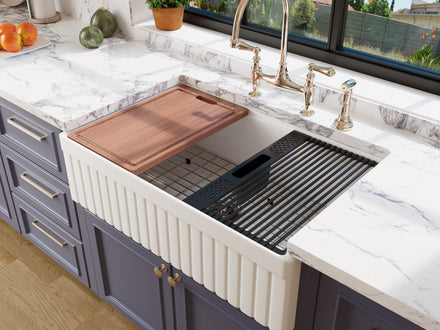
| Brass or aged brass | Warm, traditional and inviting | "Brass" is not a standardized color |
Compare the faucet against your actual cabinet pulls and lighting. Screens distort brass, bronze, black and stainless-look tones.
Plan Every Countertop Hole Before Fabrication
This is the only irreversible decision in the process — and you are planning it into a four-inch strip of stone.
The Hole Lands in a Window About an Inch Wide
Not just anywhere in those four inches. The faucet's mounting shank has to drop into open cabinet space — and the sink body starts at the four-inch mark. Drill any further forward and the bit meets fireclay.
Work it backwards from a standard 1⅜-inch faucet hole:
- Front limit. The hole's leading edge has to stay behind the sink's rear rim. On a 1⅜-inch hole, that caps the hole center at roughly 3¼ inches off the backsplash.
- Rear limit. The faucet's base plate and the swing of its handle need room behind them. That puts the practical floor at about 2 inches.
So the hole center lives in a window a little over an inch wide. It is enough — but it is not something to improvise on installation day, and it is one more reason to hand the fabricator a drawing rather than a description.
Configurations. A single-handle pull-down or pull-out usually needs one hole. A bridge faucet usually needs two, at widespread spacing. A compatible deck plate — also called an escutcheon — can cover unused holes and let some single-hole faucets work over an existing three-hole layout, but confirm the plate width against the actual hole spacing first. It cannot fix every layout.
Anything that may need its own hole: side sprayer, soap dispenser, filtered-water tap, instant-hot-water dispenser, dishwasher air gap.

Dishwasher Air Gap vs. High Loop
This is the hole people discover too late.
The requirement depends on which plumbing code your jurisdiction adopts. Areas following the Uniform Plumbing Code generally require an approved dishwasher air-gap fitting. California's Plumbing Code does so under §807.3, and that fitting needs its own hole in the countertop or sink deck.
The model 2024 International Plumbing Code instead permits the residential dishwasher waste line to rise and fasten to the underside of the sink rim or countertop — the "high loop" — which needs no deck hole at all.
Local amendments and appliance instructions vary. Confirm with your building department before the template is approved.
The Order to Work In
- Select the sink, then inspect and measure the physical piece on arrival.
- Select the exact faucet.
- Choose every dispenser, sprayer and auxiliary tap.
- Confirm the local dishwasher connection requirement.
- Review the sink and faucet specification sheets.
- Mark the holes on a template built from the actual sink.
- Check clearance above and below the counter.
- Approve fabrication only after the installer reviews the layout.
FAQs
What type of faucet is best for a farmhouse sink?
For most single-bowl farmhouse sinks, a swiveling pull-down. It gives you a useful fixed stream for routine work and hose reach for cookware and the outer areas of the basin. Choose a pull-out under a low window, or a bridge faucet for a deliberately traditional kitchen.
How far should a farmhouse sink faucet reach?
Around 8 to 9.5 inches of fixed reach is a useful starting range. For a 20-inch-deep sink in a standard 24-inch-deep cabinet, the faucet centerline typically sits about 2 to 2½ inches behind the inside rear wall — so 8 to 9.5 inches of reach lands the stream roughly 6 to 7 inches into the bowl. Calculate your own.
Why does fixed reach matter if the faucet pulls down?
Fixed reach controls where water lands during most daily tasks, with the head docked. Hose reach is for occasional extended work. You shouldn't have to pull out the sprayer every time you fill a glass.
Do farmhouse sinks need tall faucets?
No. A high arc adds cookware clearance but doesn't guarantee better reach — and it increases the total water drop, which can make splash worse. Choose the height that clears your window and cookware, nothing more.
Why does my farmhouse sink splash so much?
Usually not depth. It's the combination of a long water drop — often 20 inches or more from outlet to basin floor — and a hard collision point: the glazed floor, the drain flange or a metal grid bar. Move the landing zone before you change the faucet.
Does a 33-inch farmhouse sink need a longer faucet?
No. Every NOZLOO sink, 30-inch and 33-inch alike, is 20 inches front to back — and front-to-back depth, not width, is what drives reach. Extra width affects swivel and hose coverage instead.

Before You Order
Three numbers decide whether the faucet works. Everything else is a check.
Get these three right.
- Required fixed reach. Backsplash to the sink's rear edge, minus backsplash to the faucet hole, plus the rear wall thickness — then add the distance you want the stream to travel into the bowl. Compare the result against the faucet's technical drawing, never its photo.
- Total water drop. Spout height plus countertop thickness plus bowl depth. Once you're past twenty inches, splash is a design decision, not a faucet defect.
- Number of holes. Faucet, sprayer, soap dispenser, filtered tap — plus the dishwasher air gap if your code calls for one. This is the only number you cannot change later.
Then confirm.
- The faucet clears the window, and the window still opens
- The handle completes full hot-and-cold travel inside four inches of countertop
- The stream lands in open water with the bottom grid in place, not on a grid bar
- The hose reaches the front and corners, and the head docks clear of the workstation ledge
- The hose weight has an unobstructed vertical path inside the cabinet
- Supply lines reach the shutoff valves around a sink that fills the base
- The faucet's maximum deck thickness covers your stone plus any buildup
- If it's touchless, the control box and its batteries have somewhere to live
Then measure the sink you actually received. Fireclay is hand-finished, NOZLOO ships no paper template, and fired dimensions vary by ±⅛ inch. Use the 48-hour inspection window before the countertop is cut.
Choose the finish and style only after all of that works. That sequence prevents the expensive mistakes and still leaves room for a traditional, rustic or modern farmhouse kitchen.