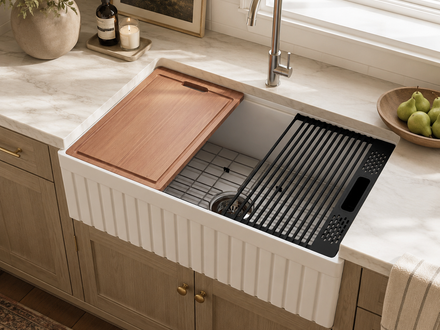
30 vs 33 Inch Farmhouse Sink: Which Should You Choose?

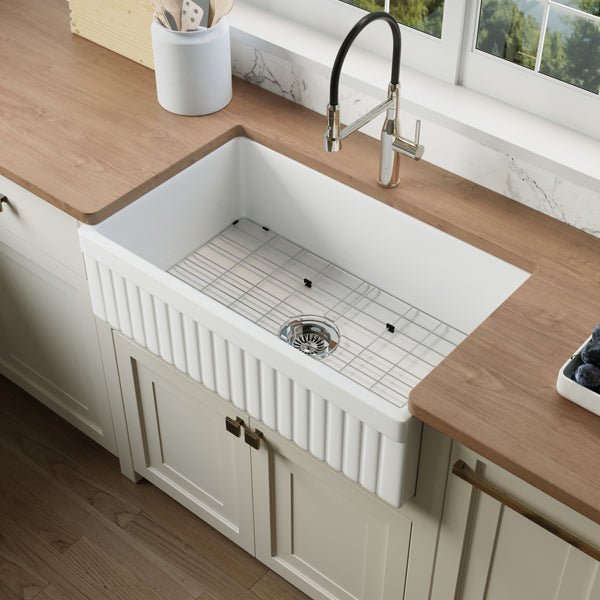
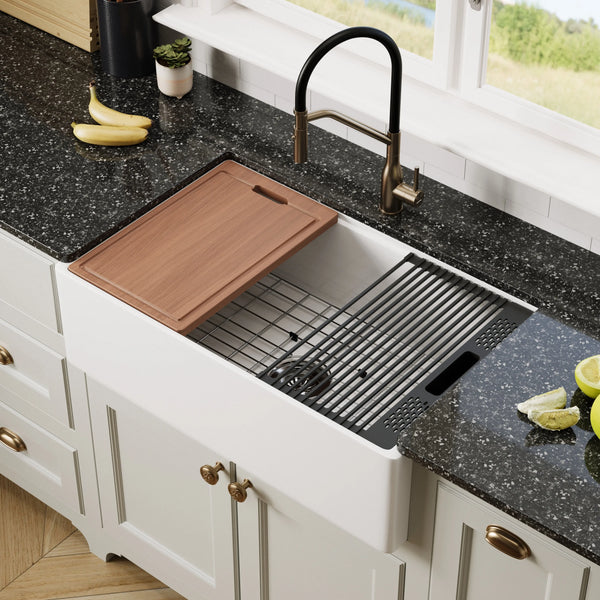
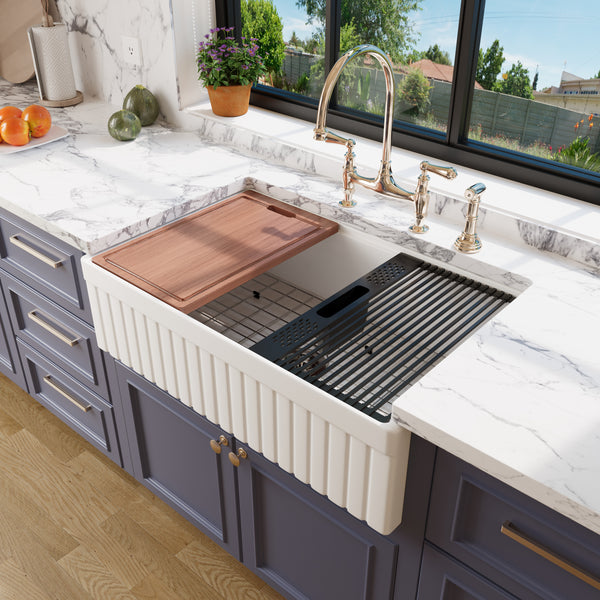
The 30 vs 33 inch farmhouse sink decision is not just about 3 inches. Those 3 inches can change how the apron front looks, how much counter space remains, whether a baking sheet fits comfortably, and how balanced the sink feels under a window or centered below a faucet.
For most kitchens, the better choice is not automatically the larger sink. A 30 inch farmhouse sink usually works better when the kitchen is compact, the cabinet run is shorter, or the sink needs to look proportional rather than dominant. A 33 inch farmhouse sink usually makes more sense when the cabinet, countertop, and kitchen layout can support the extra width.
If you are still comparing the terms themselves, see Nozloo’s farmhouse sink vs apron sink guide. This article focuses only on choosing between 30 inches and 33 inches.
Quick Answer
Choose a 30 inch farmhouse sink if your kitchen is smaller, counter space is limited, or you want a balanced apron-front look. It is also the cleaner choice for many 33 inch base cabinet layouts.
Choose a 33 inch farmhouse sink if you have the cabinet width, enough countertop around the sink, and a cooking routine that regularly involves sheet pans, large pots, or wide cutting boards.
The simplest rule:
| Choose 30 inches if... | Choose 33 inches if... |
|---|---|
| You want better kitchen proportion | You want more basin room |
| You have a tighter cabinet run | You have a wider cabinet run |
| Counter space matters more | Washing space matters more |
| You mostly use a dishwasher | You hand-wash large cookware often |
| The sink sits near a dishwasher or tight side panel | The sink has visual room on both sides |
Real Specs: 30 vs 33 Inch Farmhouse Sink
Hard numbers make this decision clearer. Here is a practical comparison using current Nozloo fireclay farmhouse sink models.
| Spec | 30 Inch Single Bowl | 33 Inch Single Bowl | 33 Inch Double Bowl |
|---|---|---|---|
| Typical outer size | 30″ × 20″ × 10″ | 33″ × 20″ × 10″ | 33″ × 20″ × 10″ |
| Inner bowl | 27-7/8″ × 16-3/4″ × 9″ | 30-7/8″ × 16-3/4″ × 9″ | 15″ × 17-3/4″ × 9″ each bowl |
| Minimum cabinet | 33″ base cabinet | 36″ base cabinet | 36″ base cabinet |
| Bowl layout | Single bowl | Single bowl | 50/50 double bowl |
| Sink weight | 100 lbs | 110 lbs | 115 lbs |
| Crated weight | ~115 lbs | ~120 lbs | ~130 lbs |
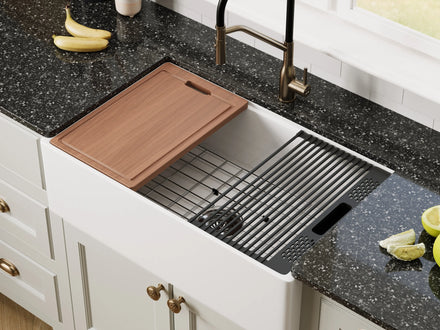
| Nozloo price examples (July 2026) | $549 | $519 smooth workstation; $479 standard reversible model in the 33″ collection | $599 workstation double bowl |
| Best use case | Compact kitchens, smaller households, counter-space priority | Larger kitchens, frequent cooking, open-basin washing | Users who want separate washing and rinsing zones |
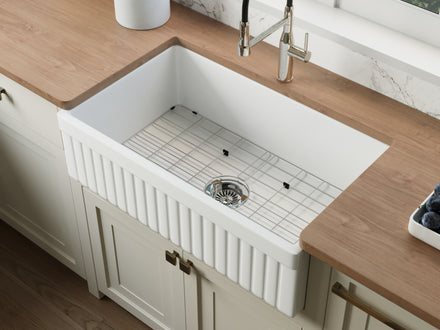
A standard half sheet pan is commonly 18″ × 13″, according to Serious Eats’ guide to sheet pan sizes. Since Nozloo’s 30 inch single bowl has an inner bowl of 27-7/8″ × 16-3/4″, a half sheet pan can usually sit within the bowl footprint. The 33 inch single bowl does not change that yes/no answer. It mainly gives you more side-to-side working room for rinsing and scrubbing.
If you are ready to compare models, Nozloo’s 30 inch fireclay farmhouse sink is the better starting point for 33″ base cabinets, while the 33 inch fireclay farmhouse sink is built around 36″ base cabinets.
Cabinet Width: Important, But Keep It Simple
Cabinet width is the first filter before choosing any farmhouse sink. For Nozloo’s current fireclay farmhouse sinks, the practical planning direction is simple:
- 30″ sink → usually planned for a 33″ base cabinet
- 33″ sink → usually planned for a 36″ base cabinet
That is enough for this article. The full cabinet explanation belongs in Nozloo’s fireclay farmhouse sink cabinet size guide, because actual fit still depends on interior width, face frame, apron cutout, support frame, drain placement, and countertop template.
For this 30 vs 33 decision, cabinet width tells you what is realistic. Kitchen proportion tells you what will look right.
Will a 30 Inch Sink Look Weird in a 36 Inch Cabinet?
Not necessarily. This is one of the most common real-world concerns because some homeowners order a 30 inch apron front sink, then find out their cabinet is 36 inches wide.
A 30 inch farmhouse sink in a 36 inch cabinet can look fine if the surrounding cabinet doors, filler panels, countertop, and faucet are balanced. In some kitchens, it even looks better than forcing a larger sink because the apron front has breathing room.
It may look off only if the filler area is poorly handled or if the cabinet front makes the sink look unintentionally undersized. This is a design-detail issue, not a strict size rule.
Choose 30 inches in a 36 inch cabinet when:
- You want more counter space
- You prefer a less dominant apron front
- The kitchen is small or medium-sized
- The sink sits near a dishwasher
- You do not want the sink to visually fill the whole cabinet bay
Choose 33 inches instead when:
- The wider apron front looks more proportional
- The sink wall is wide enough
- The kitchen has larger surrounding cabinetry
- You want more usable basin width for hand washing
When a 30 Inch Farmhouse Sink Is the Better Choice
A 30 inch farmhouse sink often works best when the kitchen needs balance. Farmhouse sinks already create strong visual weight because of the exposed apron front. In a smaller room, the sink does not need to be oversized to feel intentional.
Choose 30 inches when your kitchen has:
- A small kitchen footprint
- A short countertop run
- A narrow island
- Limited counter space beside the sink
- A dishwasher close to one side
- A window or faucet area that needs careful centering
- A design where the apron should feel classic, not oversized
A 30 inch sink is also practical for households that use the dishwasher for most plates and bowls. You still get a deep basin for daily washing, but you preserve more working area around the sink.
This size is especially useful when the cleanup zone has to do several jobs at once: rinsing produce, staging dishes, holding a cutting board, and leaving enough counter for prep.
When a 33 Inch Farmhouse Sink Makes More Sense
A 33 inch farmhouse sink is the better choice when the kitchen has the cabinet width and visual scale to support it. It gives the apron front more presence and makes the bowl feel more generous during washing.
Choose 33 inches when your kitchen has:
- A 36 inch base cabinet or wider compatible cabinet
- A longer sink wall
- More countertop on both sides
- An open kitchen layout
- A larger island
- A family cooking routine
- Frequent hand washing of large cookware
The extra width is most noticeable in a single bowl layout. A 33 inch single bowl gives pans and cutting boards more room to sit flatter, which makes rinsing and scrubbing feel less awkward.
A 33 inch farmhouse sink also works better when the sink is meant to be a focal point. In a larger kitchen, a 30 inch apron front can sometimes look too restrained, especially under a wide window or between larger base cabinets.


What About 20", 24", 27", 36", and 42" Farmhouse Sinks?
Quick answer: these sizes exist, but almost never in fireclay. There's a reason nearly every fireclay farmhouse sink you can actually buy is 30 or 33 inches wide, and it isn't laziness on the part of manufacturers.
On the small end, a 20 inch farmhouse sink or 24 farmhouse sink is almost always a stainless steel bar or prep sink. Same with a 27 inch farmhouse sink — it's a niche size, mostly stainless or made to order. An apron front at that scale is a style detail for a wet bar or butler's pantry, not a main kitchen sink. Fireclay makers rarely produce these widths because the demand is small and the tooling is not.
On the big end, the problem is physics. Our 33 inch sinks already weigh 100 to 115 lbs with 1-inch fireclay walls. Stretch that to a 36 farmhouse sink or a 42 farmhouse sink in a single bowl and the piece gets harder to fire without cracking, harder to ship intact, and heavy enough that the base cabinet needs real reinforcement — which you pay for. That's why the market mostly routes big-sink shoppers to a 33 inch double bowl instead, or to custom copper and stainless for anything wider.
| Size | What you'll actually find | Our advice |
|---|---|---|
| 20″–24″ | Stainless bar and prep sinks; fireclay is rare | Fine for a wet bar. For a main sink, go 30″ in a 33″ cabinet |
| 27″ | Niche size, mostly stainless or custom orders | If the run allows a 33″ base cabinet, step up to a 30″ sink and get a real main sink |
| 36″ | Some stainless; fireclay single bowls are scarce | A 33″ double bowl in a 36″ cabinet covers the same jobs with less weight risk |
| 42″ | Mostly custom copper or stainless | Custom territory. For a stock fireclay sink, 33″ is the practical ceiling |
Our take: skip the outlier widths unless you're outfitting a bar or commissioning a custom piece. Fireclay does its best work at 30 and 33 inches, and the cabinet math is already settled. And if you landed here hoping for a 36 inch sink, there's a silver lining: your 36″ cabinet is exactly what our 33 inch models are built for — single or double bowl, your call.
Counter Space: The Hidden Tradeoff
The 3-inch difference matters most when countertop space is already tight. Around the sink, counter space is not just empty surface. It is where you stage dishes, rinse vegetables, rest a coffee mug, dry accessories, or place cookware before washing.
The NKBA Kitchen Planning Guidelines recommend at least 24 inches of landing area on one side of a cleanup/prep sink and at least 18 inches on the other. Using that as a planning reference, the sink zone needs about 42 inches of landing space around the sink.
That creates a useful measurement:
- 30 inch sink + 42 inches of landing area = about 72 inches of sink-zone width
- 33 inch sink + 42 inches of landing area = about 75 inches of sink-zone width
This does not mean every kitchen must have exactly that much counter. It means the 3-inch difference becomes more important in a tight layout. If a 33 inch farmhouse sink leaves too little room on one side, the 30 inch sink may work better in daily use. In a larger kitchen, those same 3 inches may be worth giving up because the wider bowl adds more cleaning room without crowding the countertop.
Single Bowl Capacity: Where 33 Inches Feels Different
In a single bowl farmhouse sink, 33 inches feels different because the basin is more open side to side.
A 30 inch single bowl is usually enough for:
- Everyday dishes
- Mixing bowls
- Normal pans
- Produce washing
- Moderate cleanup
- Smaller households
A 33 inch single bowl is more comfortable for:
- Sheet pans
- Wide cutting boards
- Large pots
- Roasting pans
- Deep skillets
- Refrigerator drawers
The point is not just capacity. It is working angle. A wider bowl gives bulky items more room to lie flat, so you spend less time tilting cookware against the apron, faucet side, or basin wall.
What If You Prefer a Double Bowl?
A double bowl changes the size decision. A 30 inch double bowl can feel tight because each side loses interior width. That may be acceptable for light washing, but it is not ideal for wide pans or baking sheets.
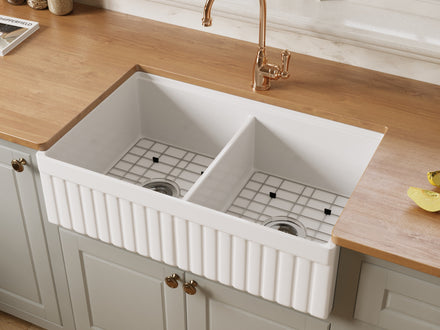
A 33 inch double bowl gives each side more practical room. Nozloo’s 33 inch 50/50 double bowl model lists each basin at 15″ × 17-3/4″ × 9″, which is better for separating washing, rinsing, soaking, and prep.
Choose a 33 inch double bowl if you care more about task separation than open space. Choose a 33 inch single bowl if large cookware flexibility matters more.
Dishwasher Next to the Sink: Should You Still Go 33 Inches?
If the dishwasher sits directly beside the sink cabinet, do not choose only by maximum sink size. This is where 30 inches can be the smarter choice.
NKBA’s planning guidance recommends placing the primary dishwasher within 36 inches of the nearest edge of the cleanup/prep sink. It also recommends at least 21 inches of standing space between the dishwasher edge and cabinets, appliances, or countertop placed at a right angle.
In a tight cabinet run, a 30 inch farmhouse sink may preserve more side structure and make the dishwasher zone feel less crowded. In a wider run, a 33 inch sink can still work well as long as the dishwasher door, cabinet side panel, support frame, and countertop support are planned before the countertop is cut.
For many tight sink-and-dishwasher layouts, 30 inches is not a downgrade. It is the cleaner fit.
Window, Faucet, and Centering Concerns
Another real concern is whether the sink will look centered under a window or faucet. This is not only about sink width. It is about the relationship between the sink, cabinet front, faucet, window trim, backsplash, and surrounding drawers or doors.
A 30 inch farmhouse sink can look better if the window is narrow or the faucet area is tight. A 33 inch farmhouse sink can look better if the window is wide, the sink wall is broad, and the apron front needs stronger visual presence.
Before choosing, check:
- Is the faucet centered on the sink or on the window?
- Does the apron front align with cabinet doors below?
- Will a wider sink make one side of the counter feel cramped?
- Does the sink look balanced with the backsplash and window trim?
If the faucet, window, and cabinet front do not align perfectly, choose the size that makes the whole wall look intentional. Do not choose 33 inches only because it is bigger.
Bowl Depth, Drain, and Under Sink Storage
Width is only part of how the sink feels. Bowl depth and drain location also affect comfort, storage, and cleanup.
Most Nozloo 30 inch and 33 inch fireclay farmhouse sinks use a 9 inch bowl depth, which is deep enough for daily cookware without becoming unnecessarily hard to reach. If you are comparing 7, 8, 9, and 10 inch basins, read Nozloo’s farmhouse sink depth guide.
Under sink storage depends on more than width. A deep bowl, center drain, garbage disposal, and support frame can all reduce usable cabinet space. A 30 inch sink may preserve a little more cabinet room, but the final result depends on the full installation plan.
Do Materials Change the 30 vs 33 Decision?
Not much. Farmhouse sinks come in fireclay, cast iron, stainless steel, granite composite, and other materials. Material affects weight, finish, scratches, and maintenance, but it should not be the main reason to choose 30 inches or 33 inches.
For heavy materials like fireclay and cast iron, confirm the support frame and cabinet reinforcement before installation. Then choose the width based on cabinet fit, kitchen proportion, counter space, and washing habits.
30 vs 33 Inch Farmhouse Sink: Decision Table
| Question | Better Choice | Why |
|---|---|---|
| I have a 33″ base cabinet | 30 inch | Better cabinet compatibility for many apron front sinks |
| I have a 36″ base cabinet | 30 or 33 inch | Choose based on proportion and basin needs |
| I cook often with large pans | 33 inch | More open width for washing |
| I mostly use the dishwasher | 30 inch | Enough daily capacity, more counter space |
| My dishwasher is directly beside the sink | Often 30 inch | Leaves more room for side support and spacing |
| My sink sits under a narrow window | Often 30 inch | Easier to keep the wall visually balanced |
| My sink sits under a wide window | Often 33 inch | Wider apron front may look more proportional |
| I want a double bowl | Usually 33 inch | Each bowl gets more usable space |
| I want a quieter visual look | 30 inch | Apron front feels less dominant |
| I want the sink as a focal point | 33 inch | Stronger visual presence |
Final Recommendation
Choose a 30 inch farmhouse sink if the kitchen is smaller, the counter run is tight, the dishwasher is close, or you want the apron front to feel balanced. It is not the compromise size. In the right kitchen, it is the more proportional choice.
Choose a 33 inch farmhouse sink if the cabinet and countertop layout can support the extra width and you want more room for sheet pans, large cookware, and family cleanup. It is the better choice when the sink should feel generous and visually substantial.
The better size is not the bigger one. It is the one that fits the cabinet, preserves enough counter space, centers well with the faucet or window, and matches how you actually use the kitchen sink.
FAQ
Is a 30 inch farmhouse sink too small?
No. A 30 inch farmhouse sink is not too small for many kitchens. It works well in smaller layouts, medium kitchens, and homes where most dishes go into the dishwasher. It may feel limiting only if you regularly hand-wash wide cookware or large baking sheets.
Is a 33 inch farmhouse sink too big for a small kitchen?
Sometimes. A 33 inch farmhouse sink can feel too large if it reduces counter space, crowds the dishwasher side, or makes the apron front dominate the cabinet run. In a small kitchen, a 30 inch farmhouse sink often looks more balanced.
Can a half sheet pan lie flat in a 30 inch farmhouse sink?
Usually, yes, if the sink has an open single bowl. A half sheet pan is commonly about 18″ × 13″, while Nozloo’s 30 inch single bowl has an inner bowl of 27-7/8″ × 16-3/4″ × 9″. The 33 inch single bowl gives more extra room around the pan, so rinsing and scrubbing feel easier.
Does a 33 inch farmhouse sink cost more than a 30 inch?
Not always. Based on Nozloo’s current listed examples, the 30 inch workstation models are listed at $549, while 33 inch options range from $479 for a standard reversible apron model to $599 for a double bowl workstation model. Price depends more on bowl layout, apron style, and included workstation accessories than on width alone.
Should I choose 30 or 33 inches for a single bowl farmhouse sink?
Choose 30 inches if you want balance, counter space, and a cleaner fit in tighter layouts. Choose 33 inches if you cook often and want more room for sheet pans, large pots, roasting pans, and wide cutting boards.