Farmhouse Sink Laundry Room Layouts: Wall Width and Cabinet Size
Plan a farmhouse sink laundry room: a 30-inch fireclay sink needs a 33-inch base, and side-by-side machines push the wall to about 87 inches.

In this guide View sections +
A farmhouse sink laundry room works well if your wall is wide enough and your cabinet is built for the weight. The sink does the job of a utility sink with a finished look. A 30-inch fireclay apron sink needs a 33-inch sink base. Put that base between two 27-inch machines and you need about 87 inches of wall before any gaps.
This guide walks through the wall math for your laundry space, the depth and height checks, the plumbing, and how a glazed fireclay bowl holds up to laundry chores. NOZLOO sizes below come from our product spec sheets.
Can you put a farmhouse sink in a laundry room?
Yes. A kitchen-style apron sink makes a strong laundry room sink, as long as you plan it like a kitchen install. That means a sturdy base cabinet, a counter cut to fit, and a real drain line.
What you get in return:
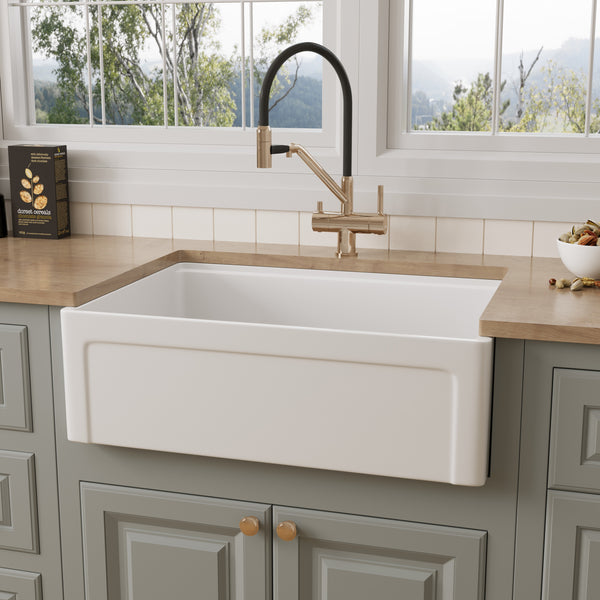
- A wide, deep single bowl. Our 30-inch models measure about 27-13/16 by 18-1/16 inches inside, with a bowl depth of 8¾ to 8⅞ inches. That is room for a soaking bucket, a muddy boot, or a full sweater.
- An apron front. The front of the sink is exposed. You can stand close to the basin without leaning over a cabinet face.
- A finished look. The laundry room stops looking like a utility room. That matters in a farmhouse laundry room, a mudroom combo or a room off the kitchen.
The tradeoff is size and weight. A plain plastic utility sink is light and narrow. A fireclay apron sink weighs 100 to 115 pounds on its own and needs a 33-inch base. If your wall cannot spare that width, read the stacked layout section below first.
How much wall does a farmhouse laundry room need?
Plan on about 87 inches of wall for a side-by-side layout with a farmhouse sink, plus clearances. Most full-size front-load washers and dryers are about 27 inches wide. Check your exact models on their spec sheets.

Here is the basic math:
- Washer: 27 inches
- Sink base for a 30-inch sink: 33 inches
- Dryer: 27 inches
- Total: 87 inches (7 feet 3 inches)
Then add what the machines need. Each installation manual lists its own side clearance. Also leave a little room at each end wall to slide the machines in and out. Walls are rarely perfectly square, so a few inches of slack saves a lot of fuss.
Laundry room sink layouts
| Layout | Wall width before gaps | Best for |
|---|---|---|
| Washer, sink, dryer (sink in the middle) | 87 in | A long wall where you want to move wet clothes left and right |
| Sink at one end, machines side by side | 87 in | Keeping the sink near a door or window |
| Stacked washer and dryer plus sink | 60 in (27 + 33) | Narrow rooms and closets |
| Sink on its own wall | 33 in for the sink base | Mudrooms and L-shaped rooms |
A center laundry room sink splits the machines, which means two separate counter runs. A sink at one end keeps the machines together and gives you one long run of counter space for folding. The stacked plan is the space saver. It frees about 27 inches of wall in a small laundry space for a hanging rod or a tall cabinet.
Cabinet size for a laundry room sink
Match the cabinet to the sink, not the other way around. NOZLOO 30-inch sinks need a 33-inch sink base. Our 33-inch sinks need a 36-inch base.
For most laundry rooms, the 30-inch single bowl farmhouse sink is the better fit. It saves 3 inches of wall over a 33-inch sink, and the bowl is still wide enough for soaking and hand-washing. Choose a 33-inch farm sink only if you have the wall and want a bigger basin for pet baths or large bins.
Use a true farmhouse sink base, not a standard base with a cut-down face. The base needs:
- A support frame. The sink rests on a frame or cleats tied to the cabinet sides. The countertop should not carry the load.
- An open front. The apron replaces the top drawer area, so the cabinet face is cut to the sink's apron height.
- Level sides. Laundry room floors are often out of level, especially near a floor drain. Shim the cabinet level before the sink goes in.
Our cabinet size guide covers the frame build in detail. If you are torn between sizes, the 30 vs 33 inch comparison lays out the tradeoffs.
Lining up the sink, machines and counter space
A laundry room sink will probably not line up on its own, so plan for it. Sink cabinets and laundry machines use different depths and heights.

Depth
Our 30-inch farmhouse sinks are 20 inches front to back. A standard base cabinet is 24 inches deep. Front-load machines are often deeper once you count the door, the hoses and the vent. Check your spec sheets and add room for hose and vent bends behind the machines.
You have two choices. Pull the sink cabinet forward to align the faces, or accept a step between them. If you pull the cabinet forward, fill the gap at the back with a deeper counter. That extra ledge is handy for detergent bottles.
Height
A standard sink base gives you a counter about 36 inches high. Many full-size front-loaders are taller than that. So one continuous counter over the machines and the sink often does not work.
Measure the machine height, then add the top clearance from its manual. If that number is above 36 inches, step the counter. Keep the sink counter at 36 inches and raise the folding counter over the machines. Or skip the counter over the machines and use a shelf above them instead.
Aisle and doors
Front-load doors swing out into the room. Leave enough floor space to open both doors fully and still stand at the sink. If the room door swings in, check that it clears the open machine doors too.
How to plumb a laundry room sink
Give the sink its own drain and trap, and give the washer its own standpipe or laundry box. Do not let the washer pump empty into the farmhouse sink.
There are good reasons to keep them apart:
- Lint. Washer water carries lint. It can build up in the sink's trap and slow the drain.
- Volume and overflows. A washer pumps out a lot of water at once, often faster than a sink strainer and trap can take it. Then the sink spills onto the floor.
Many US jurisdictions base residential plumbing rules on the International Residential Code. Others, including California, use the Uniform Plumbing Code. Your local version sets trap, vent and standpipe details. Hire a licensed plumber or check with your building department before you open the wall.
For the sink itself, our plumbing rough-in guide shows where the drain, trap and shutoffs usually go. Laundry rooms often have the hot and cold supply valves high on the wall for the washer. You can tee off those lines for the sink faucet in many cases. Ask your plumber what your local code allows.
Picking a faucet
Farmhouse sinks have no faucet holes. The faucet mounts in the counter behind the sink or on the wall. For laundry work, look for:
- A tall spout, so a bucket fits under it
- A pull-down sprayer, for rinsing boots and the bowl itself
- Enough reach to hit the center of the bowl
A wall-mount faucet saves counter depth in a tight laundry room. It also needs supply lines inside the wall, so plan it before drywall. See our farmhouse sink faucet guide for reach and height numbers.
Is fireclay good for a utility sink?
Yes, for most laundry chores. The bowl is fired with its glaze at about 2,200°F. That fuses the glaze to the clay body. The result is a dense, non-porous surface.
Here is what that means day to day:
- Detergent and dye. Spills sit on top of the glaze instead of soaking in. Rinse them off soon, and the bowl wipes clean.
- Stain pretreating. Pretreat sprays and soaps rinse away. Do not leave strong products sitting on the glaze for hours. Rinse the bowl when you are done.
- Mud and grit. Rinse grit away before you scrub. Use a soft sponge, not steel wool. Our fireclay cleaning guide lists safe cleaners.
There are honest limits too. Fireclay resists chipping in normal use, but a dropped iron, paint can or tool can still damage the glaze. And avoid pouring boiling water straight into a cold sink. Run warm tap water first, or let hot water cool a little before you pour it.
The walls of the bowl are about 1 inch thick. That thickness gives the sink its weight and its solid feel. It is also why the cabinet support matters so much.
Using the workstation kit in a laundry room
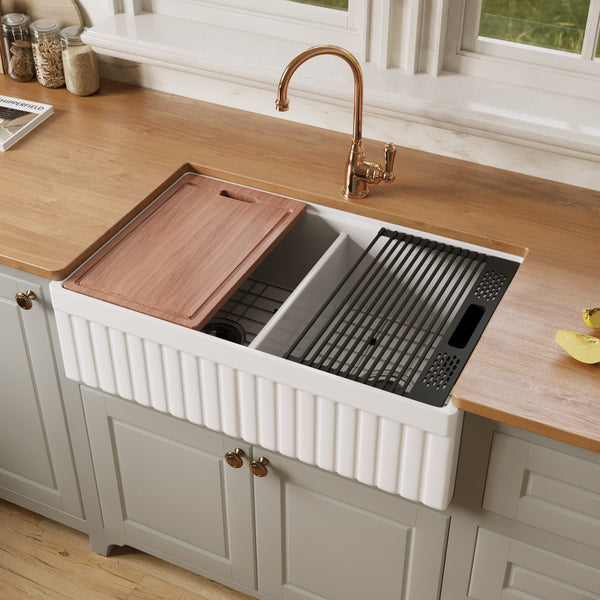
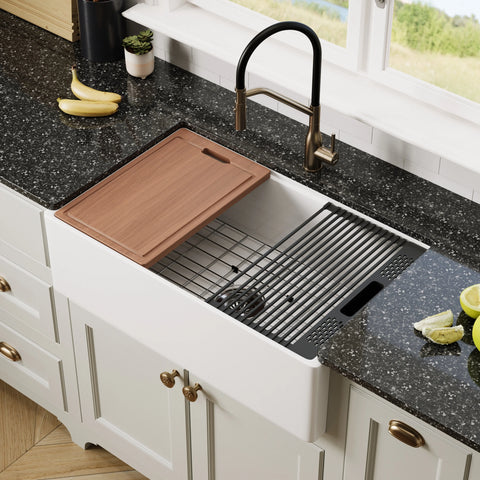
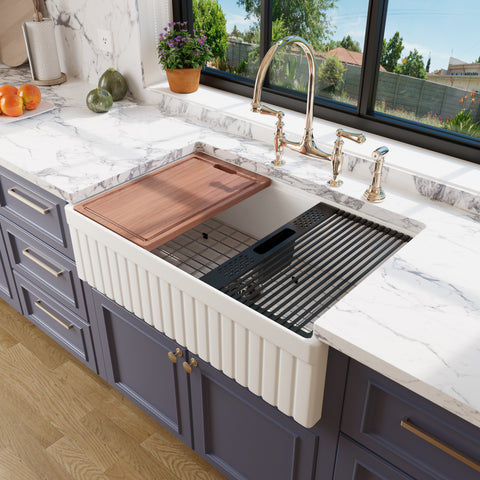
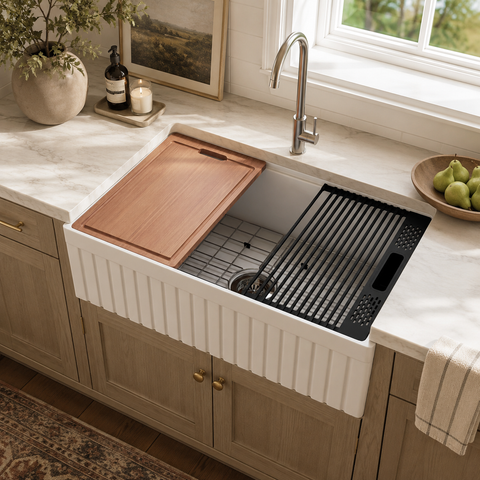
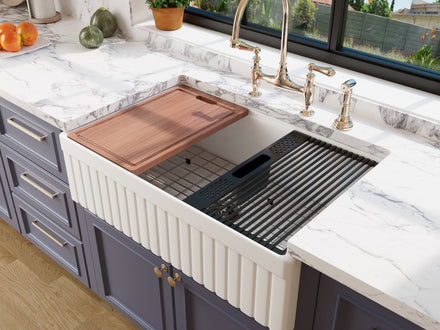
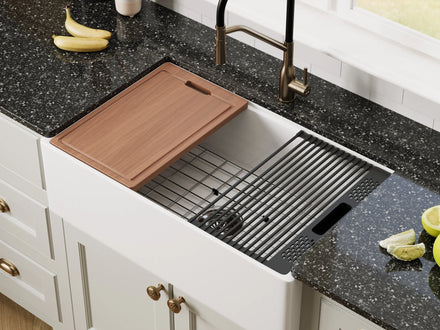
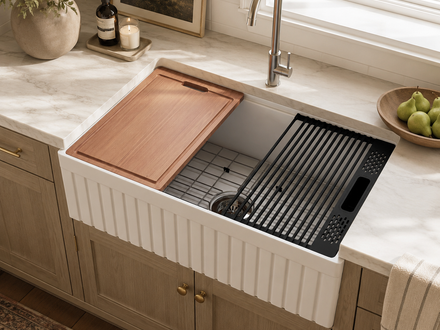
Better than you might expect. Our 30-inch workstation sinks come with a four-piece kit: a roll-up drying rack, a bottom grid, a sapele cutting board and a colander. They ride on ledges inside the single bowl, and three of them are useful in a laundry room.

- Roll-up rack. Lay it across the bowl. A hand-washed sweater or a pair of gloves can drip-dry right over the drain. Nothing drips on the floor.
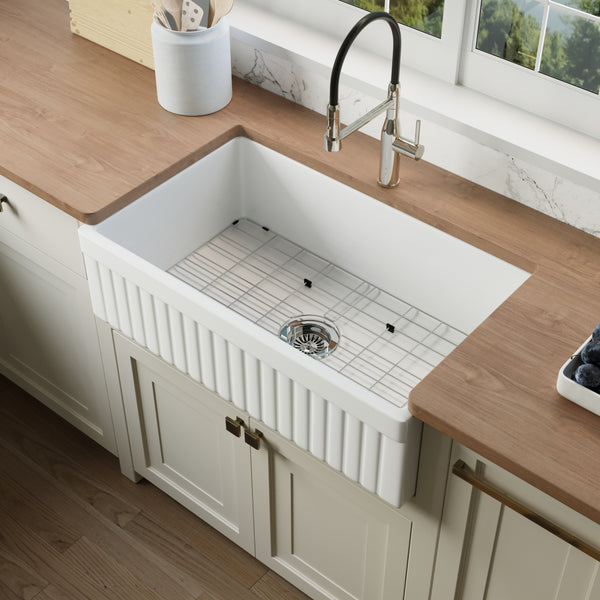
- Bottom grid. It lifts items off the bowl floor. Set a soaking bucket or a muddy boot on it. It also puts a buffer between hard objects and the glaze.
- Cutting board. Slide it over part of the bowl as a small shelf for a spray bottle or stain brush. Dry it after use, since it is wood.
The rack also rolls up and stores in a drawer when you need the full bowl. The accessories carry a 1-year accessory warranty. Learn more in our workstation accessories guide.

Choosing a sink style for a laundry room
Pick the sink style that matches the rest of the house. The laundry room usually sits next to a kitchen, a mudroom or a hall, so it should feel like part of the same home.
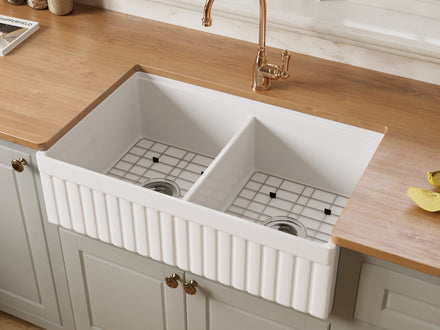
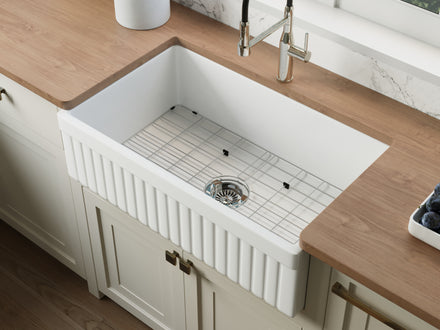
- Grooved. A recessed groove runs around the apron face. It reads clean and a bit traditional. It works well in transitional rooms with Shaker cabinets.
- Fluted. Vertical ribs add texture and shadow. They suit cottage rooms and a farmhouse laundry room with beadboard or painted cabinets.
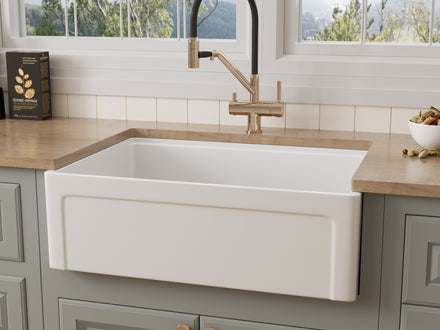
- Smooth. A plain face suits modern rooms with flat-panel cabinets.
Both of our 30-inch single bowl models are reversible: grooved or fluted on one face, smooth on the other. You choose the side before install. Switching later means pulling the sink and may mean countertop work. Our apron styles guide shows each one up close.

How to measure before you order
Measure the whole laundry room, not just the wall. Write each number down and check it against the spec sheets for the farmhouse sink and both machines.
- Wall width. Measure at the floor, at 36 inches and at 60 inches. Use the smallest number.
- Machine widths and depths. Use the spec sheet numbers, including the door and the hose space.
- Machine height. Add the top clearance from the manual. Compare it with your planned counter height. If you are replacing machines, check the new models' widths and heights on the ENERGY STAR clothes washer list before you lock in the wall plan.
- Sink base. Allow 33 inches for a 30-inch sink or 36 inches for a 33-inch sink.
- Drain and supply lines. Mark where they come through the wall. Note the floor drain if you have one.
- Doorways and halls. The sink alone weighs 100 to 115 pounds, and the packaging adds more. Plan the path and line up a second person to carry it.
Our step-by-step measuring guide covers the sink side in more detail. Then follow the fireclay install guide for the cabinet and counter work.

Is a farmhouse sink worth it in a laundry room?
A farmhouse sink is worth it if you use the laundry room sink often and have the wall to spare. Think about how you would use it in a normal week.
- Good fit: you want more than a utility sink, you hand-wash knits, soak sports gear, rinse muddy boots, wash a small dog, or want the room to match your kitchen.
- Weak fit: a basic utility sink would cover your needs, the sink would sit unused, the wall is under about 87 inches with side-by-side machines, or you cannot build a proper sink base.
The farmhouse sink body carries a Limited Lifetime Warranty for the original purchaser in a home. Inspect the sink within 48 hours of delivery and report any issue. That window protects you before the install begins.
Frequently asked questions
Can you put a farmhouse sink in a laundry room?
Yes. A kitchen-style apron sink works well in a laundry room if the wall is wide enough and the cabinet is built to carry it. A 30-inch fireclay sink needs a 33-inch sink base with a support frame. The deep, wide bowl handles soaking, hand-washing and rinsing boots. Plan the drain, faucet and counter just as you would in a kitchen.
How much wall space do you need for a washer, dryer and farmhouse sink?
For side-by-side machines, plan on about 87 inches before clearances. That is two 27-inch machines plus a 33-inch base for a 30-inch sink. Add the side clearances from your machine manuals and a little slack at each wall. With stacked machines, the same sink fits in about 60 inches of wall.
Should the washer drain into the farmhouse sink?
It is better not to. Give the washer its own standpipe or laundry box and the sink its own trap. Washer water carries lint that can clog a sink trap. A pump can also push out water faster than the sink drains. Your local plumbing code sets the exact rules, so check with a licensed plumber.
Is fireclay good for a laundry sink?
Fireclay works well for most laundry chores. The glaze is fused to the clay at about 2,200°F, which gives a dense, non-porous surface. Detergent, dye and mud rinse off rather than soaking in. It resists chipping in normal use, but a dropped heavy tool can still damage it. Avoid pouring boiling water into a cold bowl.
What size farmhouse sink is best for a small laundry room?
A 30-inch sink is usually the best choice for a small laundry room. It fits a 33-inch base, saving 3 inches over a 33-inch sink. The bowl is still about 27-13/16 by 18-1/16 inches inside, with a depth of 8¾ to 8⅞ inches. If the wall is tight, stack the machines to free space.
Ready to plan your own laundry wall? Browse our fireclay farmhouse sink collection to compare the 30-inch and 33-inch models, their apron options and the included workstation kits.