Farmhouse Sink in Bathroom Vanities: Width, Height and Support
A 30-inch farmhouse sink fits a bathroom only in a 36-inch or wider vanity. Here is the width, depth, height, faucet, drain and support math.

In this guide View sections +
Can you put a farmhouse sink in bathroom vanities? Yes, but only in the right one. A 30-inch fireclay apron front sink measures 30 x 20 x 10 inches and needs a sink base at least 33 inches wide.
That rules out the common 24- and 30-inch bath vanities, which suit a standard bathroom sink. It fits a 36-inch or wider single vanity. For two farmhouse sinks, plan on a 72-inch vanity.
The width is only the first check. A farmhouse sink in a bathroom also changes your faucet, your drain, your storage and how far you bend. This guide works through each one with real numbers, so you can decide before you buy a vanity or cut a countertop.
The payoff is the farmhouse look: a white apron front becomes the focal point of the vanity.
When a farmhouse sink works in a bathroom
It works when four things line up. If any one fails, a standard bathroom sink is the better choice.
- Width: the sink section of the vanity is 33 inches or wider.
- Depth: the vanity is 22 to 24 inches deep, or the faucet mounts on the wall.
- Support: the cabinet can carry a 100 to 115 lb farm sink plus a full basin of water.
- Height: the vanity height suits the people who use it most, since the bowl is deep.
For a farmhouse bathroom, primary baths, large hall baths, and a laundry room that doubles as a bath are the best fits. Small powder rooms rarely are.
What size vanity fits a farmhouse sink?
A 30-inch farmhouse sink needs a vanity whose sink section is at least 33 inches wide. The NOZLOO 30-inch models list a 33-inch minimum cabinet. The extra 3 inches covers the cabinet side panels and gives room to set the farmhouse sink level.

| Vanity width | Fits a 30-inch apron front sink? | What you get |
|---|---|---|
| 24 in | No | Too narrow by 9 inches |
| 30 in | No | Too narrow by 3 inches |
| 36 in | Yes, just | Sink fills the vanity; about 3 in of counter on each side |
| 48 in | Yes | One sink plus a drawer stack of about 15 in |
| 60 in | Yes | One centered sink with drawer stacks of about 13 in on each side |
| 72 in | Yes, one or two | Two sinks use 66 in and leave about 6 in; one sink leaves room for wide drawers |
Measure the sink section, not the overall vanity, before you buy an apron front sink. A 48-inch vanity with a 24-inch center door does not work, even though the total width looks generous. If you are working with an existing vanity, our farmhouse sink cabinet size guide explains how to measure the opening.
A 33-inch farmhouse sink needs a 36-inch base. That is why the 30-inch size is the one to plan around in most bathroom design. Our 30 vs 33 inch comparison covers the full trade-off.

Vanity depth matters more than width
Depth is the check most people miss. The farmhouse sink is 20 inches from front to back. Most bathroom vanity cabinets are about 21 inches deep, or about 22 inches with the countertop. That leaves only 1 to 2 inches behind the farm sink.
That is not enough for a faucet. Faucets that mount on the counter need a few inches of deck behind the farmhouse sink for the base and handles. You have three ways around it.
- Use a deeper vanity. A 22- to 24-inch depth leaves room for a deck faucet. Kitchen base cabinets are typically 24 inches deep, so some people use one as the sink section.
- Mount the faucet on the wall. This frees the whole counter depth for the farmhouse sink. It is the cleanest look on a standard-depth vanity.
- Let the apron front stand slightly proud. A small forward offset adds a little deck space. Keep it modest; our guide on how far a farmhouse sink should stick out explains the limits.
Also check walking room. A deeper vanity pushes into the floor space in front of the farm sink. The NKBA planning guidelines are a useful reference for clearances in front of fixtures, doors and toilets.
Basin depth and vanity height
The bowl is deeper than a typical bathroom sink, so vanity height matters more than usual. The NOZLOO 30-inch reversible model has an 8¾-inch bowl depth, and the 30-inch grooved model is 8⅞ inches. The overall farmhouse sink height is 10 inches.

Here is the basin-floor math, with the sink rim close to counter height:
- 36-inch comfort-height vanity: the basin floor sits about 27 inches off the floor.
- 32-inch traditional vanity: the basin floor sits about 23 inches off the floor.
If the counter overlaps the rim, subtract the counter thickness, often about 1¼ inches. For comparison, a kitchen farmhouse sink on a 36-inch counter has its basin floor at about the same 27 inches.
You wash your hands under the faucet stream, not at the basin floor, so daily use feels normal. The depth of a farmhouse sink shows up when you rinse your face or lean in to brush your teeth. For most adults, a 36-inch vanity is the easier choice. A 32-inch vanity suits kids' baths and shorter users, but expect to bend more.
The upside of a deep apron front sink is splash control. Water from a running faucet stays inside the basin instead of on the counter and floor. It also makes the farm sink useful for soaking hand-wash clothes.
Can a vanity hold a fireclay farm sink?
Most stock bathroom vanities cannot, unless you add support. A 30-inch fireclay farmhouse sink weighs about 100 to 115 pounds. A full basin of water can add well over 100 pounds more. The cabinet carries all of it, plus anyone leaning on the front edge.
A fireclay farmhouse sink is heavy for a reason. The body is about 1 inch thick, and the glaze and clay are fired together at about 2,200°F. That dense body is what gives the sink its solid feel. It also means the base must be built for the load.
Plan the support like this:
- Build a support frame. Use 2x4 cleats or a platform fastened to the cabinet sides, with legs to the cabinet floor if needed. The sink should sit on the frame, not hang from the counter.
- Set the height carefully. The frame sets where the rim meets the counter. Shim until the farmhouse sink is level on its own.
- Anchor the vanity. Screw the cabinet to wall studs. This matters most on legged or furniture-style vanities.
- Check the vanity build. Thin side panels and drawer boxes are not load-bearing. A sink base designed for an apron front sink is the safer start.
The same support rules apply to a farmhouse sink in a bathroom as in a kitchen. Our fireclay farmhouse sink installation guide walks through framing, dry-fitting and sealing step by step.
Faucets for a farmhouse bathroom sink
Use a wall-mounted bathroom faucet unless your vanity is at least 22 inches deep. An apron front sink has no faucet holes, so the faucet goes either on the counter behind the farmhouse sink or on the wall above it.
For a wall-mounted faucet, check these points before the wall is closed:
- Spout reach: measure from the finished wall to the drain. Choose a reach that lands the stream near the middle of the bowl, not at the back wall of the farmhouse sink.
- Spout height: leave enough room above the rim to cup your hands and fill a glass.
- Valve rough-in: the valve goes inside the wall. It must be placed before tile or drywall goes up.
Flow rate is the other choice. A kitchen faucet works, but it is built for filling pots, while a bathroom faucet uses less water. According to the EPA WaterSense program, labeled bathroom faucets flow at 1.5 gallons per minute or less, compared with a standard 2.2 gpm. In a deep bowl, the lower flow also splashes less.
Our guide to faucets for farmhouse sinks covers reach, height and splash control in more detail.
Drain and plumbing changes
A farmhouse sink in a bathroom works with a few plumbing changes. A kitchen farmhouse sink uses a kitchen-size drain opening and basket strainer, not the small pop-up drain found on most bathroom sinks.
- Drain size: kitchen strainers have a 3½-inch opening and a 1½-inch tailpiece. A bathroom sink drain is often 1¼ inch. The trap and the connection in the wall may need to be 1½ inch to match. See our kitchen sink drain size guide.
- Trap drop: the farmhouse sink bottom sits about 10 inches below the rim. On a 32-inch vanity, that puts it near 22 inches off the floor. The strainer and trap need several inches below that, so the wall drain may need to be lower.
- Drain position: the 30-inch grooved model has an offset rear drain. That keeps the trap toward the back and leaves more room in front for storage.
- Overflow: a typical bathroom sink has an overflow hole, while a kitchen apron front sink often does not. Check the product drawing, and do not leave water running with the drain closed.
Local plumbing code decides trap and drain sizes. In many US jurisdictions that is the International Residential Code traps chapter, which sets minimum trap sizes; some states, such as California, use the UPC instead. For layout details, read our farmhouse sink plumbing rough-in guide.
How much storage do you lose?
You lose the top drawer and some door height. The apron front replaces the drawer front, and the farmhouse sink body fills the top 10 inches of the cabinet. The trap then sits in the middle of what remains.

On a 36-inch vanity, a rough budget looks like this. Take about 1¼ inches for the counter, 4 inches for the toe kick and 10 inches for the farmhouse sink. That leaves around 20 inches of door height, with plumbing in the center.
Ways to win storage back in a farmhouse bathroom:
- Go wider: a 48- or 60-inch vanity adds drawer stacks beside the farm sink.
- Use the wall: a recessed medicine cabinet holds daily items the counter can no longer take.
- Add a ledge: a narrow shelf or backsplash ledge keeps soap and toothbrushes off the thin counter edges.
- Plan the interior: U-shaped drawers or pull-outs can wrap around the trap.
With only a narrow strip of counter beside the farmhouse sink on a 36-inch vanity, plan where toiletries go before you commit.
Apron front styles for bathroom design
Choose the apron front by how much texture the room already has. It is a white glazed face about 10 inches tall, so it reads as a strong feature in a small room.
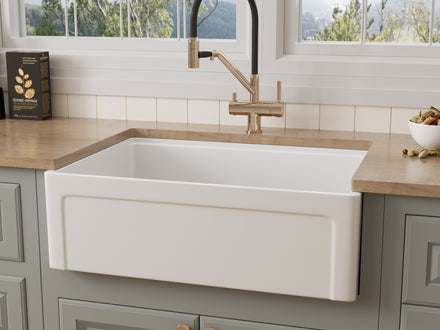
- Smooth: best for a modern farmhouse bathroom or spa-style bath. It reads as one clean white plane.
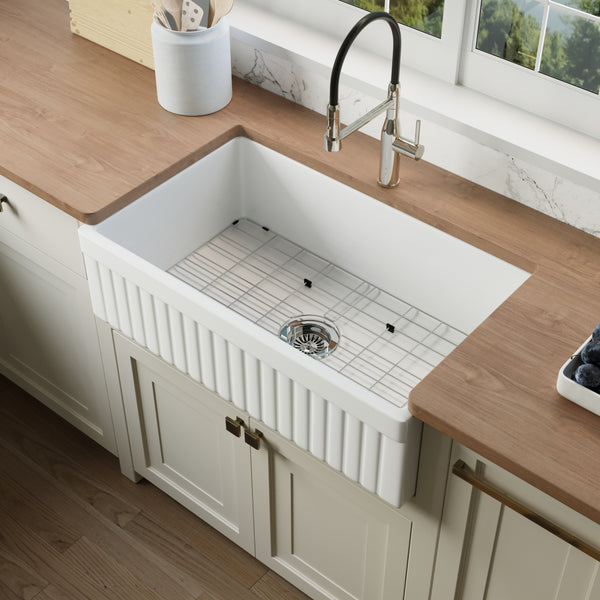
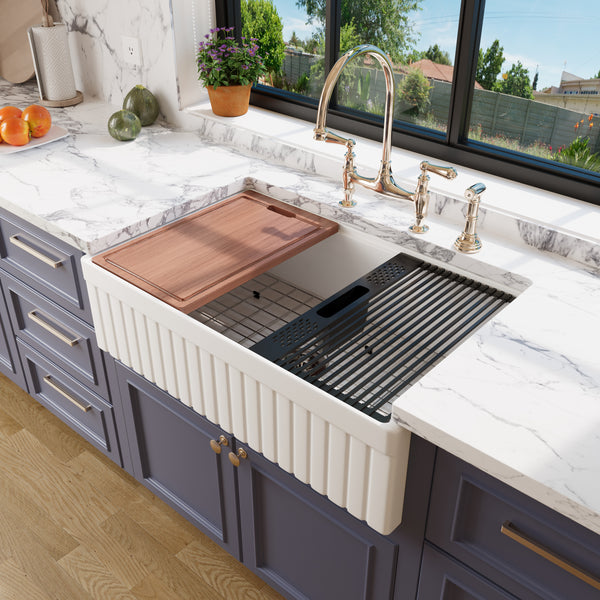
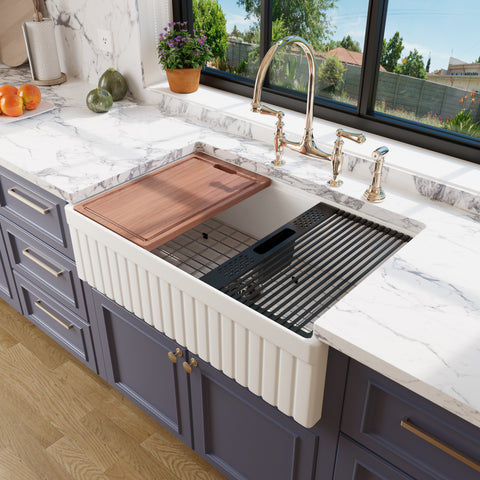
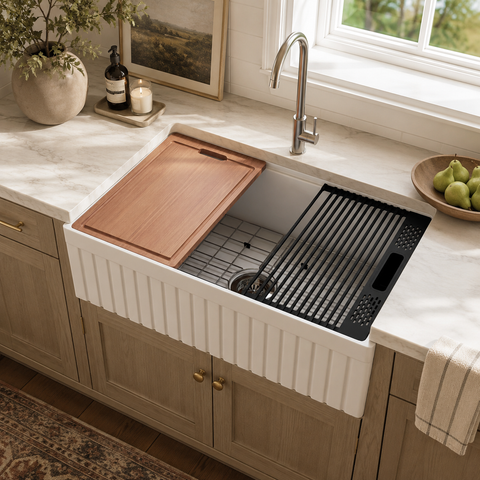
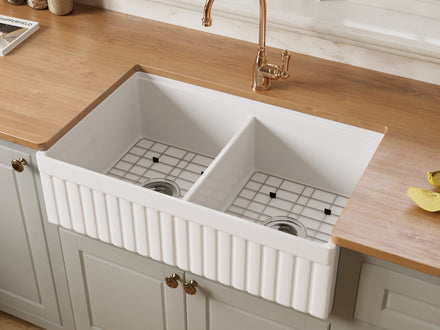
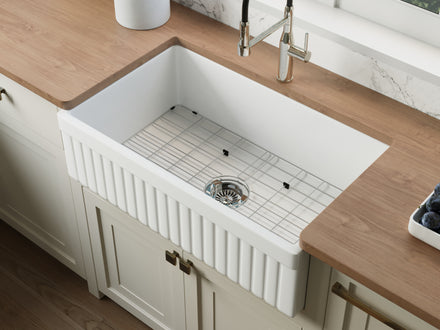
- Fluted: vertical ribs add shadow lines. It suits a traditional farmhouse bathroom or cottage bath, and it separates the farmhouse sink from white cabinets.
- Grooved: a recessed panel catches the light. It fits Shaker and classic vanities.
Keep the rest of the bathroom design simple around it. One strong apron front is usually enough for the farmhouse look; plain tile and simple hardware let it lead.
Both NOZLOO 30-inch apron front sink models are reversible. The 30-inch reversible sink has a fluted face and a smooth face. The 30-inch grooved sink has a grooved face and a smooth face, and you pick the side at install. See all options in our apron styles guide.

Is the workstation kit useful here?
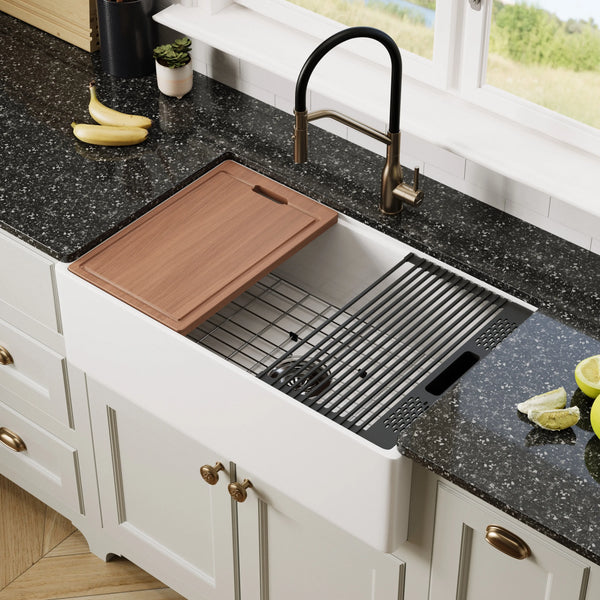
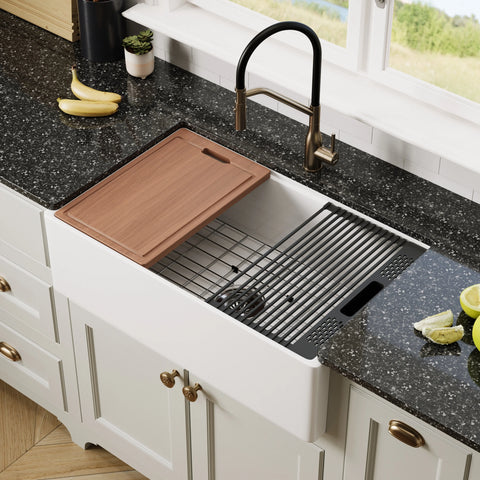
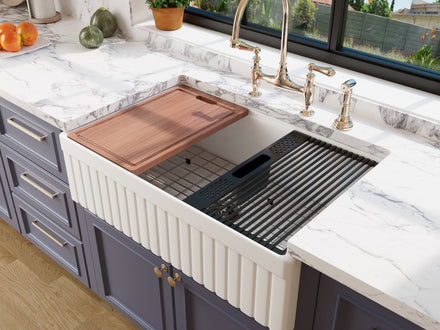
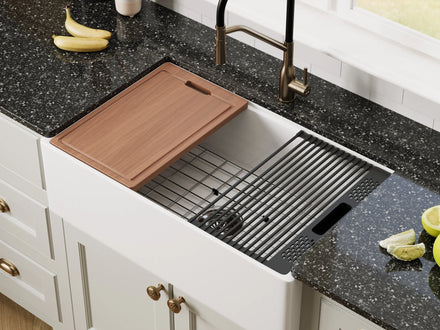
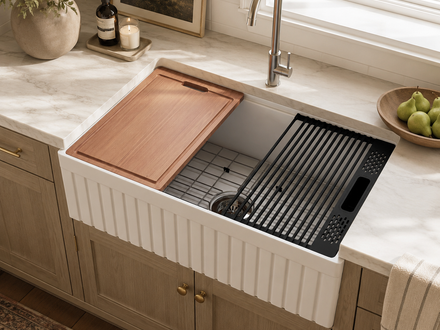
Partly, especially in a laundry room bath. Both 30-inch models come with a roll-up drying rack, a bottom grid and a sapele cutting board that ride on ledges inside the bowl.
- Roll-up rack: useful for drying hand-wash items or setting down a razor or brush while you work.
- Bottom grid: lifts items off the basin floor while they soak or drain, which helps when the farm sink works as a utility sink.
- Cutting board: it has no real bathroom job. Most people keep it in the kitchen.
The accessories carry a 1-year accessory warranty. The sink body carries a Limited Lifetime Warranty for the original purchaser in residential use.
Using a farm sink as a utility sink
In a laundry room that doubles as a bath, a farmhouse sink can also work as a utility sink. The deep bowl is useful for soaking hand-wash clothes, and the bottom grid lifts items off the basin floor while they drain.
If the room is used mostly as a utility sink, a 32-inch base keeps the basin floor lower. If it is mostly an everyday bathroom sink for adults, 36 inches is the easier height.
Caring for a fireclay bathroom sink
Treat it like any glazed farmhouse sink and it stays easy to clean. The glaze is non-porous, so toothpaste, soap film and makeup wipe off with a soft cloth and mild cleaner.
- Rinse dyes quickly. Hair dye and some cosmetics can mark caulk and grout faster than the glaze.
- Skip harsh abrasives. Scouring powder and steel pads can dull the glaze over time.
- Mind heavy drops. Fireclay resists chipping in normal use, but a heavy glass bottle dropped on the rim is still a risk.
- Avoid sudden heat. Do not pour boiling water into a cold sink.
For cleaner choices and stain removal, see how to clean a fireclay sink.
Before installation, inspect the farmhouse sink within 48 hours of delivery. Check the glaze under good light and confirm the dimensions against your model's drawing. The one below is for the 30-inch reversible model; the grooved model's drawing is on its product page.

Farmhouse bathroom sink checklist
Run through this list with your contractor before you order a vanity.
- Sink section of the vanity is at least 33 inches wide.
- Vanity is 22 to 24 inches deep, or the faucet is wall-mounted.
- Vanity height is set for the main users; 36 inches suits most adults.
- Support frame is planned for a 100 to 115 lb farm sink plus water.
- Wall valve or deck space is planned before tile goes up.
- Plumber has confirmed trap size and drain height.
- Storage plan covers the drawer lost to the apron front.
Frequently asked questions
Can you use a kitchen farmhouse sink in a bathroom?
Yes, if the vanity is big enough and built to carry the load. A 30-inch fireclay apron front sink needs a sink base at least 33 inches wide, so plan on a 36-inch or wider vanity. It also needs a support frame, a faucet plan for the 20-inch sink depth, and a drain that suits a kitchen-style strainer.
What size vanity do you need for a farmhouse sink?
For a 30 x 20 x 10-inch sink, the sink section of the vanity must be at least 33 inches wide. That means a 36-inch single vanity at minimum. Choose 48 or 60 inches if you want drawers beside the sink, and 72 inches if you want two sinks. Aim for 22 to 24 inches of depth if the faucet mounts on the counter.
Is a farmhouse sink too deep for a bathroom?
It is deeper than a typical bathroom sink, but that is often a plus. The bowl on the NOZLOO 30-inch models is 8¾ to 8⅞ inches deep, which holds splashes in. The trade-off is height. On a 32-inch vanity the basin floor sits around 23 inches off the floor, so taller adults usually prefer a 36-inch vanity.
What faucet works with a farmhouse sink in a bathroom?
Apron sinks have no faucet holes, so the faucet goes on the counter behind the sink or on the wall. A wall-mounted bathroom faucet is the easiest fit on a standard 21-inch-deep vanity. Choose a spout reach that lands the water near the middle of the bowl, and consider a WaterSense-labeled model to keep flow at 1.5 gpm or less.
Do bathroom farmhouse sinks need extra support?
Yes. A 30-inch fireclay sink weighs about 100 to 115 pounds before any water goes in. Most bathroom vanities are not built for that. Add a support frame tied into the cabinet sides, or order a sink base designed for an apron front sink, and anchor the vanity to wall studs.
Ready to plan a farmhouse bathroom around a 30-inch farmhouse sink? Compare dimensions, bowl depths and apron front faces in our fireclay farmhouse sink collection.