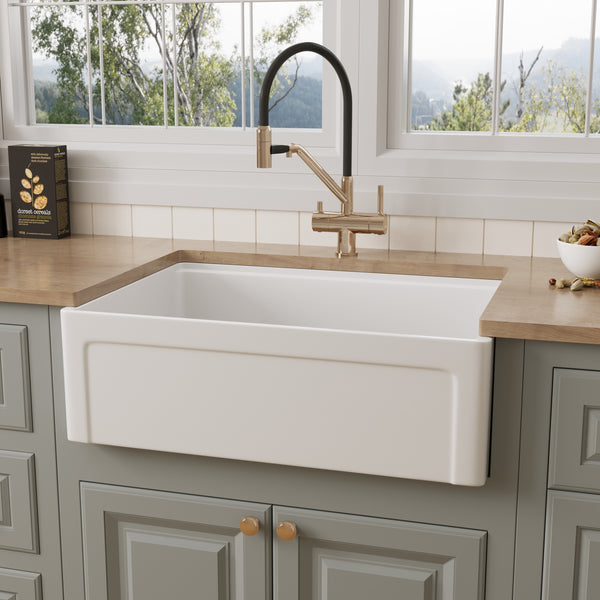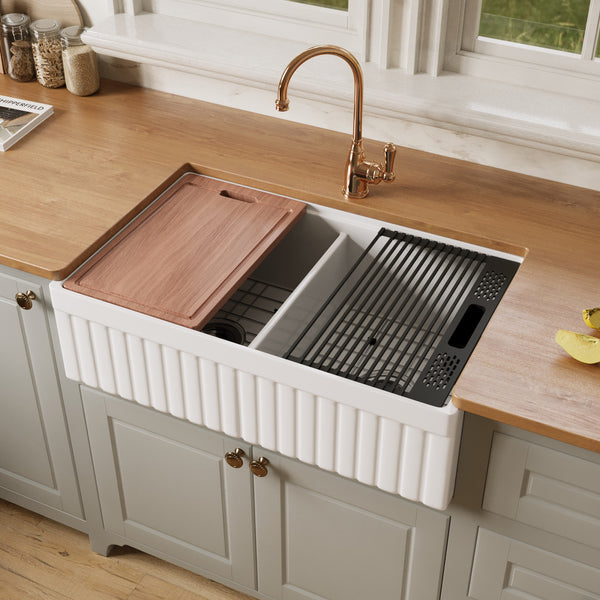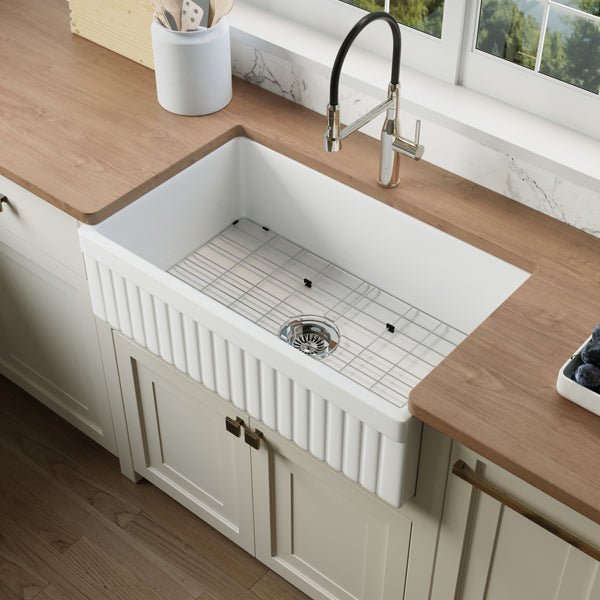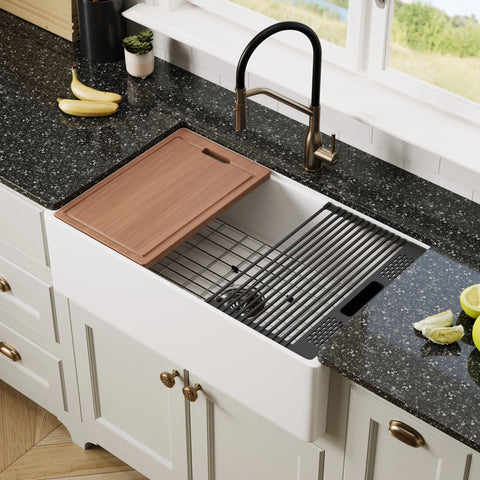
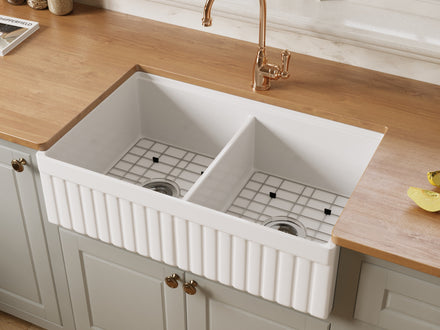
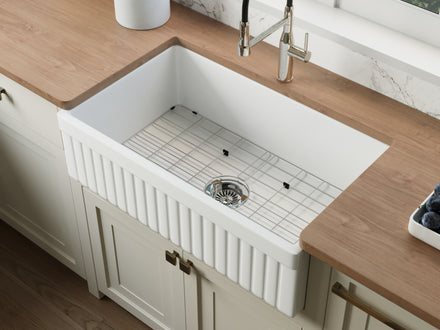
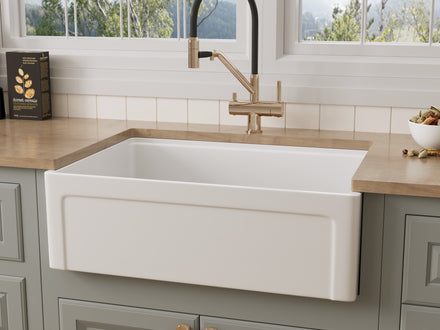
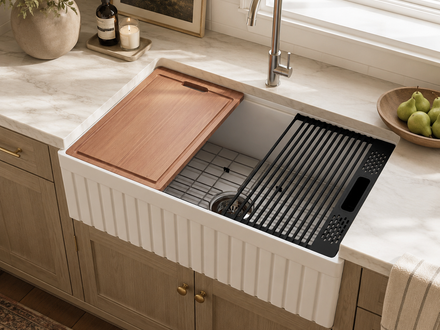
Farmhouse Sink Countertop Compatibility: Quartz, Granite, Laminate & Butcher Block
Compare quartz, granite, laminate, and butcher block for a farmhouse sink, then use a fabricator checklist and the correct templating order before any countertop is cut.

In this guide View sections +
Reviewed: August 21, 2026 · Countertop planning claims checked against current surface-industry, stone-industry, laminate-manufacturer, and U.S. workplace-safety guidance.
Quick answer: A farmhouse sink can work with quartz, granite, laminate, or butcher block, but the cutout detail is not interchangeable. Quartz and granite usually give a fabricator the most direct path to a finished exposed edge. Laminate needs an approved edge and mounting detail that keeps its core dry. Butcher block needs every exposed cut surface protected. In every case, the cabinet or a dedicated frame—not the countertop—should carry a heavy fireclay sink.
The safest order is simple: choose and inspect the exact sink, settle its height and support, then let the countertop fabricator template around the delivered unit. Do not order a countertop cutout from a nominal “30-inch” or “33-inch” label.
Farmhouse Sink Countertop Compatibility at a Glance
| Countertop | Can it work? | Main planning issue | Who must approve it? |
|---|---|---|---|
| Engineered quartz | Usually, with professional fabrication | Cutout shape, inside corners, seams, and surface-specific rules | Quartz fabricator and surface supplier |
| Granite | Usually, after slab review | Stone characteristics, cutout reinforcement, edge finish, and seam layout | Natural-stone fabricator |
| Laminate | Sometimes, with an approved detail | Preventing water from reaching the particleboard or MDF core | Countertop fabricator and sink instructions |
| Butcher block | Sometimes, when the wood top and finish system permit it | Protecting end grain and every exposed cut face from repeated wetting | Wood-top fabricator or qualified installer |
“Compatible” means the complete sink, counter, cabinet, support, and sealing plan works together. It does not mean every farmhouse model can use every mounting detail.

Four Rules That Do Not Change With the Countertop
- Template from the delivered sink. Handmade fireclay can vary slightly from the published dimensions. Inspect the unit, give the actual sink and model-specific instructions to the fabricator, and keep it available for final measurement. The International Surface Fabricators Association likewise advises providing the new sink when the countertop company makes its final template.
- Support the sink independently. A fireclay basin is heavy before water, cookware, accessories, or a disposal are added. Define who will build the cabinet platform or support frame; do not assume adhesive or the countertop edge will carry the load.
- Let the fabricator own the cutout. The finished opening, inside corners, reinforcement, exposed edge, seam location, and allowable field adjustments depend on the selected surface and slab. A generic online cutout formula is not a shop drawing.
- Freeze the visible choices before templating. Sink height, apron projection, countertop overhang, faucet position, mounting relationship, and reveal affect the final template. Changing one after fabrication can change several others.
What Changes by Countertop Material?
Quartz: predictable fabrication, but not a universal detail
Engineered quartz commonly accommodates an apron-front cutout, but the fabricator still needs the exact sink, surface thickness, edge profile, corner geometry, and seam plan. Ask which current surface manual governs the job; cutout, support, and warranty rules vary by named product.
Granite: judge the actual slab and layout
Granite can work, but each slab and layout differ. Veining, fissures, thickness, narrow rails, and seams affect the plan. The Natural Stone Institute's installation standards overview treats seam placement, cutout reinforcement, joint widths, and tolerances as professional decisions. Approve the seam and opening layout before production.
Laminate: the core is the deciding issue
Laminate can surround a sink, but its water-sensitive substrate or core must not remain exposed. The selected system needs a protected edge and continuous seal. The Architectural Woodwork Institute's countertop installation requirements call for field-cut sink edges in moisture areas to be sealed with a water-resistant sealer, sealant, or caulk. Because an apron cut may remove a postformed front edge, verify that the exact worktop-and-sink system permits the detail and retains its warranty. Do not copy a stone detail onto laminate.
Butcher block: compatible when cut faces stay protected
Wood creates a warm surround, but the opening exposes end grain in a wet zone. Keep the load off the top and finish every cut face before setting the sink. For finish selection and maintenance, use the dedicated farmhouse sink with butcher block guide.

Questions to Ask the Countertop Fabricator
| Ask this | Why it matters | Record before approval |
|---|---|---|
| Which surface fabrication manual and version governs this job? | Cutout, corner, seam, and support rules vary | Document title and revision |
| Do you need the physical sink at final template? | Fireclay dimensions can vary | Delivery and inspection deadline |
| Who sets the cutout and inside-corner geometry? | Surface rules and sink shape both apply | Approved shop drawing |
| Where will any countertop seams land? | Slab size, pattern, opening, and support affect placement | Seam positions on the layout |
| Which edges will be exposed and finished? | Apron-front openings reveal more than a standard drop-in cutout | Edge finish and color expectation |
| Who builds and verifies the sink support? | The counter should not carry the sink | Named trade and completion date |
| Is any on-site stone cutting expected? | Scope, dust controls, and protection must be planned | Shop versus site work |
Stone cutting and grinding can release respirable crystalline silica. The current OSHA/NIOSH countertop safety alert recommends completing as much work as possible under controlled shop conditions and using appropriate dust controls. Do not enlarge a quartz or granite opening as a casual DIY step.
The Correct Order Before Countertop Templating
- Select the exact sink model. Confirm overall size, weight, minimum cabinet, apron shape, and approved mounting options.
- Receive and inspect it. Check for shipping damage and measure the delivered unit.
- Prepare the cabinet and support plan. Confirm door, frame, plumbing, faucet, and disposal clearances.
- Dry-position the sink. Set the intended height and apron projection before the fabricator's final visit.
- Complete the final template. Give the fabricator the sink, instructions, and the settled reveal and mounting relationship.
- Approve the layout. Review the opening, finished edges, seams, faucet holes, backsplash clearance, and who owns each remaining task.
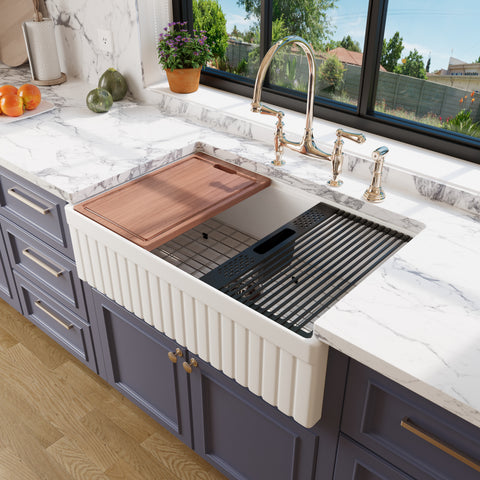
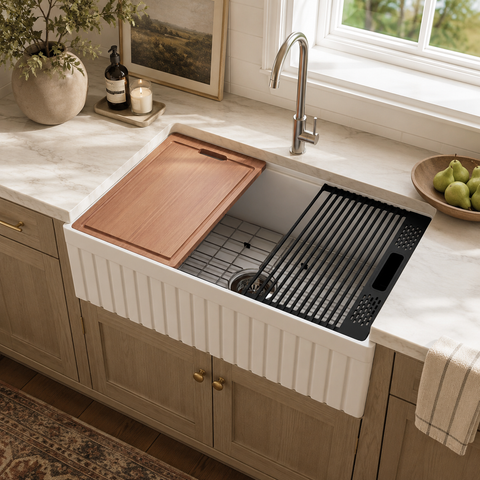
The NOZLOO NZ-103W3320 shows why this order matters. It measures 33″ × 20″ × 10″, weighs approximately 105 lb, and specifies a 36-inch minimum base cabinet with dedicated support. Its dimensions are useful for planning, but the delivered sink—not this card—controls final fabrication.


Where This Guide Stops
This page owns countertop compatibility, fabricator questions, cutouts, seams, independent support, and templating order. Use the fireclay farmhouse sink installation guide for the full installation sequence. Use the farmhouse sink reveal guide for positive, zero, and negative reveal, and the farmhouse vs undermount guide for mounting-style and cabinet-face decisions.
How We Checked This Guide
NOZLOO reviewed the live U.S. search results and related questions for farmhouse-sink countertop terms, then checked the planning claims against current guidance from the International Surface Fabricators Association, Natural Stone Institute, an official laminate manufacturer, and OSHA/NIOSH. Final fit still follows the delivered sink, selected countertop system, qualified fabricator's shop drawing, and local project requirements.
Frequently Asked Questions
What countertop is best for a farmhouse sink?
There is no universal best. Quartz and granite are often the most straightforward for a professionally finished exposed edge. Laminate and butcher block can also work when their vulnerable cut surfaces are properly detailed.
What type of sink works best with quartz countertops?
Quartz can work with several sink styles, including a properly supported apron-front sink. The best choice is a model whose cutout, edge, mounting relationship, and support plan are approved by the selected quartz fabricator.
Can a farmhouse sink be used with laminate countertops?
Sometimes. The exact sink and counter detail must protect the countertop's water-sensitive core and follow both sets of instructions. Do not assume a standard stone undermount detail is suitable.
Can you add a farmhouse sink to existing quartz or granite?
Possibly. A fabricator must inspect the slab, current opening, seams, rails, cabinet, and required cutout. The change may be impractical even when the surface material itself is compatible.
What is the main countertop drawback of a farmhouse sink?
Its apron and large opening require more coordination than a typical rimmed sink. The fabricator must resolve exposed edges, corners, seams, faucet clearance, and sealing while the cabinet or a dedicated frame carries the sink.
Does the fabricator need the actual farmhouse sink?
Yes, especially for hand-finished fireclay. Published dimensions help with early planning, but the delivered sink and model instructions should control the final template and cutout.
Bottom Line
Choose the material only after a fabricator confirms the complete detail. Quartz and granite are commonly workable; laminate and butcher block need extra attention at exposed cut surfaces. Whatever the counter, put the exact sink on site, support it independently, and approve the cutout and seam plan before fabrication.