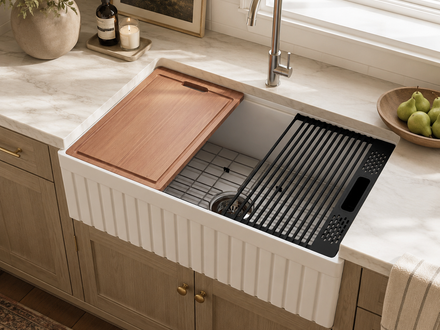
Farmhouse Sink vs Undermount Sink: Which Is Better for Your Kitchen?

Choosing a kitchen sink often looks like a style decision until the cabinet drawings begin. A traditional farmhouse sink usually changes the cabinet front; a conventional undermount sink usually does not. That difference affects the countertop cutout, installation cost, daily use, and future replacement.
A farmhouse sink often fits a full kitchen remodel because the cabinetry and countertop can be planned around it. A conventional undermount sink is usually easier for a limited replacement.
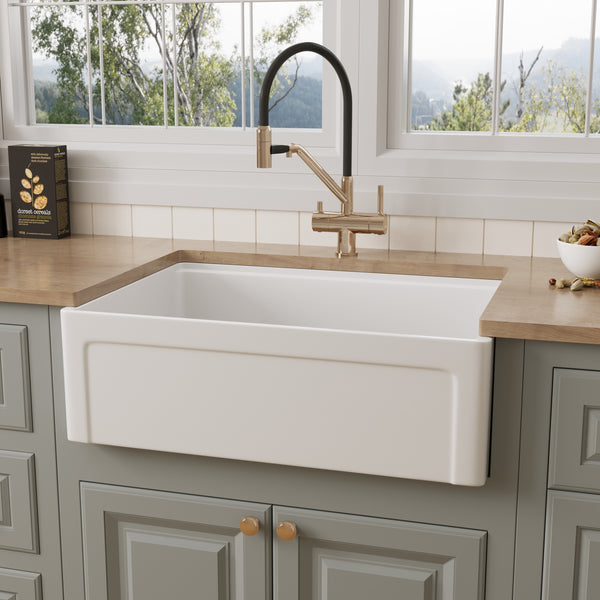
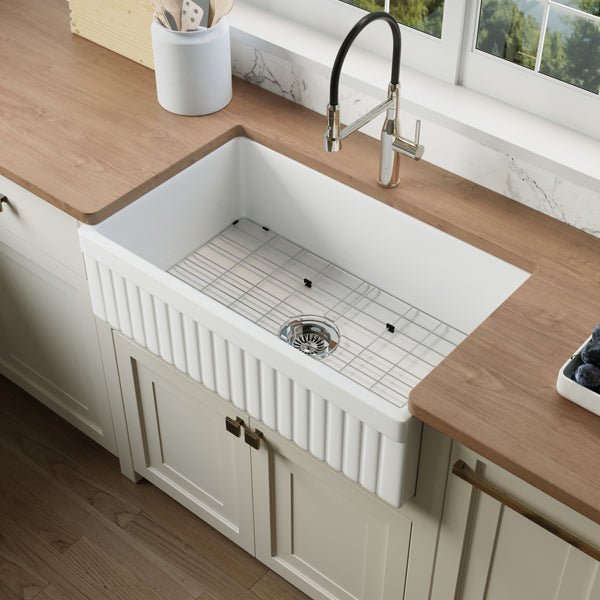
“Farmhouse” describes the apron-front form; “undermount” describes how a sink is mounted. Some apron sinks are installed beneath the countertop. Here, farmhouse sink means an exposed-front apron sink; undermount sink means a conventional basin behind the cabinet face.
Farmhouse Sink vs Undermount Sink: Quick Comparison
|
Factor |
Farmhouse Sink |
Conventional Undermount Sink |
|---|---|---|
|
Appearance |
Exposed front becomes a focal point |
Bowl blends into the countertop |
|
Cabinet |
Usually needs an apron opening and support |
Usually preserves the cabinet face |
|
Countertop |
Cutout must match the apron, rim, and mount |
Enclosed cutout follows the bowl |
|
Installation |
Best planned with new or custom cabinetry |
Often easier when replacing a similar sink |
|
Cost |
May add cabinet and fabrication work |
Usually requires fewer cabinet changes |
|
Daily use |
Can shorten the reach to a deep basin |
Easy cleaning from countertop to bowl |
|
Replacement |
Apron size and cutout narrow the options |
Still depends on a compatible cutout |
|
Best project |
New cabinetry or full remodel |
Like-for-like replacement or limited remodel |
Are Farmhouse and Undermount Sinks Opposites?
Not exactly. An apron front sink has an exposed front panel. An undermount sink has a rim installed beneath the countertop. A farmhouse model may be undermounted, flush mounted, or top mounted. Drop in sinks leave a visible rim above the counter.
Can a Farmhouse Sink Be Drop-In or Top-Mount?
Yes, drop-in farmhouse sinks exist, but only when the model was made with a rim that rests on the countertop. Some manufacturers offer a top-mount apron-front sink, often sold as a retrofit farmhouse sink. NOZLOO sinks do not have that rim, so they install undermount or flush only.
How Are Farmhouse Sinks Mounted?
Undermount or flush is the usual method for apron-front models; the table shows how the three mounts compare.
| Mount | How it mounts | What holds it | Countertop needed |
|---|---|---|---|
| Drop-in (top-mount) | Rim rests on the counter | Rim clips plus silicone; counter carries the weight | Any, including laminate |
| Undermount (conventional bowl) | Hangs under the counter | Clips or brackets plus adhesive; counter carries the weight | Stone, quartz, or solid surface |
| Apron-front (undermount or flush) | Rests on a platform inside the cabinet | Cabinet support frame; silicone only seals | Typically stone, quartz, or solid surface, cut to match the actual sink |
Does the Counter or the Cabinet Carry the Sink?
A NOZLOO bowl weighs 100–115 lbs (45–52 kg) empty, and no adhesive or clip should carry that much. That is why a NOZLOO sink rests on a support platform inside the cabinet, passing the weight to the cabinet floor. Never hang it from screws in the cabinet sides, and never screw into fireclay.
Wooden wedges or small blocks at the sides keep it from sliding, and silicone only seals the counter joint. The full step-by-step sequence, including leveling, is in the install guide linked above.
What Are the Downsides of a Top-Mount Farmhouse Sink?
A top-mount farm sink is a fair choice when your counters are staying, especially laminate, whose cut edge typically cannot be polished smooth. The rim covers that cut edge, so you often do not need a countertop shop to finish it.
- The rim stays visible and breaks the countertop line.
- The caulk seam under that rim needs scraping and re-caulking eventually. The daily-use section below covers the cleanup difference.
- Many top-mount models use a shorter apron so they fit a standard sink base with less cutting.
If you are installing stone or quartz and rebuilding the sink base, choose an undermount farmhouse sink or a flush mount. If your cabinet is staying but the counters are not, read the existing-cabinet retrofit guide before you order.
How Do the Cabinet and Countertop Requirements Differ?
A traditional farmhouse sink passes through the cabinet face. The installer may need to trim the front rails, adjust the cabinet doors, and build support for the sink’s weight. New custom cabinetry can be built around the apron front; a retrofit may need major changes or a new sink base.
An undermount sink stays behind the cabinet face. It still needs width, support, plumbing clearance, and disposal space, but normally leaves the front intact. Check the usable interior opening rather than relying only on the cabinet label. NOZLOO’s farmhouse sink cabinet size guide explains which measurements matter.

For either kitchen sink, the countertop is the second commitment. An apron front sink needs a cabinet opening, while its countertop cutout depends on the mount. A conventional undermount sink uses an enclosed cutout, but the corner radius, reveal, and bowl profile must still match.
Use Natural Stone, the Natural Stone Institute’s educational resource, recommends providing the fabricator with the exact sink make and model before countertop templating. NOZLOO’s measurement guide covers apron height, overall dimensions, drain position, cutout, and space below the bowl.
Which Sink Is Easier to Install or Replace?
A farmhouse sink is usually easier to coordinate during a full remodel because its support, apron opening, plumbing, and countertop can be planned together. A retrofit may require cabinet rebuilding, countertop work, and plumbing changes below a deep basin.

An undermount sink is often easier to replace when the new model matches the old cutout. Even then, small differences in bowl shape, corner radius, reveal, or mounting access can create extra work.
Future replacement depends on the opening, not the label. A replacement apron sink must match the existing apron opening and countertop cutout. An undermount replacement must leave a clean, properly supported countertop edge.
For the complete installation sequence, see fireclay farmhouse sink installation guide.
How Do They Compare in Daily Use?
Pulled-forward apron sinks reduce the countertop strip in front of the bowl, which can shorten the reach when washing dishes or large pots. This Old House also notes that this layout can reduce leaning.
A deep basin offers more space for large pots but may require more bending. Comfort depends on bowl depth, counter height, and the user—not the sink label alone.
A conventional undermount sink simplifies counter cleanup. With the rim installed beneath the surface, crumbs and water can be swept directly into the bowl. The same detail creates a clean, integrated look.

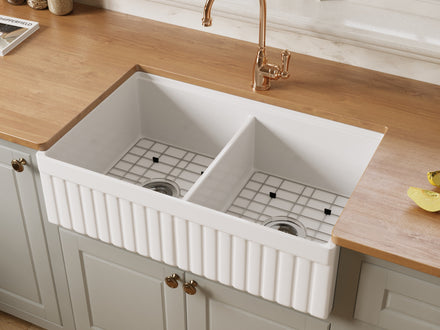
Judge capacity by interior dimensions and bowl layout. An apron front does not automatically create more usable space. Large cookware may favor an open bowl; separate washing and rinsing may favor two basins.
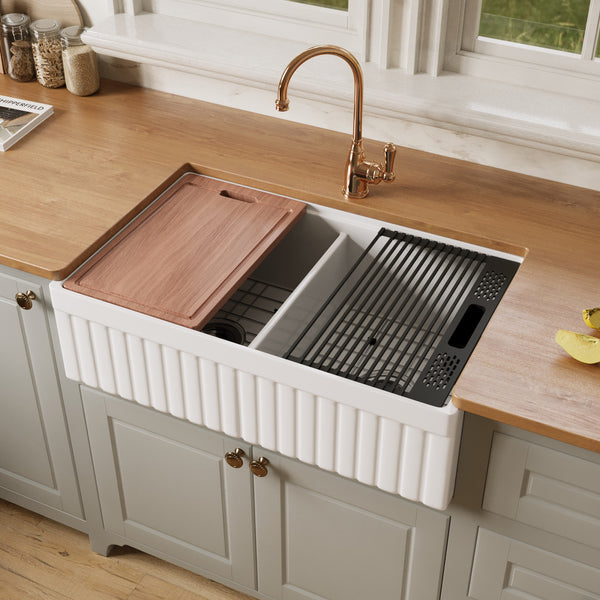
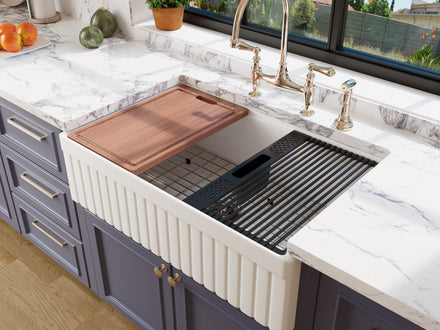
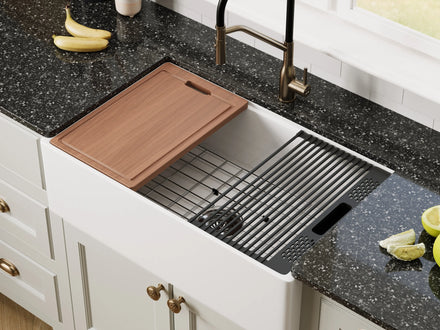
Some farmhouse sinks add workstation ledges for food prep and drying. They can save counter space, but they are not standard on every model.
Material is a separate choice. Compare fireclay, stainless steel, cast iron, or copper only after the cabinet and mounting requirements are clear.
Why Does a Farmhouse Sink Project Usually Cost More?
Beyond the sink itself, a farmhouse kitchen sink project may require custom cabinetry, cabinet-face work, structural support, a custom cutout, added labor, and plumbing adjustments.
An undermount project can also become expensive if the countertop must be removed, repaired, or replaced. Compare the total work, not only the sink prices.
A Three-Question Project Test
Are the cabinets and countertop already being replaced?
If yes, either style is practical. If no, an undermount sink is usually the lower-disruption choice.
Can the cabinet face be permanently modified?
If no, most exposed-front farmhouse configurations are ruled out. If yes, confirm support, door clearance, and under-sink storage.
How important is future replacement flexibility?
A conventional undermount opening may offer more replacement options, but sink cutouts are not universally standardized. Bowl shape, corner radius, reveal, and mounting access still need to match. A custom apron opening ties future options to the apron dimensions and countertop cutout.
Farmhouse Sink or Undermount Sink: Which Should You Choose?
Choose a farmhouse sink for a planned remodel, a modifiable cabinet, and a kitchen design where the sink should become a focal point. Selected workstation models also add prep space above the basin.
Choose an undermount kitchen sink to preserve the cabinet face, simplify cleanup, or replace a kitchen sink without redesigning the room.
If an apron front sink suits the project, compare fireclay farmhouse sink by size, bowl layout, apron design, and workstation features.

Final Verdict
Project scope is the deciding factor in the farmhouse sink vs undermount sink comparison.
A farmhouse sink is stronger for a renovation designed around it. It creates a focal point and may shorten the reach, but requires more cabinet and countertop planning.
An undermount sink is often better suited to a contained update. It preserves the cabinet face, supports easy cleaning, and may offer more options when the existing cutout is common.
Frequently Asked Questions
Can a Farmhouse Sink Also Be Undermounted?
Yes. “Farmhouse” refers to the exposed apron front; “undermount” means installed beneath the countertop. Some apron sinks support undermount installation, while others use a flush mount or top mount.
Can You Replace an Undermount Sink With a Farmhouse Sink?
Sometimes, but rarely as a direct swap. The cabinet must accept and support the apron sink, while the countertop cutout, plumbing, apron height, and cabinet doors must remain workable.
Which Is Easier to Clean: a Farmhouse Sink or an Undermount Sink?
A conventional undermount sink is usually easier for wiping the countertop because no top rim blocks the bowl. A farmhouse sink can also be easy to clean, but its exposed front and installation seams need occasional wiping.
Is a Farmhouse Sink Better for Large Pots?
Often, but not automatically. Many farmhouse sinks have a deep basin for large pots and sheet pans. Judge capacity by the interior bowl size and layout, not the apron front alone.
Can a Farmhouse Sink Be Top Mounted?
Only if that model has a rim designed to sit on the counter; some manufacturers sell these as retrofit farmhouse sinks. The countertop then carries the weight, and clips under the rim hold it down. Confirm the mount type before you order, because a top-mount cutout usually cannot be reused for an undermount later.
What Holds a Farmhouse Sink in Place?
It depends on the mount. A top-mount model hangs from its rim, held by clips and silicone. An undermount or flush apron sink is typically held by its own weight on a support platform inside the cabinet. The mount table above lays out all three cases side by side.