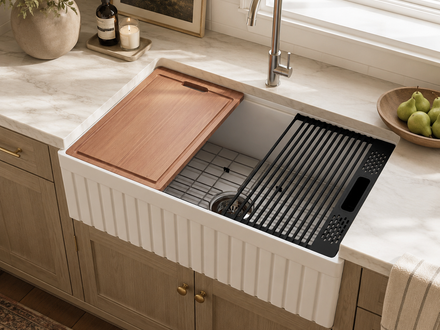
Can You Use a Garbage Disposal with a Fireclay Sink?

Yes, most fireclay sinks can be used with a garbage disposal. The installation works when the disposal flange fits the thickness of the sink, the basin has independent structural support, and the cabinet provides enough room for the disposal and plumbing.
A standard 3.5-inch drain opening is an important starting point, but it does not guarantee complete compatibility. Fireclay can be thicker around the drain than stainless steel, so the flange included with a disposal may not be long enough to engage the mounting system. Some installations require an extended garbage disposal flange designed for thicker sink materials.
Before installation, check:
- The diameter of the sink’s drain opening
- The fireclay thickness around the drain
- The maximum thickness supported by the disposal flange
- Compatibility between the flange and mounting system
- Space for the disposal, support frame, P-trap, and supply lines
- The disposal outlet’s position relative to the wall drain
- Independent structural support beneath the sink
- The sink warranty and disposal installation instructions
When these parts are planned as one system, a fireclay farmhouse sink and garbage disposal can work together reliably.
In This Guide
- Fireclay sink and garbage disposal compatibility
- Whether disposal vibration can crack fireclay
- When an extended disposal flange may be required
- Sink support, cabinet clearance, and plumbing rough-in
- Center drain vs. side or offset drain
- Disposal size, feed type, air switches, noise, and finishes
- NOZLOO product and warranty considerations
- Frequently asked questions
Fireclay Sink and Garbage Disposal Compatibility Checklist
Check the entire sink, cabinet, and plumbing layout before ordering a disposal.
| What to check | Why it matters |
|---|---|
| Drain opening | Most residential disposals are designed around a standard kitchen sink drain opening |
| Sink thickness | Fireclay thickness at the drain determines whether the flange is long enough |
| Flange capacity | The flange must fully engage the gaskets and mounting assembly |
| Mount compatibility | The flange, mounting ring, gaskets, and disposal must work as one approved system |
| Sink support | A heavy fireclay sink needs structural support independent of the disposal |
| Cabinet clearance | The disposal must fit around support rails, hoses, valves, filters, and storage |
| Disposal outlet height | The outlet must remain high enough for the P-trap and wall drain |
| Plumbing alignment | Pipes should meet the disposal without pulling or twisting the drain connection |
| Service access | The reset button, wiring, trap, and mounting components should remain reachable |
| Warranty requirements | Improper installation may affect warranty coverage |
Residential food waste disposers are covered by standards such as ASSE 1008, which addresses the plumbing performance of disposers installed at residential kitchen sink outlets. Local plumbing and electrical requirements may also apply.
Can a Garbage Disposal Crack a Fireclay Sink?
A compatible, correctly installed garbage disposal should not crack a fireclay sink during normal operation.
Fireclay is dense and durable, but it is also rigid. It does not flex like thin stainless steel when pressure is applied around the drain. The main concern is therefore not the presence of a disposal. It is stress created by incompatible parts or improper installation.
Common risks include:
| Risk | How to reduce it |
| Flange is too short | Measure the drain-area thickness and select compatible mounting hardware |
| Hardware is overtightened | Follow the disposal manufacturer’s tightening sequence |
| Disposal hangs unevenly | Make sure the mounting assembly engages fully and evenly |
| Sink moves in the cabinet | Support the fireclay sink independently from below |
| Plumbing pulls on the outlet | Adjust the pipe layout so the connections meet naturally |
| Support rails block the trap | Coordinate cabinet framing and plumbing before installation |
| Disposal vibrates excessively | Inspect the mount, appliance condition, and nearby pipe contact |
| A leak remains unresolved | Stop using the unit and repair the connection promptly |
The completed installation should remain stable when the disposal starts and stops. The sink should rest securely on its cabinet support, the disposal should hang evenly from its mounting assembly, and the plumbing should not pull against the drain.
For more detail on material and installation damage, read Do Fireclay Sinks Crack Easily?.
Do You Need an Extended Garbage Disposal Flange?
Some fireclay sinks require an extended garbage disposal flange. Others may work with the standard flange included with the disposal.
The deciding factor is the thickness of the sink around the drain opening.
A 3.5-inch drain opening describes the diameter of the opening. It does not confirm that the disposal flange is long enough for the sink.
Use the following process:
- Measure the actual fireclay thickness at the drain opening.
- Identify the exact disposal brand and model.
- Review the maximum sink thickness supported by its standard flange.
- Check whether an approved extended flange is available.
- Dry-fit the flange, gaskets, and mounting components.
- Confirm that the mounting ring engages fully without excessive force.
Avoid trying to make a short flange fit by removing required gaskets, modifying the mounting system, or applying additional tightening pressure.
The drain assembly included with a sink is also not normally used to mount a garbage disposal. A standard basket strainer and a disposal flange perform different functions. When a disposal is installed, its compatible flange and mounting assembly generally replace the basket-strainer assembly at that drain opening.
Extended flanges are not universally interchangeable. Even when two products have similar dimensions, their mounting rings, seals, and locking systems may differ. The safest approach is to use hardware approved for the selected disposal.
Support the Fireclay Sink Independently
A fireclay farmhouse sink should rest on a level support frame, reinforced platform, or rated bracket system inside the sink base cabinet.
The countertop, cabinet face, drain flange, and garbage disposal should not be expected to carry the full weight of the sink.
A suitable support structure should:
- Transfer the sink’s weight into the cabinet
- Keep the basin level and stable
- Avoid concentrated pressure points
- Leave the drain opening accessible
- Allow room for the disposal and P-trap
- Preserve access to supply valves and wiring
The disposal itself normally hangs from its approved mounting assembly. An improvised rigid support should not be placed beneath the disposal unless its manufacturer specifically approves that installation method.
The distinction is important:
- The fireclay sink requires independent cabinet support.
- The disposal requires a compatible flange and mounting system.
See How to Install a Fireclay Farmhouse Sink for the complete support, dry-fitting, leveling, and countertop sequence.
Check Cabinet Clearance Before Choosing a Disposal
A disposal may connect to the sink correctly and still produce an impractical cabinet layout.
Farmhouse sinks are often deeper than standard sinks. Their support framing also occupies space below the basin. Once the disposal and plumbing are added, the remaining cabinet area may be smaller than expected.
Plumbing clearance
Measure space for:
- Disposal body height and diameter
- Disposal discharge tube
- P-trap and trap removal
- Trap arm to the wall
- Dishwasher drain hose
- Water-supply valves
- Filter connections
- Sink support rails
Electrical and faucet components
Allow room for:
- Electrical outlet or hardwired connection
- Disposal reset button
- Air-switch control unit and tubing
- Faucet supply hoses
- Pull-down faucet hose and counterweight
- Instant-hot-water equipment
Storage and accessories
Consider whether the cabinet must also accommodate:
- Water-filtration housings
- Reverse-osmosis tank
- Leak tray or water sensor
- Pull-out waste bins
- Cleaning supplies
- Cabinet organizers
A compact disposal can preserve more usable space, but overall size is not the only consideration. Its outlet height, body diameter, mounting system, and pipe route must also fit the cabinet.
Use the Fireclay Farmhouse Sink Cabinet Size Guide to plan the sink, cabinet, support structure, and plumbing together.
Check the Disposal Outlet and Wall-Drain Height
A deep farmhouse sink combined with a disposal can position the discharge outlet lower than expected.
The typical drainage route is:
Sink flange → disposal → discharge tube → P-trap → trap arm → wall drain
The disposal outlet should remain above the P-trap, and the trap arm must reach the wall drain through a workable downward route. The plumbing should not run uphill or rely on strained connections.
Before setting the wall-drain rough-in:
- Establish the final installed sink height.
- Obtain the dimensional drawing for the exact disposal.
- Locate the centerline of the disposal discharge outlet.
- Allow enough space for the discharge tube and P-trap.
- Check that the trap can be removed for cleaning.
- Plan the trap-arm route to the wall.
- Make sure cabinet supports do not block the pipes.
- Dry-fit the main components before closing the wall or templating the countertop.
There is no universal wall-drain height that works for every farmhouse sink. Basin depth, cabinet height, support framing, drain location, disposal dimensions, and local plumbing requirements can all change the final position.
Plan the plumbing downward from the installed sink outlet rather than copying a generic kitchen-sink diagram.
See Farmhouse Sink Plumbing Rough-In and Drain Height for a more detailed planning sequence.
Center Drain vs. Side or Offset Drain
A garbage disposal can work with either a center-drain or offset-drain fireclay sink. An offset drain is not required for disposal compatibility.
A rear off-center drain is also sometimes described by shoppers as a side drain or offset drain. Because these terms may refer to slightly different positions, use the product’s dimension drawing when planning the cabinet and plumbing.
| Feature | Center drain | Rear off-center or side drain |
| Disposal position | Usually near the middle of the cabinet | Shifted toward the rear or one side |
| Central cabinet space | May be divided by the disposal and trap | May leave a larger open area elsewhere |
| Plumbing route | Often familiar and direct | May require a planned horizontal offset |
| Basin appearance | Symmetrical drain placement | Drain appears less centered |
| Best suited for | Larger cabinets and straightforward plumbing | Cabinets with filters, bins, or storage priorities |
| Main consideration | Disposal may occupy useful central space | Wall drain and support framing must suit the offset |
A side or offset drain does not automatically create more storage. The final result depends on:
- Disposal diameter
- P-trap position
- Wall-drain location
- Support-frame design
- Water valves
- Filtration equipment
- Cabinet doors and hinges
Choose the drain position as part of the complete under-sink plan, not from the basin appearance alone.
How to Choose a Garbage Disposal for a Fireclay Sink
Horsepower is only one part of the decision. Begin with the physical dimensions and mounting requirements.
Flange and mounting capacity
The standard or extended flange must accommodate the thickness of the fireclay at the drain. Use a flange, gasket set, mounting ring, and disposal designed to work together.
Overall height
A taller disposal leaves less room for the P-trap, particularly beneath a deep farmhouse sink.
Discharge-outlet height
The outlet position can matter more than overall appliance height. It determines whether the P-trap and trap arm can reach the wall drain correctly.
Body diameter
A wide disposal may interfere with supply valves, faucet hoses, water filters, storage systems, or cabinet hinges.
Noise and vibration control
Fireclay’s substantial construction may transmit sound differently from thin stainless steel, but the sink material alone does not guarantee a quiet disposal.
Perceived noise also depends on:
- The disposal’s internal insulation
- The mounting system
- Cabinet construction
- Plumbing contact
- Sink support
- Loose components
For a quieter installation, choose a disposal with appropriate sound-control features and make sure the sink, mount, and pipes remain stable.
Continuous feed vs. batch feed
| Type | How it operates | Main consideration |
| Continuous feed | Runs after activation by a wall switch or air switch | Convenient for frequent cleanup |
| Batch feed | Runs only when its activation cover is correctly positioned | Provides more controlled activation |
Continuous-feed models are common and convenient. Batch-feed models may appeal to households that prefer the disposer to operate only when the drain opening is covered.
Wall switch vs. air switch
An air switch can be useful when a conventional wall switch is difficult to position, particularly on an island or open countertop layout.
The air-switch button is normally installed through a suitable opening in the countertop or sink deck and connects by air tubing to a control unit below the sink.
Plan the button location before countertop fabrication. A farmhouse sink does not automatically provide a dedicated air-switch hole, and drilling requirements depend on the countertop material.
Make sure the selected switch is rated for the disposal and installed according to applicable electrical requirements.
Flange finish
Disposal flanges may be available in finishes that coordinate with the faucet and other kitchen hardware. However, finish options can be more limited when an extended flange is required.
Use this order of priority:
- Compatible mounting system
- Correct flange depth
- Approved dimensions and materials
- Preferred finish
A matching finish is useful, but mechanical compatibility should come first.

A Rear Off-Center Drain Option from NOZLOO
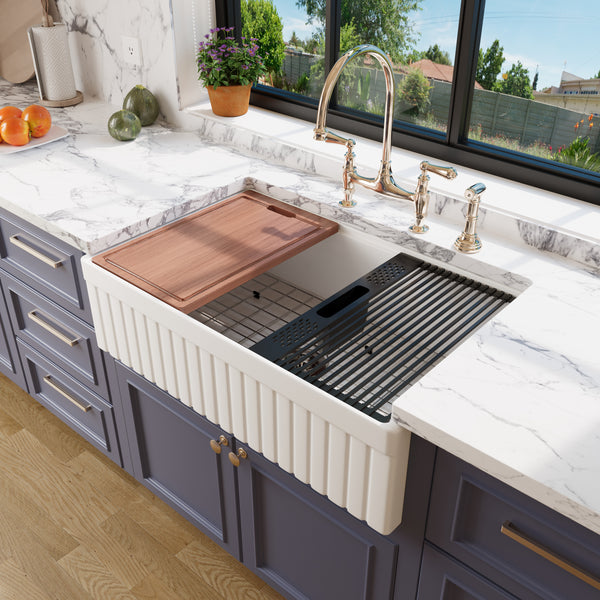
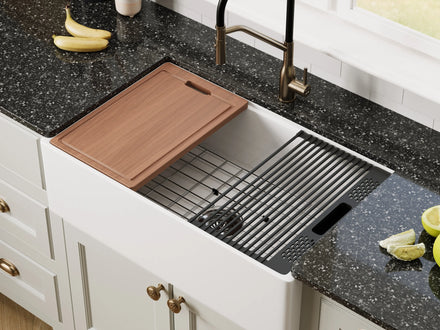
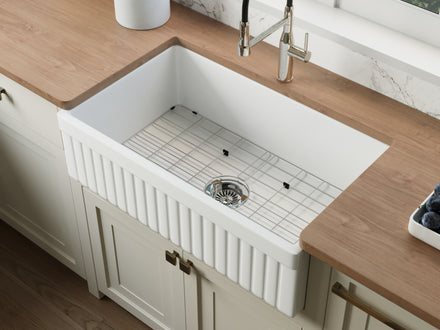
The NOZLOO 30" Grooved Apron Fireclay Farmhouse Sink with Workstation Kit uses a standard 3.5-inch drain opening with a rear off-center drain location.
Moving the drain away from the exact center can shift the disposal toward the rear and one side of the cabinet. Depending on the support and plumbing layout, this may preserve a more usable area for a filter, leak tray, organizer, or cleaning supplies.
A center-drain NOZLOO sink can also work with a garbage disposal when:
- The disposal flange accommodates the sink thickness
- The basin has suitable cabinet support
- The disposal and trap fit below the sink
- The plumbing reaches the wall drain without strain
The better layout depends on the full cabinet plan rather than drain position alone.
Because flange capacities vary, NOZLOO does not recommend assuming that every disposal or extended flange will fit every installation. Measure the sink at the drain and verify the mounting hardware for the selected disposal before installation.
Will a Garbage Disposal Affect the Sink Warranty?
A garbage disposal does not automatically cause or prove a sink defect. Warranty coverage depends on the cause of the problem and the applicable warranty terms.
NOZLOO’s Limited Lifetime Warranty covers qualifying manufacturing defects in the sink body under normal residential use. Damage caused by improper installation is excluded.
To reduce installation risk:
- Use compatible mounting hardware
- Follow the sink and disposal instructions
- Support the fireclay sink independently
- Avoid excessive tightening pressure
- Keep the sink and disposal model information
- Photograph the support and plumbing before closing the cabinet
- Report visible damage before installation
Review the current warranty terms before work begins. A compatible disposal installed according to the relevant instructions is different from damage caused by an undersized flange, inadequate support, forced plumbing, or excessive pressure around the drain.
Frequently Asked Questions
Can you use a garbage disposal with a fireclay sink?
Yes. Most fireclay sinks can use a disposal when the drain opening, sink thickness, flange, cabinet support, clearance, and plumbing are compatible.
Do fireclay sinks require an extended garbage disposal flange?
Some do. Measure the sink around the drain and compare that measurement with the flange’s supported thickness. A standard 3.5-inch opening does not guarantee that the standard flange is long enough.
Can a garbage disposal crack a fireclay sink?
A correctly installed disposal should not crack a fireclay sink during normal operation. Risk increases when the flange is incompatible, the mounting hardware is overtightened, the sink lacks support, or the plumbing pulls against the drain.
Is a side-drain farmhouse sink better for a disposal?
Not necessarily. A side or rear off-center drain may move the disposal away from the cabinet center, but a center drain can work equally well when the cabinet provides sufficient clearance.
Will installing a disposal void the sink warranty?
Improper installation damage may be excluded from warranty coverage. Use compatible parts, follow both manufacturers’ instructions, and review the current sink warranty before installation.
Can you use a garbage disposal with a septic system?
It is possible, but a disposal adds food solids to the septic tank. The U.S. Environmental Protection Agency recommends limiting garbage-disposal use because food waste can increase the amount of solid material entering the system.
Scrape or compost larger food scraps where practical, keep fats and grease out of the drain, and maintain the system according to local guidance.
Read the EPA guidance for caring for a septic system.
Is batch feed or continuous feed better?
Continuous-feed disposals are convenient for frequent use. Batch-feed disposals operate only when their activation cover is in position, which some households prefer for more controlled activation.
Where should an air switch be installed?
The button can usually be installed through a suitable countertop or sink-deck opening within comfortable reach. Coordinate its position before countertop fabrication and avoid placing it where it may be activated accidentally.
The Bottom Line
You can usually use a garbage disposal with a fireclay sink, but compatibility involves more than a standard 3.5-inch drain opening.
A successful installation requires four things:
- A flange that accommodates the fireclay thickness
- Independent structural support beneath the sink
- Enough cabinet space for the disposal and P-trap
- Plumbing that connects without strained or uphill runs
A center drain can work well in a cabinet with sufficient clearance. A rear off-center or side drain may shift the disposal away from the cabinet center and provide more flexibility for storage or filtration equipment.
Before installation, compare the physical sink, disposal dimensional drawing, flange specifications, cabinet-support plan, and plumbing rough-in. Treating these components as one system is the most reliable way to combine a fireclay farmhouse sink with the everyday convenience of a garbage disposal.
Explore NOZLOO Fireclay Farmhouse Sinks