Undermount vs Drop-In Sink: Which Fits Your Countertop?
Compare undermount and drop-in kitchen sinks by countertop compatibility, daily cleaning, installation, replacement, and total project cost. A concise checklist helps you choose from the conditions in your own kitchen.

In this guide View sections +
Updated: August 21, 2026 · Installation and countertop claims checked against current industry, surface-manufacturer, and U.S. workplace-safety guidance.
Quick answer: Neither mount is universally better. Choose an undermount for a clear counter-to-bowl wipe path when a compatible countertop and professional installation are already in the plan. Choose a drop-in for the broadest retrofit flexibility, especially with an existing laminate counter or when simpler removal matters.
An undermount sink attaches below the countertop. A drop-in sink rests on it with a visible rim; top-mount, overmount, and self-rimming are common names for the same basic format.
Start with the countertop and existing opening—not the look. Mounting method changes the cut edge, support, cleaning path, installation work, and future replacement options. Sink material, bowl layout, and apron style are separate decisions.
Undermount vs Drop-In Sink: Quick Comparison
| Decision factor | Undermount | Drop-in or top-mount |
|---|---|---|
| Countertop | Needs an approved cut edge, mounting method, and support | Rim covers the cut edge and suits more retrofit situations |
| Counter cleanup | Wipe water and crumbs directly into the bowl | Raised rim interrupts the wipe path |
| Installation | Precise cutout, reveal, alignment, sealing, and support | Model template, perimeter seal, and specified fasteners |
| Replacement | Visible opening makes shape and reveal more exacting | Rim may cover the opening, but the new bowl must still fit |
| DIY potential | Usually professional work with stone or solid surface | Often more DIY-friendly when instructions and plumbing allow |
| Typical cost pattern | More fabrication and support can raise labor | Often needs less countertop finishing |
| Often the better fit | New compatible countertop and easy wipe-downs | Existing counter, fast retrofit, or simpler future access |
These are planning patterns, not guarantees. The exact sink instructions, counter system, cabinet clearance, and local conditions decide the installation.

What Actually Changes Between the Two Mounts?
A drop-in transfers the sink and its contents through the rim to the top surface. An undermount is secured from below and needs the attachment and support specified for the sink and counter. The Natural Stone Institute's standards library treats sink mounting, cabinet and substrate requirements, fabrication, adhesives, and support as connected parts of countertop installation.
The opening changes too. A drop-in rim hides the cut edge. An undermount exposes it, so the finish, corner radius, and reveal remain visible. Positive, zero, and negative reveals also change the relationship between the counter edge and bowl. If you are planning an apron-front installation, the farmhouse sink reveal guide explains those terms in more detail.
Which Countertops Work With Each Sink?
| Countertop | Undermount | Drop-in or top-mount |
|---|---|---|
| Natural or engineered stone | Common with a properly finished edge and specified anchoring or support | Also possible; the rim covers the opening |
| Solid surface | Common when installed with the surface system's frame, seam, and finishing method | Possible when the sink and surface instructions allow it |
| Laminate | Only with a sink and edge system specifically approved for laminate | Usually more straightforward because the rim covers the cut core |
| Wood, tile, or another built-up surface | Do not assume; edge protection, waterproofing, and support are system-specific | Often more forgiving, but still needs an approved opening and continuous seal |
Laminate is the important exception to oversimplified advice. Do not assume every laminate top is incompatible with an undermount, but never improvise a generic stone-style detail. Confirm the exact countertop-and-sink system first. The Architectural Woodwork Institute's installation requirements call for field-cut sink edges in moisture areas to be sealed with a water-resistant sealer, sealant, or caulk.
For solid surface, support, leveling, cutout preparation, and seaming are separate skilled steps rather than one universal detail. The International Surface Fabricators Association's fabrication program covers layout, seaming, required support, cutouts, and installation. Always verify the chosen surface warranty and sink instructions.
Which Is Easier to Clean and Maintain?
For everyday counter cleanup, undermount has the practical advantage. There is no top rim to stop a cloth, so crumbs and water can move straight into the bowl. That does not make the installation seam-free: the joint below the counter edge still needs cleaning and inspection.
A drop-in rim creates a visible ledge where water and debris can sit. Wipe the rim and perimeter seal during normal cleanup. Its visible joint can also be easier to inspect. For either mount, repair a loose, damaged, or separated seal according to the sink and countertop instructions rather than following a universal replacement schedule.

Installation and Future Replacement
With a new countertop, choose the sink before templating. Give the exact model, template, reveal choice, and support requirements to the fabricator. With an existing counter, measure what is already committed before shopping. The sink's advertised width is not a cutout standard; use our standard kitchen sink sizes guide to separate overall dimensions from the finished opening.
Record these details for a replacement:
- counter material, thickness, and condition;
- cutout length, width, shape, and corner radii;
- new sink's outer rim or flange and model-specific template;
- undermount reveal and finished-edge condition;
- cabinet opening, rails, fasteners, and access for support;
- faucet deck, accessory holes, drain, disposal, and plumbing position.
A drop-in can be simpler to remove because the top rim and seal are accessible, but it is not an automatic swap. The rim must cover the existing opening while the bowl and clips clear the cabinet. An undermount can also be replaced; difficulty depends on its seam, anchors, access, and whether the opening needs refinishing. The International Surface Fabricators Association's countertop FAQ notes that sink removal and reinstallation may be a separate part of countertop work, so include that scope when comparing replacement quotes.
Do not treat stone reshaping as a casual home project. Cutting, grinding, drilling, or polishing natural and engineered stone can release hazardous respirable silica dust. The current OSHA and NIOSH countertop safety alert describes the required dust controls. Use a qualified fabricator when a stone opening must change.
What Really Changes the Cost?
There is no useful national flat price for either mount. Compare the complete job: sink and hardware, opening fabrication, exposed-edge finishing, support, cabinet access or alteration, old-sink removal, faucet and disposal work, drain reconnection, and local labor.
An undermount often adds alignment, edge finishing, and support work. A drop-in often reduces those steps, but an awkward existing opening or damaged counter can reverse the expected difference. Give each bidder the same sink template, counter details, opening measurements, cabinet photos, and plumbing notes, then request a line-item quote.
Choose in 60 Seconds
- Choose undermount when the counter system approves it, the opening can be professionally finished, and direct wipe-in cleanup matters.
- Choose drop-in when you are keeping laminate, want a less invasive retrofit, or value easier access to the visible perimeter.
- Pause before ordering when the opening must change, the surface instructions are unclear, or support and plumbing access have not been checked.
If bowl material is still undecided, compare it separately in our kitchen sink materials guide. A durable material does not make an incompatible mount workable.

Mounting Style Is Not Sink Style
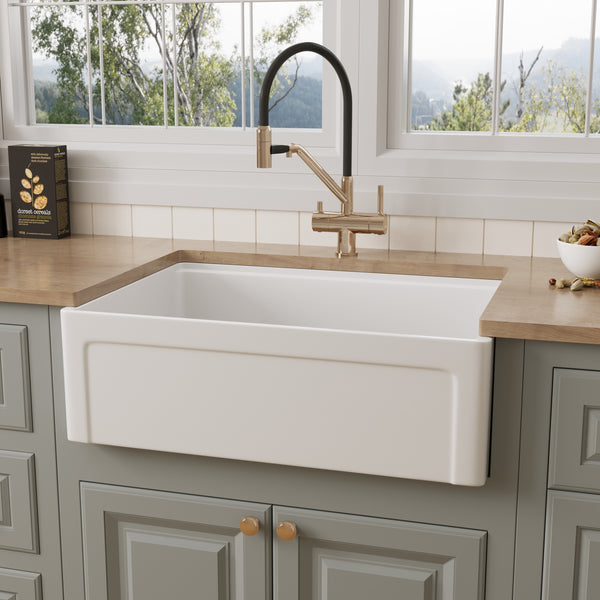
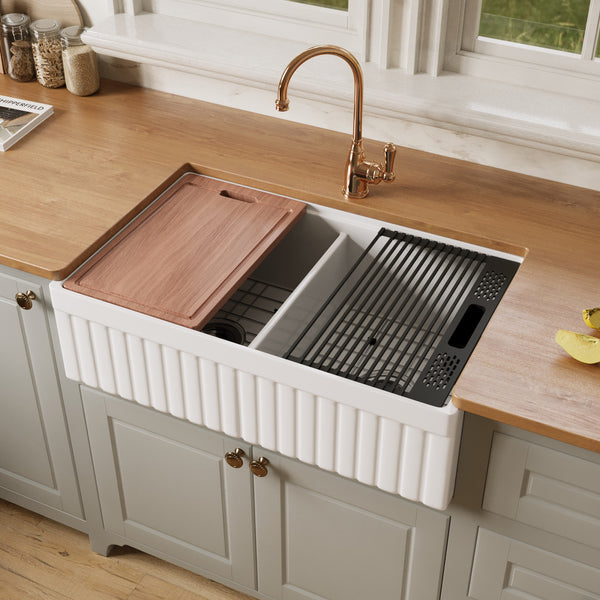
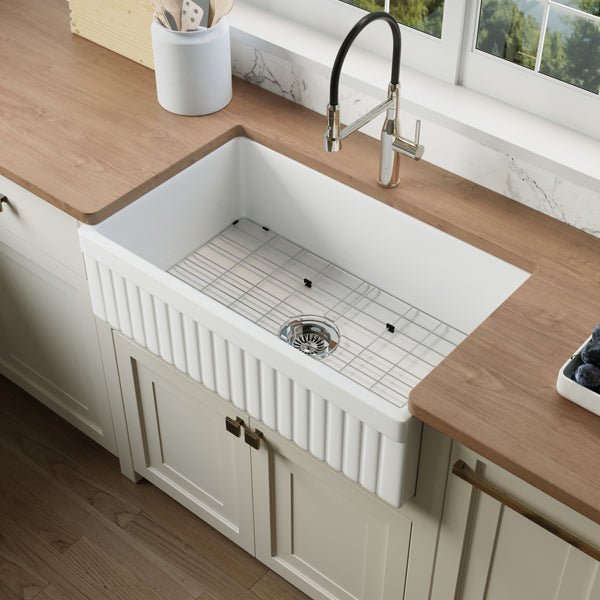
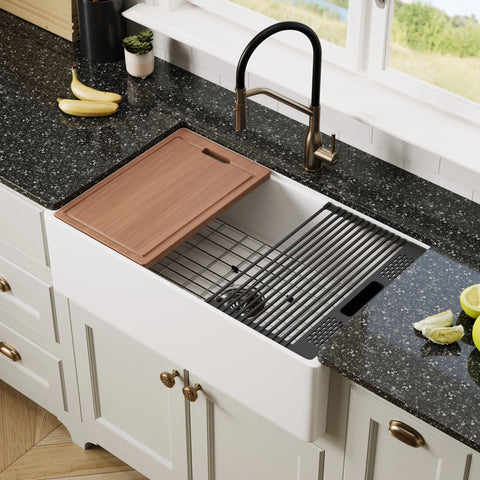
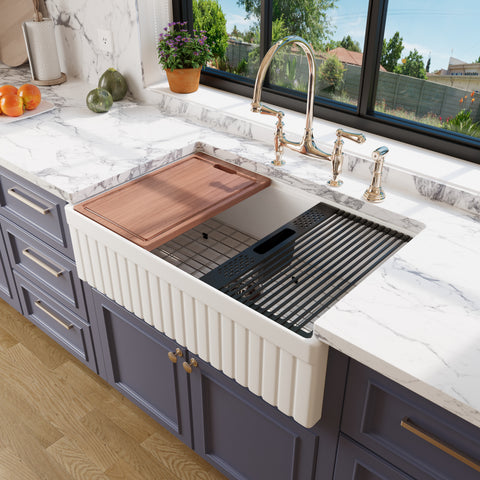
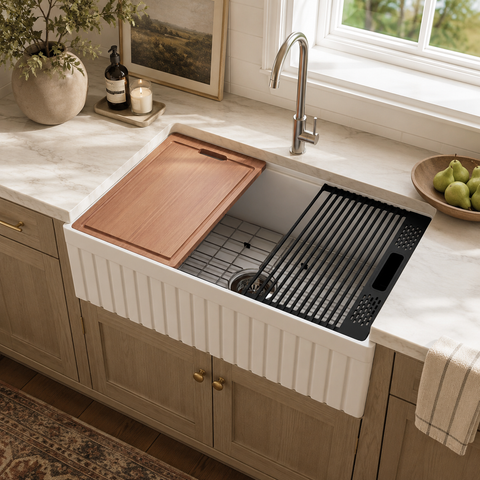
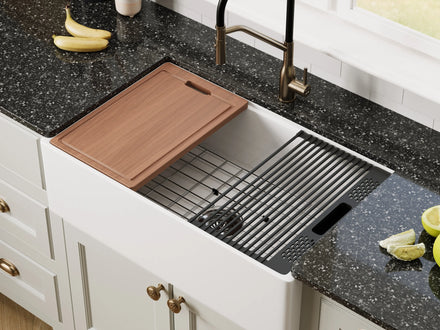
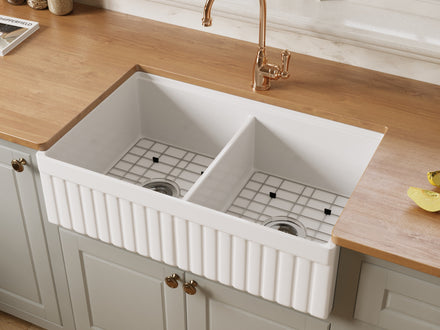
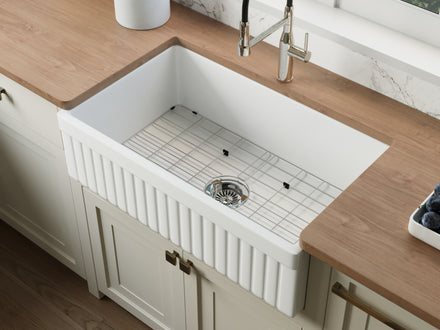
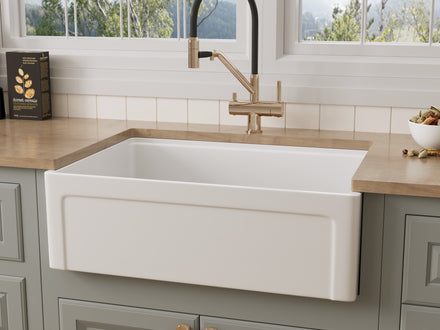
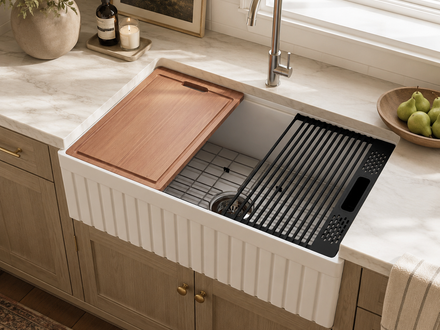
“Farmhouse” describes an exposed apron, while undermount and drop-in describe how the rim meets the countertop. Some apron-front sinks support more than one mounting method. If an exposed apron is part of the plan, use the focused farmhouse sink vs undermount guide for cabinet-face and remodel-scope decisions; this article owns only the two countertop mounting methods.
Can a Farmhouse Sink Be Drop-In?
Quick answer: A traditional farmhouse sink is neither a true undermount nor a true drop-in. The apron stays exposed on the cabinet face, and the bowl rests on supports built inside the cabinet, no clips and no rim. But drop-in farmhouse sinks (sometimes sold as top-mount farmhouse) do exist in small numbers. They keep the apron look and add a flanged rim that rests on the countertop, and that rim changes the install, the cleanup, and the look.
Apron-Front vs Drop-In Farmhouse
| Detail | Apron-front (standard install) | Drop-in farmhouse |
|---|---|---|
| What carries the weight | Supports inside the cabinet | Rim shifts part of the load to the counter |
| Countertop | Cut flush to the bowl, nothing on top | Needs a cutout the rim overlaps |
| Cleanup | Wipe water straight into the bowl | Raised rim catches water and crumbs at the seam |
| Front edge | Apron and counter meet in one line | Visible rim line breaks the front edge |
That rim seam is the honest downside of a drop-in farmhouse: it's a caulked ledge right where you rinse and scrub all day, so it needs regular wiping and an intact seal.
The mistake we actually see people make: templating a drop-in style cutout, then ordering an apron-front sink. An apron-front has no rim to cover that opening. The counter gets cut flush to the bowl, and the cabinet face gets modified for the apron. Confirm which format you bought before anyone cuts stone.
Every NOZLOO sink is apron-front, standard install. Our 33-inch and 30-inch models all run 20 inches front to back with 1-inch fireclay walls, and a 33-inch weighs roughly 100 to 115 pounds. The cabinet does the carrying, which is why we spec a 36-inch base cabinet minimum under a 33-inch sink and a 33-inch cabinet under a 30-inch.
Our take: a drop-in farmhouse is a fair choice for one specific job, a retrofit where you refuse to cut the cabinet face and doors. If you're already replacing the counter or remodeling, go apron-front. You get the clean wipe path and the look people mean when they say farmhouse sink.
How We Checked This Guide
On August 21, 2026, NOZLOO reviewed current guidance from the Natural Stone Institute, official laminate and solid-surface fabrication resources, and OSHA/NIOSH. We used those sources for support, sealing, replacement, and stone-cutting claims. Final fit still follows the selected sink's template, the countertop system, the fabricator's plan, and local requirements.

Frequently Asked Questions
Is an undermount sink better than a drop-in sink?
Not universally. Undermount suits a compatible new counter and a clear wipe path. Drop-in often suits an existing counter, a faster retrofit, or simpler access around the visible rim.
Can you install an undermount sink with laminate countertops?
Sometimes, but only with a sink and edge system specifically approved for laminate. Use its waterproofing method and professional installation rather than adapting a standard undermount detail.
Can I replace a drop-in sink with an undermount sink?
Possibly. A fabricator must confirm that the counter can take a finished opening, the cutout can be reshaped safely, and the cabinet can accept the required support.
Which sink is easier to clean?
An undermount gives the easier counter-to-bowl wipe because no top rim blocks the cloth. A drop-in rim needs wiping, while an undermount's underside joint still needs cleaning and inspection.
Which sink costs less to install?
A drop-in often needs less countertop fabrication, but total cost depends on the sink, opening, support, cabinet, plumbing, removal, and local labor. Compare itemized quotes.
Can an undermount sink be used as a drop-in sink?
Only if the manufacturer explicitly approves that exact model for dual-mount installation. Rim shape, finished surfaces, fastener positions, and sealing details are not interchangeable by default.
Final Verdict
Choose the countertop and cutout match first, then compare cleaning and appearance. Undermount is often the stronger new-counter choice; drop-in is often the more flexible retrofit. The exact model instructions decide.