Best Material for a White Kitchen Sink: 4 Surfaces Compared
Compare four white sink constructions by everyday marks, chip consequences, weight, care, and installation before choosing a surface.

In this guide View sections +
Reviewed: August 22, 2026 · Material definitions, search intent, installation limits, care boundaries, and NZ-103W3320 dimensions checked against the sources and product data below.
Quick answer: Choose by construction, not color alone. Glazed fireclay suits a smooth or fluted white apron-front look; porcelain enamel gives a glassy white surface over cast iron or steel; ceramic sinks use a fired ceramic body; and white composite usually has a matte, more uniform material appearance. None is stain-proof. The best choice is the wear pattern, weight, installation, and care routine you can accept.
A “white sink” is not one material. The same bright surface can sit over clay, ceramic, metal, or a composite body, and damage has different consequences in each construction.
Compare the Four White Sink Constructions
| Construction | Surface and everyday marks | Impact consequence | Installation reality |
|---|---|---|---|
| Glazed fireclay | Smooth glossy glaze; white scale has low contrast, while gray metal transfer or colored deposits may show | A hard strike can chip the glaze/body | Heavy farmhouse models need cabinet-tied independent support |
| Porcelain enamel over cast iron or steel | Glassy coating over a separate metal substrate | A chip can expose the underlying metal; the consequence depends on substrate and location | Cast iron is typically much heavier than steel; follow the exact model instructions |
| Glazed ceramic or vitreous body | Fired ceramic body with a glazed surface; construction and fixture use vary | Impact can chip or crack a brittle body | Confirm that the exact sink is made and approved for the intended kitchen installation |
| White composite | Often matte or softly textured; formula, pigment, and care limits vary by model | Surface change, impact behavior, and repairability are model-specific | Weight and mounting vary; verify support, heat limits, and cleaners before purchase |
The ASME standard for enamelled cast-iron and steel fixtures and the separate ASME ceramic-fixture standard are a useful reminder that similar-looking white sinks can belong to different construction categories.

First Identify the Surface and the Substrate
“Porcelain” is especially ambiguous in shopping language. It may mean a porcelain-enamel finish bonded to cast iron or steel, or it may refer loosely to a ceramic-bodied fixture. The Porcelain Enamel Institute defines porcelain enamel as glass bonded to metal at high temperature. That is not the same construction as fireclay or a ceramic body.
If that label is the source of your shortlist, the dedicated fireclay vs porcelain sink guide explains the substrate question without treating every glossy white surface as the same material.
Before comparing reviews, find four items on the exact model specification sheet:
- Body or substrate: fireclay, cast iron, steel, ceramic, or composite.
- Surface: glaze, porcelain enamel, polished metal, or through-body composite.
- Mounting: farmhouse/apron-front, undermount, drop-in, or another approved method.
- Care limits: approved cleaners, heat guidance, grid requirements, and warranty exclusions.
Do Not Call Every Mark a Stain
A white basin makes diagnosis easier because the mark is visible, but appearance alone does not identify the cause.
| What you see | Possible cause | Low-risk first response |
|---|---|---|
| Chalky white haze or rings | Mineral residue from hard water | Check the maker's care guide before using any acid or descaler |
| Gray line after a pan slides | Metal transfer on a harder light surface, or a true surface mark | Wash gently first; do not assume aggressive abrasion is safe |
| Dull film | Soap, grease, or cleaner residue | Rinse fully and dry, using only material-approved mild care |
| Sharp edge, missing surface, or visible dark layer | A true chip or exposed substrate | Stop scrubbing and ask the sink maker about repair or replacement |
The U.S. Geological Survey explains that hard water is largely dissolved calcium and magnesium and can leave mineral residue. That deposit is a water condition, not proof that the sink material itself has stained.

Choose by the Look and Wear You Can Accept
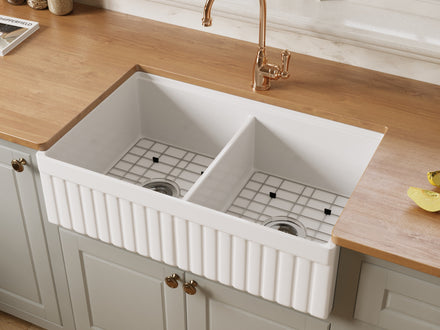
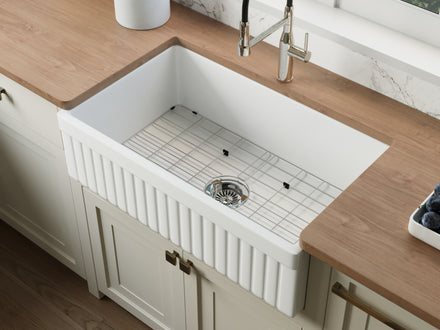
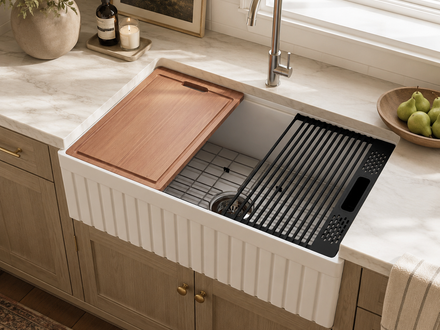
- Choose glazed fireclay when a smooth or fluted white apron-front is the goal and the cabinet can support a heavy sink. Accept that a hard impact can chip it.
- Consider enamelled cast iron when you want a glassy white metal-core fixture and can accommodate substantial weight. Ask what a chip would expose.
- Consider enamelled steel when a lighter metal substrate fits the project. Judge the exact steel, coating, sound control, and mounting—not the word “porcelain” alone.
- Consider a ceramic-bodied sink only after confirming it is intended for the kitchen use and installation you need.
- Consider white composite for a softer matte appearance. Verify the formula, heat limits, cleaning instructions, and how the finish handles mineral haze.
If color is not fixed, begin with the broader kitchen sink material comparison. If the decision is specifically white porcelain-labelled versus metal, use the focused porcelain vs stainless steel sink guide.

Let Installation Eliminate the Wrong Choices
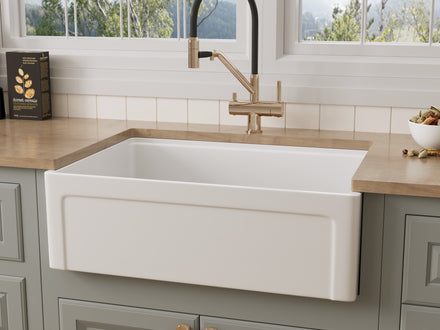
Measure the sink base and identify who will support the fixture before ordering. A heavy apron-front sink does not hang from thin countertop clips. Its support structure must transfer the load into the cabinet, with lower doors beneath the visible apron. The apron replaces the upper cabinet face; it does not sit inside a drawer opening.
Other white sinks may use drop-in rims, undermount hardware, frames, or model-specific supports. Countertop compatibility and field cuts vary. Follow the exact sink and counter instructions, plan plumbing around the real drain location, and use the fireclay farmhouse sink installation guide only when that is the construction you actually selected.
The diagram below uses the NOZLOO NZ-103W3320 only as a dimensional example. Its 9-inch measurement is not a universal fireclay depth; always use the dimensions for the exact sink being installed.

A White Fireclay Farmhouse Example
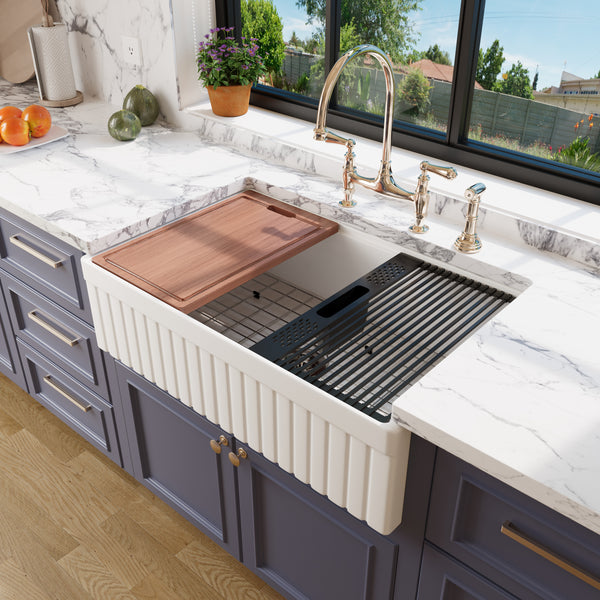
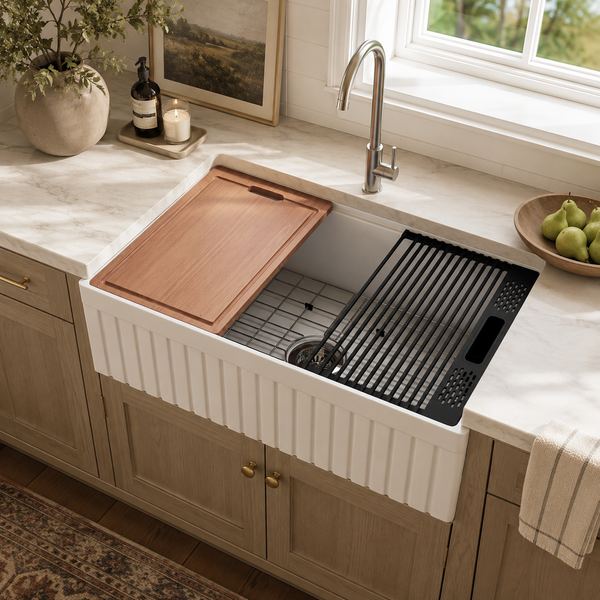
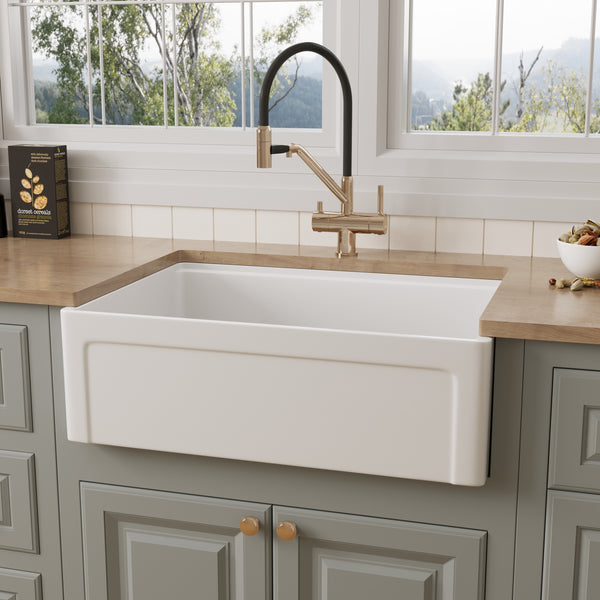
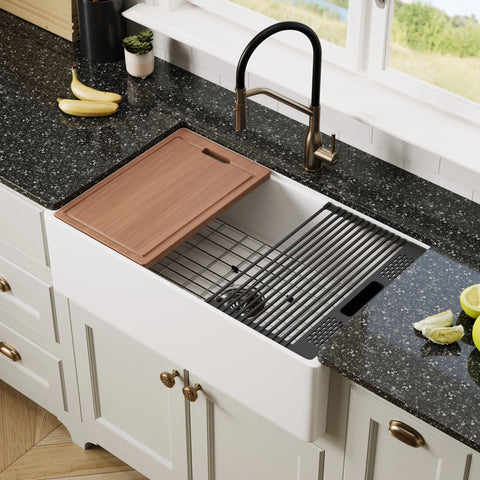
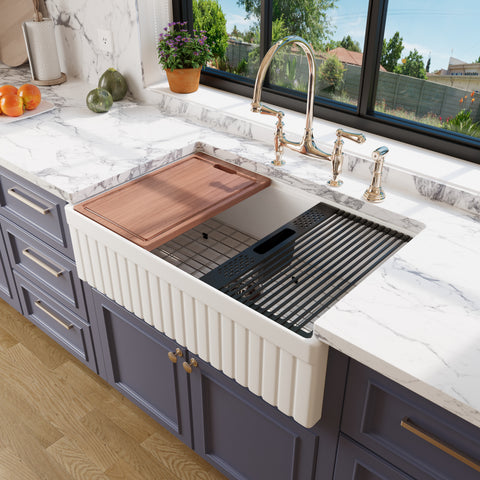
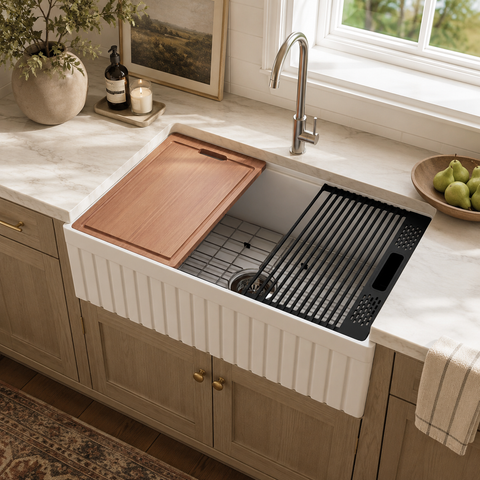
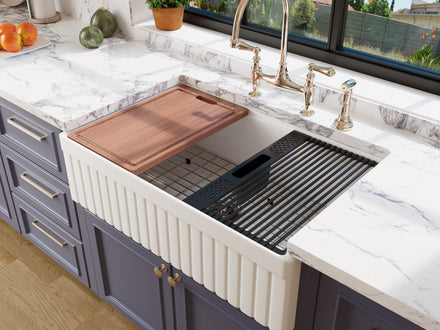
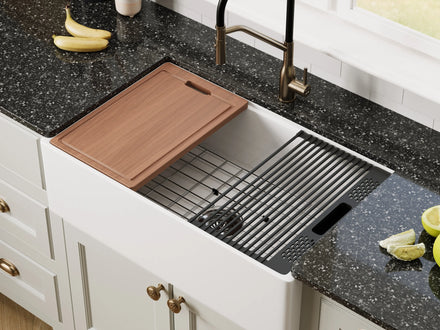
The NOZLOO NZ-103W3320 is a white glazed fireclay farmhouse sink—not porcelain-enamel metal, stainless steel, or composite. It measures 33″ × 20″ × 10″ overall with a 31″ × 17¾″ interior. The 9-inch interior depth is measured vertically from the rim to the lowest point at the centered drain, not at a side wall. It has a centered 3.5-inch drain, requires a 36-inch minimum cabinet, and weighs about 105 pounds.
It is a fit when you want a smooth or fluted white apron, a wide single bowl, and a properly supported installation. It is not damage-proof: lower heavy cookware onto a fitted grid instead of dropping it. Review the farmhouse sink cabinet-size guide before treating any 33-inch sink as an automatic fit.

How We Checked This Guide
NOZLOO reviewed live Google US results and related questions on August 22, 2026. ASME separates enamelled-metal, ceramic, and stainless plumbing-fixture standards; the Porcelain Enamel Institute supports the glass-on-metal definition; USGS supports the mineral-residue explanation. Product sheets and care instructions still control for a specific model.
Frequently Asked Questions
What is the best material for a white kitchen sink?
There is no universal best. Glazed fireclay fits a smooth white farmhouse look; enamelled metal provides a glassy surface over cast iron or steel; ceramic sinks use a fired body; and white composite often provides a matte look. Compare substrate, impact consequence, weight, mounting, and approved care.
Which is better, a stainless steel sink or a white sink?
Color alone cannot decide it. Stainless steel is usually lighter, avoids glaze chipping, and commonly shows water spots, fingerprints, and fine scratches. A white sink may be fireclay, enamelled metal, ceramic, or composite, so its weight, impact pattern, mounting, and care depend on the substrate. Choose stainless for a metal finish and generally lighter installation; choose a white construction when its appearance and specific wear pattern fit the kitchen.
Is there a white kitchen sink that does not stain?
No responsible material claim is “stain-proof.” Many visible marks are mineral residue, soap film, food color, or metal transfer rather than permanent staining. Cleaning safety and resistance vary by exact surface, so use the model's care guide.
Is a white composite sink the same as fireclay?
No. Fireclay is a fired clay body with a glaze. A composite sink contains mineral filler and binder in a model-specific formula and commonly has a matte or textured appearance. Verify composition rather than relying on color.
Are gray marks on a white fireclay sink scratches?
Not always. A gray line can be metal transfer from cookware, but it may also be surface damage. Start with approved mild cleaning and inspect it; do not jump to abrasive pads or compounds that the sink maker has not approved.
Which white sink material needs extra cabinet support?
Heavy fireclay and cast-iron models commonly need planned support, but the exact requirement belongs to the specific sink. A farmhouse sink should transfer its load into cabinet-tied rails, ledgers, posts, or another approved support system—not rely on thin countertop clips.