Is a 33 Inch Double Bowl Farmhouse Sink Worth It? How to Choose Double vs Single Bowl
Is a 33 inch double bowl farmhouse sink worth it? An honest double vs single bowl guide — who benefits, the sheet-pan problem, and how to decide.

In this guide View sections +
A 33 inch double bowl farmhouse sink is worth it if you hand-wash most of your dishes, like working in zones, or want a garbage disposal kept away from your clean-rinse side. It is a closer call if your cooking revolves around stockpots and oversized cutting boards, because each bowl is 15 inches wide — but sheet pans are not the deal-breaker they are on a full-height double: this is a low-divide sink, with the divider 2" (50 mm) below the rim, so a sheet pan lays flat across both bowls. That is the honest answer up front — the rest of this guide helps you figure out which camp you are actually in.
A quick note on where I stand. I'm Rokan, and at NOZLOO we make exactly six white fireclay farmhouse sinks in two sizes, 33 inch and 30 inch — nothing else. One of the six is a double bowl; the other five are singles. Since we sell both layouts at similar prices, I have no reason to steer you either way. I would much rather you buy the right sink the first time than deal with boxing up and freight-shipping a fireclay sink back.
Why the double bowl layout refuses to die
Kitchen designers have been predicting the death of the double bowl for years, and yet people keep asking us for one. The reason is simple: two bowls match how a lot of households actually work at the sink. One side holds hot soapy water while the other rinses. Dirty dishes stack on the left while the right stays free to fill a kettle or drain pasta. If a disposal lives under one bowl, food scraps stay on that side and never touch the side where clean dishes drip dry.
Hand-washers get the biggest payoff. Filling one bowl for washing and using the second for rinsing uses far less water than scrubbing everything under a running tap, and it turns a pile of dinner dishes into an assembly line. If that is your nightly routine, the divider is not a limitation — it is the whole point.
Who a 33 inch double bowl actually suits
Based on the conversations we have with buyers, the double bowl earns its place when several of these sound like you:
- You hand-wash daily. Wash bowl plus rinse bowl is the classic two-station workflow, and it works as well now as it ever did.
- You think in zones. Greasy pans and prep scraps on one side, clean rinse water on the other, without constantly re-rinsing the whole basin.
- You run a garbage disposal. Mounting it under one bowl keeps scraping and grinding away from the bowl you use for glassware.
- Two people share clean-up. One washes, one rinses and racks. A single bowl turns that into a shoulder-bumping exercise.
- You soak while you work. A casserole dish can sit in one bowl all evening while the other bowl stays fully usable.
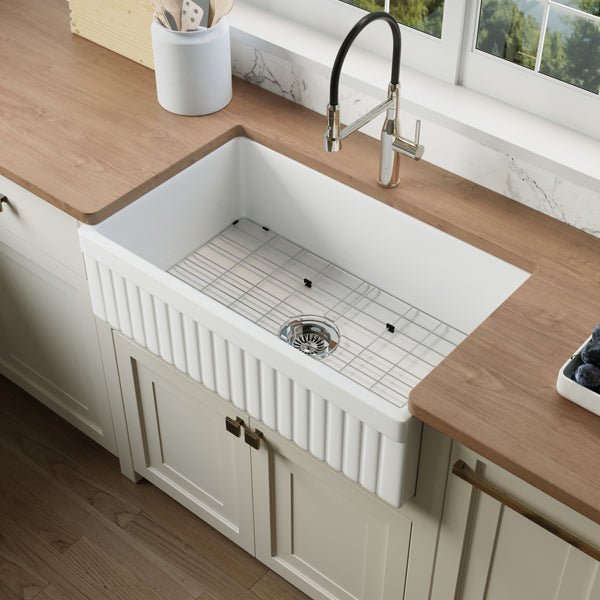
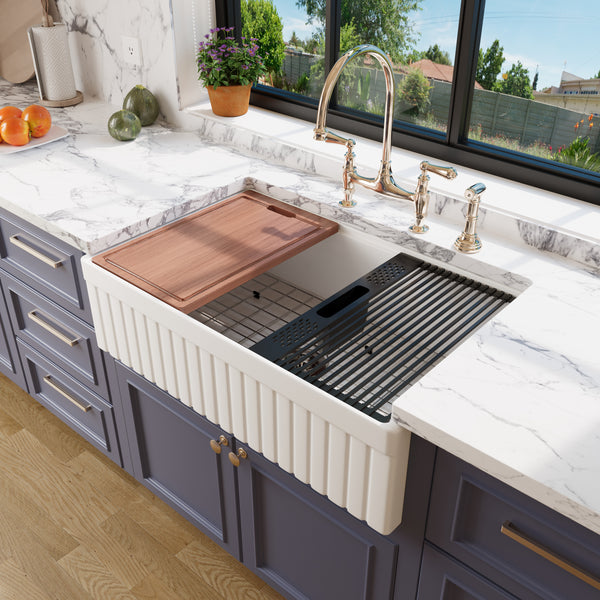
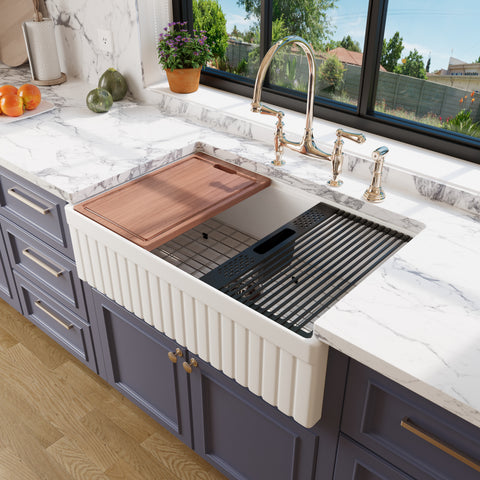
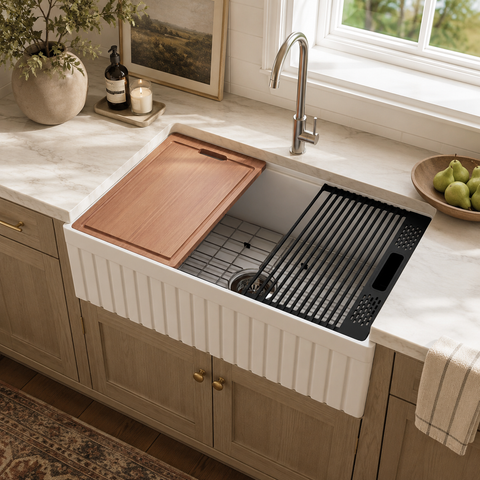
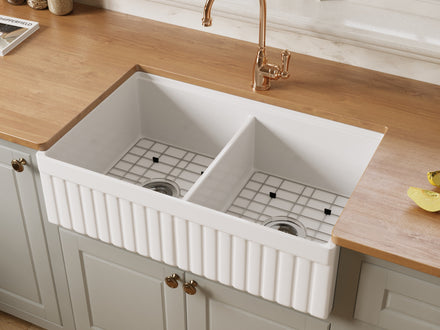
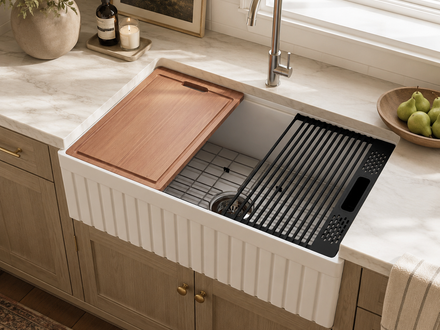
Our double bowl is the 33" Double Bowl 50/50 Workstation (NZ103W3320D) at $599. It splits the basin evenly, gives each bowl its own drain, and includes workstation rails across the top for cutting boards and drying racks.

The honest limitation: each bowl is 15 inches wide (and what the low divide fixes)
Here is the part that usually gets glossed over. A 33 inch sink sounds wide, but once you subtract the 1 inch (22–25 mm) fireclay walls and the center divider, each bowl in a 50/50 layout is 15 inches across. A standard half sheet pan measures about 18 by 13 inches, so it will not lie flat inside either bowl on its own. What changes the picture is the divider: on this sink it is a low divide, topping out 2" (50 mm) below the rim. Lay the sheet pan across both bowls and it sits flat on the divider; fill the sink above the divider line and it soaks. Wide stockpots and oversized cutting boards are still a 15-inch-bowl question — you can wash them, but you will be tilting and rotating more than you would in a single bowl.
The workstation rails give you a second option: because they span the full width of the sink, you can rest a sheet pan on the rails to scrub and rinse it up at counter height. For soaking a burnt pan overnight, use the divider instead — pan across both bowls, water above the divider line.
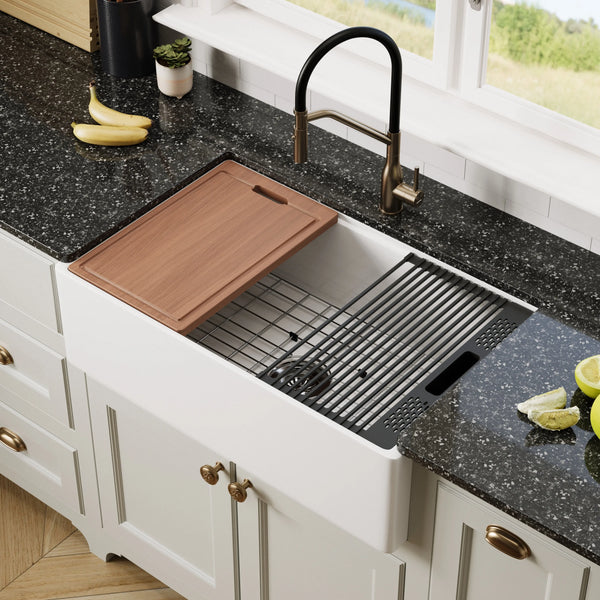
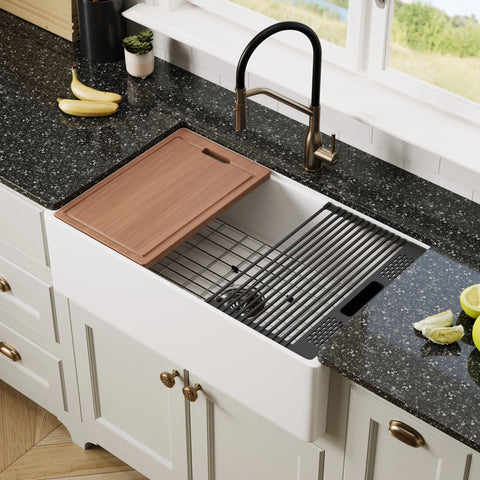
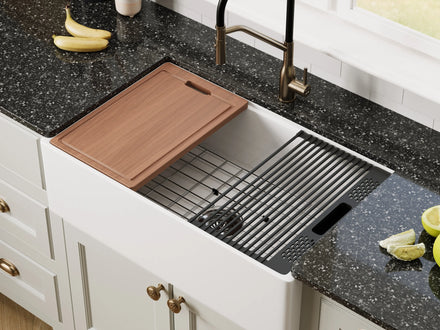
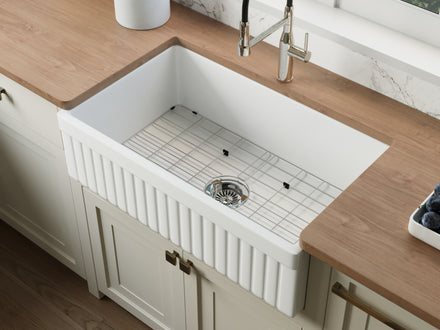
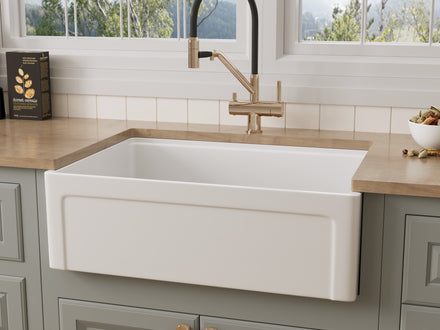
So the test is simple. If a big stockpot or a full-size roasting pan hits your sink more than a couple of times a week and you want it fully submerged, buy a single bowl and do not look back. Our 33" Smooth Apron Workstation (NZ3320S) at $519 gives you one uninterrupted basin, 10 inches deep, so pans lie flat and stockpots soak fully submerged.
Double bowl vs single bowl: side by side
| Spec | 33" Double Bowl 50/50 (NZ103W3320D) | 33" Smooth Single (NZ3320S) | 33" Fluted/Smooth Single (NZ103W3320) |
|---|---|---|---|
| Price | $599 | $519 | $569 |
| Bowl layout | Two bowls, even 50/50 split, low divide (2" below the rim) | One full-width bowl | One full-width bowl |
| Drains | Two, one per bowl | One, center | One, center |
| Workstation rails | Yes | Yes | Yes |
| Best for | Hand-washing, zoned work, disposals — sheet pans lay flat across the low divide | Sheet pans, stockpots, large boards | Same as the smooth single, plus a choice of apron texture |
All three are handmade fireclay with the same white glaze and the same 1 inch wall thickness, so you are not trading away durability with any of them. The real decision is layout, plus one styling question: the 33" Reversible Fluted/Smooth Workstation (NZ103W3320) at $569 has a reversible apron — install it fluted side out for a more traditional face, or flip it smooth for a cleaner modern line. At 105 pounds net, it is also a good reminder that fireclay is a two-person carry.
One more option worth knowing: if you like the single bowl layout but do not need the rails, we make a $479 reversible single without them, and it ships with a bottom grid and drain included.

The plumbing details worth checking before you order
A double bowl means two drains, and that is where the surprises hide. If you are replacing an existing double bowl, your under-cabinet plumbing is probably ready as-is. If you are coming from a single bowl, your plumber will tie the two tailpieces into one trap — a routine job, but worth confirming before installation day. Take a photo of your under-sink layout before you order; it answers most questions in one shot.
The 50/50 split is symmetrical, so if you plan to add a disposal, you can mount it under either bowl, wherever your outlet and habits prefer. Just remember the disposal eats cabinet space below that side, which matters if you also want a trash pull-out down there.
Fit, weight, and the unglamorous parts
The rule of thumb for apron-front sinks is a base cabinet about 3 inches wider than the sink, so plan on a 36 inch base for any of our 33 inch models. If your cabinet run is tighter, our 30 inch sinks at $549 are built to fit 33 inch cabinets instead.
Then there is weight. Fireclay is dense — our 33 inch fluted single weighs 105 pounds before you add water and dishes — so the cabinet needs a proper support frame underneath, not just cleats on the sides. And because every sink is handmade, dimensions can vary slightly from piece to piece. Wait until your sink arrives and template the cabinet cutout from the actual sink rather than from a spec sheet. That one habit prevents most of the installation headaches we hear about.

A five-question checklist
- What did you wash last night? If the answer involves a stockpot or a full roasting pan you want submerged, lean single. If it was a sheet pan, the low divide handles it either way. If it was plates, glasses, and a skillet done by hand, lean double.
- Does a dishwasher handle most loads? If the machine takes the dishes and the sink mostly sees cookware, a single bowl fits that job better.
- Do you soak things overnight? Big items need the single. Casseroles and mixing bowls soak fine in half of a double.
- Will a disposal live under there? A double bowl keeps grinding separate from rinsing, which disposal owners tend to appreciate daily.
- Have you lived with a double bowl before? Your own history beats any guide, including this one. If you loved it, you will love it again. If the divider drove you crazy, no feature list will change that.

What I would honestly tell a friend
Most kitchens today are better served by a single bowl — that is exactly why five of our six sinks are singles. If your dishwasher does the daily work and your sink's main job is handling big cookware, take the smooth NZ3320S or the fluted NZ103W3320 and never think about it again.
But if you read the hand-washing section and found yourself nodding, do not let the "single bowls won" narrative talk you out of it. For committed hand-washers, zone workers, and disposal households, the 50/50 double bowl is not a compromise — it is the right tool for the way you already work, and at $599 it costs $30 to $80 more than our 33 inch workstation singles.
You can compare all six models side by side in our fireclay farmhouse sink collection. Whichever layout you choose, the sink itself carries a Limited Lifetime Warranty (included accessories are covered for 1 year), ships free within the contiguous US, and comes with 30-day returns. And if you are staring at your cabinet wondering what fits, email us a photo — we reply within 12 hours, usually with a straight recommendation rather than a sales pitch.