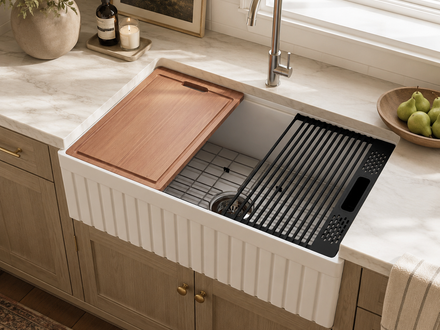
Fireclay vs Stainless Steel Sink: An Honest Comparison

Neither material is simply the better one. They suit different kitchens, and which way you lean comes down to how you cook, what you want to spend, and how long you plan to keep the place. Fireclay holds its looks with almost no effort, but it costs more and it's a project to install. Stainless steel is cheaper, lighter, and nearly impossible to damage, though it shows wear and can be noisy. Both will last for decades. Here's how they actually compare.
Fireclay vs Stainless Steel Sink at a Glance
| Fireclay | Stainless Steel | |
|---|---|---|
| Scratch resistance | High — the glaze resists everyday marks | Lower — fine scratches build up over time (brushed hides them) |
| Impact / chip risk | Can chip on a hard, direct hit, and a chip is permanent | Very high resistance — won't crack or chip; worst case is a dent |
| Stain resistance | Excellent — non-porous | Good — resists stains but shows water spots |
| Heat resistance | Excellent | Excellent |
| Noise | Quiet on its own — the dense body absorbs sound | Louder, but a thick 16-ga sink with pads gets close |
| Daily upkeep | A quick rinse | More frequent wiping for spots and fingerprints |
| Weight | Heavy (~80–120+ lbs); often needs cabinet reinforcement | Light; standard install |
| Price (sink only) | ~$450 – $1,800+ | ~$110 – $850 |
| Color options | Mostly white/off-white; a little black | Steel only |
| Configurations | Mostly single-bowl apron front | Nearly any size, layout, and mount |
| Best for | Design-led remodels where the sink is a feature | Any kitchen — budget, family, or chef-style |
How Each Material Is Made
Fireclay starts as a high-kaolin clay. It's molded, usually by hand, then glazed and fired in a kiln at very high heat, generally above 2,200°F. That firing fuses the glaze and the clay into a single dense, non-porous piece of ceramic.
Stainless steel is a chromium-nickel alloy pressed into shape by machine. You'll see it rated by gauge, and the numbering runs backwards from what you'd expect: the lower the number, the thicker the metal. For a home kitchen, 16- and 18-gauge are the range worth buying, and 304 (300-series) steel is the standard for shrugging off corrosion (Bob Vila).
So one is heavy, dense, and a little artisanal. The other is light, uniform, and made in just about every shape you can picture.
Durability: Two Kinds of Tough
People talk about durability as if it's one thing, but fireclay and stainless are tough in opposite ways.
Stainless wins on impact. Drop a cast-iron pan in the basin and the worst you'll usually get is a dent; it won't crack or chip. What it won't do is stay pristine. Over the years it picks up a fine web of scratches, and they show more on a polished finish than a brushed one. That's cosmetic rather than a failure, and plenty of people stop noticing it, or come to like the lived-in look.
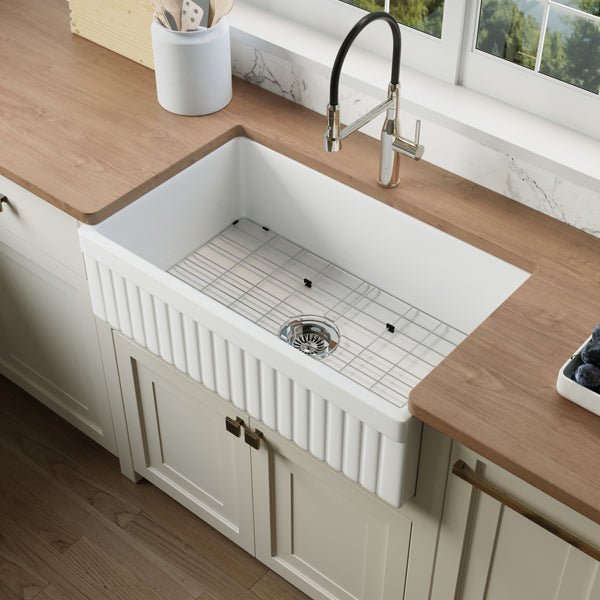
Fireclay wins on the surface. The fired glaze resists scratches, stains, and heat, so a good one still looks close to new after years of pots and pans, which is why the neutral guides tend to rate it as durable and long-lived (Bob Vila). The catch is impact. A hard knock at a bad angle can chip the glaze, and a chip doesn't behave like a dent, it's permanent. You can sometimes touch up a small one, but a deep chip or a crack usually means professional restoration or a new sink. A bottom grid is cheap insurance and worth using.
Put simply: stainless takes a beating without breaking but wears its history, while fireclay stays looking new but isn't chip-proof.
Maintenance
Cleaning stainless is easy: soap and water. The nuisance is how often you have to do it, because water spots, hard-water film, and fingerprints turn up fast on a shiny surface. Keep it looking sharp and you'll be wiping it down a lot. For the full routine we actually use, see our guide on how to clean a fireclay sink.
Fireclay asks less of you day to day. The glaze doesn't hold spots or stains, so a rinse after the dishes usually does it. The one thing to steer clear of is abrasive pads and scouring powders, which can dull the finish over time.
Noise
Thin metal rings, so a stainless sink amplifies running water, dropped dishes, and the disposal. It's a solvable problem, though. A thicker 16-gauge bowl with rubber pads and undercoating runs far quieter than a cheap 22-gauge one, and when Consumer Reports tested sinks, those dampening pads mattered more for quiet than the gauge itself did (Consumer Reports). Fireclay skips all of that; its sheer mass keeps it quiet on its own. Fireclay wins here out of the box, but a well-padded stainless sink closes most of the gap.
Heat
Both take hot pans without complaint. Fireclay was fired far hotter than your stove will ever get, and stainless won't warp or discolor. The only habit worth keeping with fireclay is not dumping boiling water into a cold, dry basin; run a little warm water first. Thermal-shock cracks are rare in a well-made sink and more of a risk in thin, low-fired clay, so it's an easy thing to avoid. Call it a wash.
Style
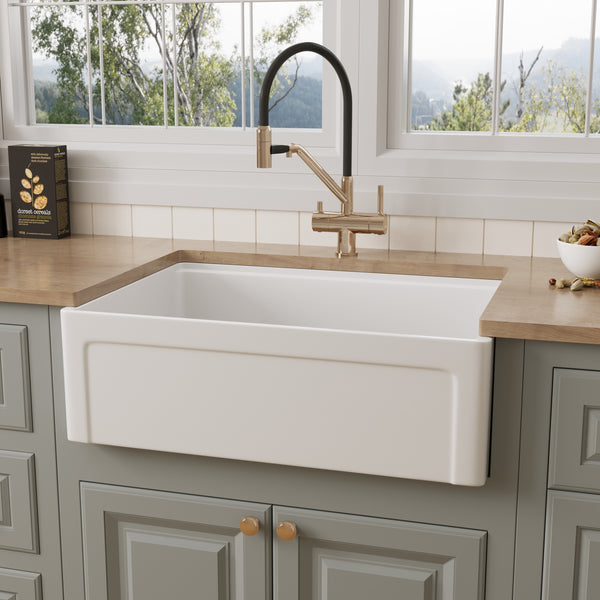
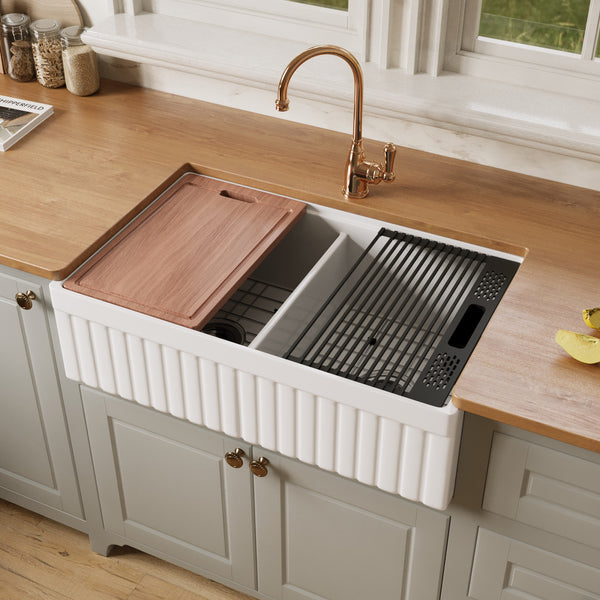
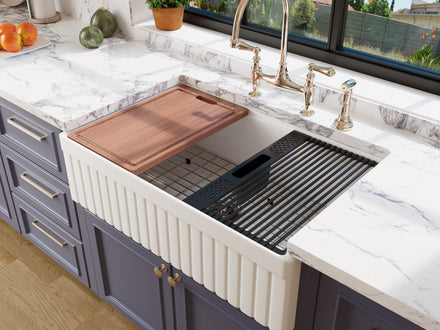
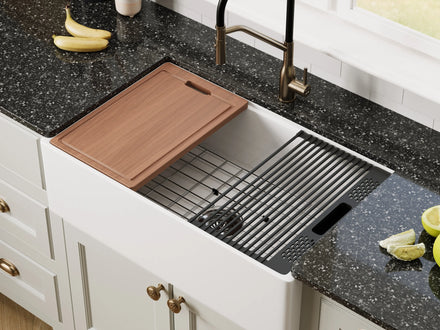
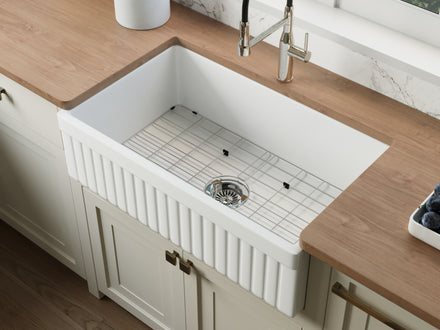
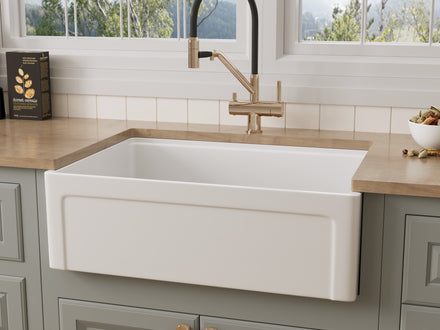
Stainless is the most common sink material out there, and it goes anywhere (Consumer Reports, Bob Vila). That's both the appeal and the ceiling. It works with any counter and any cabinet color, and a premium brushed or workstation model can look genuinely high-end, but it rarely becomes the thing people notice in a kitchen. Fireclay is the opposite. A white or off-white apron front anchors the room and reads warm in a way steel doesn't. It's most at home in farmhouse, transitional, and traditional kitchens, though it can carry a modern one too. Color is the trade-off: you're basically choosing between white, off-white, and a bit of black, and the colored options usually cost more (Angi).

Cost, Installation, and Long-Term Value
On price, a quality stainless sink runs about $110 to $850 with fixtures, depending on gauge and brand (Bob Vila). Fireclay sits higher, roughly $450 and up, and can climb well past a thousand for larger or premium models. The ranges overlap at the low end, but fireclay is generally the pricier material.
Installation is where the weight starts to matter. Stainless is light and drops into a standard cutout, often an under-an-hour job. Fireclay is heavy, 80 to 120-plus pounds, and usually needs reinforced cabinetry or a support frame, especially for apron fronts, which adds labor and time (Angi).
Over the long haul, the gap narrows. Both can go decades, but they age differently. Stainless shows scratches and spotting sooner, and some people replace it for looks long before it stops working. Fireclay tends to hold its appearance, so if you're staying put, you may get more years out of it before it starts to bother you. Neither is the cheaper choice in every case; it depends on how long you'll keep the kitchen and how much the finish matters to you.

Single Bowl vs Double Bowl
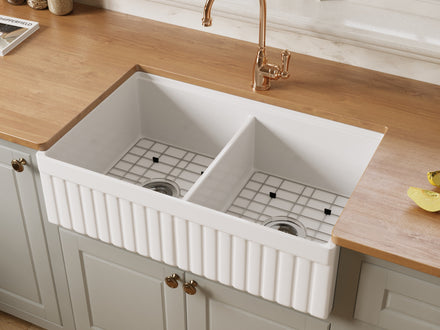
Stainless comes in every layout you can name: single, double, low-divide, undermount, drop-in, workstation. Fireclay mostly comes as a deep single-bowl apron front, though double-bowl versions do exist (Consumer Reports). A big single bowl handles sheet pans and stockpots better than a divided one, so for a lot of people that's no loss. But if you need a specific size or a true double bowl, stainless simply gives you more to choose from.
Resale
An apron-front fireclay sink tends to read as a desirable, design-forward feature, especially in a farmhouse-leaning home. If you're kitting out a rental or expect to sell soon, stainless is the safer bet, since it suits every buyer and never complicates the install. Just take any blanket "adds resale value" claim with a grain of salt, because it really depends on the buyer and the kitchen.
A Word on Other Materials
A few more will come up while you shop. Cast iron has a similar enamel look but is heavier and can rust where the coating chips. Porcelain and ceramic are fired cooler, so they're softer and stain more readily as the glaze wears. Granite composite is durable, matte, darker, and comes in more colors. We go deeper on the closest calls in fireclay vs ceramic, fireclay sink pros and cons, and do fireclay sinks crack easily.

So Which One?
Go with fireclay if you're keeping the kitchen a while, you want low upkeep and a sink that earns its place in the design, you like the farmhouse look, and you can absorb the higher cost and the heavier install.
Go with stainless steel if you want maximum impact resistance and no chip risk, you need a particular size or a real double bowl, you'd rather spend less, or you want something that disappears into a modern kitchen. It's also the deliberate pick for a serious cook's kitchen, where heavy-gauge stainless is a high-end choice, not a compromise.
Both are good answers. They just answer different questions.
Since we flagged it up top: we make fireclay, so if this pushed you toward it, sanity-check us against an independent source or two before you buy. And if stainless is where you land, that's a perfectly good outcome. If you do want to see fireclay options, ours are here.
FAQ: Fireclay vs Stainless Steel
Which is more durable, fireclay or stainless steel?
Depends what you mean by durable. Fireclay resists scratches, stains, and heat better and keeps its looks longer. Stainless is far harder to crack or chip. So fireclay usually looks better over time, while stainless holds up better to a hard, direct hit.
Do fireclay sinks chip easily, and can you fix a chip?
Not under normal use, but a hard, direct impact can do it, and a fireclay chip is permanent. A small one can sometimes be touched up; anything deep usually needs professional restoration or a replacement. A bottom grid is the cheapest way to lower the odds.
Which sink is quieter?
Fireclay, on its own, because its dense walls soak up sound. Stainless rings more, but a thick 16-gauge sink with dampening pads gets close. The loud ones are the thin, cheap bowls.
Are fireclay sinks high-maintenance?
No. The non-porous surface doesn't cling to stains or water spots the way stainless does, so a rinse after use usually does it. Just skip abrasive scrubbers.
Can you put hot pans in either sink?
Yes, both shrug off normal cooking heat. With fireclay, just don't pour boiling water into a bone-dry cold basin; run some warm water first.
How long do they last?
Both can go decades. The difference is looks: fireclay tends to keep its finish, while stainless usually shows scratches and spotting sooner, which is what prompts a lot of people to swap it out early.
Why does fireclay cost more?
It's more work to make, molded and kiln-fired at extreme heat, and it's heavy, which drives up shipping. Stainless is machine-pressed and lighter, so it comes in cheaper.
Can you use a garbage disposal with a fireclay sink?
Yes. Fireclay's thicker drain opening usually needs an extended disposal flange instead of the standard one. Once that's on, it mounts and runs just like it would on stainless.
Which is more eco-friendly?
Stainless is highly recyclable and worth money as scrap, so it gets melted down and reused without losing quality. U.S. steel packaging is recycled at over 70% (EPA), though rates vary by product. Fireclay isn't part of a mainstream recycling stream, but as an inert ceramic it can be crushed and reused instead of landfilled. Either way, longevity matters most: a sink that lasts decades gets replaced far less often.
Which is better for a farmhouse kitchen?
Fireclay is the classic pick, since the apron front and warm white are signature farmhouse elements. Stainless farmhouse sinks exist, but they read more industrial than rustic.
Sources
- Consumer Reports — Best Sink Buying Guide (independent sink testing: material popularity, gauge vs. sound-dampening, bowl configurations)
- Bob Vila — The 7 Best Kitchen Sink Materials for Your Renovation (material comparison, gauge and grade, pricing)
- Angi — Fireclay Sink Pros and Cons (fireclay cost, weight and installation, colors)
- U.S. EPA — Ferrous Metals: Material-Specific Data (steel recyclability)
Related guides: fireclay vs granite composite