Copper Sink Pros and Cons: Copper vs Glazed Fireclay
Compare copper sink finishes, patina, upkeep, construction, gauge, seams, drain and support requirements, plus how copper differs from glazed fireclay.

In this guide View sections +
Reviewed: August 23, 2026 · Copper finish terminology, US search questions, antimicrobial-claim limits, buying checks, and NZ-103W3320 specifications checked against the research record.
Quick answer: A copper sink makes sense if you genuinely want a surface that can change color and show use. Its biggest advantage is visual character; its biggest risk is expecting every finish to age, clean, and wear the same way. Before buying, identify whether the sink is natural, pretreated, or sealed, then verify actual thickness, seams, drain, cabinet support, care instructions, and warranty. Choose glazed fireclay instead when a stable white apron-front appearance matters more than a living metal finish.
Copper is not automatically better—or harder to live with—than another sink material. The decision turns on the exact finish and construction. Start with our kitchen sink material guide if copper is still one of several options.
Copper Sink Pros and Cons at a Glance
| Decision point | Potential advantage | Trade-off to accept or verify |
|---|---|---|
| Appearance | Warm color and one-of-a-kind tonal variation | Natural and pretreated finishes may change unevenly |
| Impact behavior | No brittle glaze layer to chip in the same way as a ceramic surface | Thin sheet can dent; rims and seams still need good workmanship |
| Finish choices | Bright, dark, hammered, pre-aged, or coated looks | Finish names do not reveal care limits or whether color is stabilized |
| Daily marks | Some buyers enjoy the accumulated patina | Acidic food, salt, minerals, and cleaners can create unwanted contrast |
| Construction | Can be formed into apron-front and other shapes | Thickness, forming, seams, drain detail, and support vary by model |
| Hygiene | Some specifically registered copper-alloy surfaces have limited antimicrobial claims | An unspecified kitchen sink is not self-disinfecting; normal cleaning still applies |
First Identify the Copper Finish
Natural or unsealed copper is meant to react with use and its environment. It can darken, lighten in contact spots, and develop irregular brown, red, black, or other tones. There is no honest universal patina timeline because water, air, food, hands, cleaners, and use patterns differ.
Pretreated or pre-patinated copper has color established during production. It may begin dark brown or variegated rather than bright orange. “Pre-aged” does not necessarily mean sealed, and it does not guarantee that the starting color will remain unchanged.
Sealed or clear-coated copper uses a coating to slow direct contact and preserve an appearance while the coating remains intact. That creates a different ownership problem: the coating has its own heat, abrasion, cleaner, repair, and warranty limits. A sealed sink should not be polished or chemically treated as though it were bare copper.

The National Park Service metal-care handbook defines patina as a colored layer that may form naturally or be produced artificially, and lacquer as a separate resin coating. That conservation reference is not a sink-cleaning recipe; it explains why finish identification must come before maintenance advice.
The Advantages Buyers Usually Want
- Visual depth: copper has warmth and tonal variation that stainless steel, white glaze, and uniform composite surfaces do not reproduce.
- A surface that records use: on an unsealed finish, changing color is part of the material story rather than automatically a defect.
- Farmhouse character: a copper apron can become the strongest visual element in a rustic, traditional, or collected kitchen.
- Different impact behavior: copper will not chip like a brittle glaze, although a thin bowl may dent and a severe impact can still deform a rim or floor.
- Fabricated forms: formed and joined construction allows smooth or hammered bowls, apron fronts, and decorative details—but also makes workmanship important.
The Drawbacks That Cause Buyer Regret
Color is not fixed. If the purchase depends on matching one showroom sample forever, natural copper is a risky choice. Pretreated and sealed finishes may be more controlled, but only the written care and warranty terms explain what change is expected.
Food and cleaners can alter the look. Acidic ingredients, salt, mineral deposits, abrasive polishing, and incompatible chemicals can create bright or dark spots on exposed copper or damage a coating. Prompt cleanup may reduce contrast, but restoration is finish-specific. This buying guide deliberately leaves the full routine to the material-cleaning owner rather than inventing one recipe for every copper sink.
Thickness is not the whole quality story. A thicker sheet can resist denting better than a thinner version of otherwise similar construction, but gauge alone says nothing about a poorly formed rim, a rough seam, an unstable base, or a vulnerable coating. Historic U.S. Bureau of Standards sheet-metal tables show that several gauge systems have existed and that Brown & Sharpe gauge was used for nonferrous sheet such as copper. Ask for actual thickness in inches or millimeters and the named system.
Handmade does not remove the need for tolerances. Hammer marks and tonal variation can be intentional. A rocking flange, distorted drain opening, incomplete seam, or dimensions outside the accepted installation plan are different issues. Get the sink on site before final cabinet and countertop work.
Six Specifications to Check Before Ordering
- Base metal and finish: ask what the bowl is made from, whether the surface is natural, pretreated, or coated, and which appearance changes are excluded from warranty.
- Actual thickness: record inch or millimeter thickness and the gauge system. Compare like with like; do not copy a stainless-steel gauge assumption onto copper.
- Forming and seams: inspect corners, apron transitions, welds or soldered joints, rim flatness, and underside finishing. Ask how a seam defect is handled.
- Overall and bowl dimensions: verify exterior width, front-to-back size, interior dimensions, apron height, and minimum cabinet. Nominal width alone is not a cutout.
- Drain and disposal: confirm opening diameter, center or offset location, flange depth, included drain, and disposal compatibility. Use our farmhouse sink plumbing guide to map the space below.
- Mounting and support: obtain the exact installation instructions, loaded weight assumptions, fasteners or frame, countertop requirements, and any cabinet reinforcement. Adhesive and plumbing are not substitutes for structural support.

Our standard kitchen sink size guide explains overall size versus usable bowl size. The delivered sink and its current instructions must control fabrication.
Copper vs Glazed Fireclay
| If you prioritize… | Copper direction | Glazed fireclay direction |
|---|---|---|
| Color behavior | Warm living surface; natural or pretreated patina may evolve | Stable glossy glaze, commonly white |
| Daily wear | Tonal shifts, water marks, possible dents depending on construction | Metal transfer can mark glaze; severe impact can chip an edge |
| Care decision | Finish-specific; bare and coated copper cannot share one routine | Glaze-specific care with nonabrasive tools and current instructions |
| Installation | Weight and support vary widely by model and fabrication | Full-size fireclay is very heavy and needs independent cabinet-tied support |
| Best aesthetic fit | Buyer wants change, warmth, and artisan variation | Buyer wants a smooth or fluted white apron-front statement |
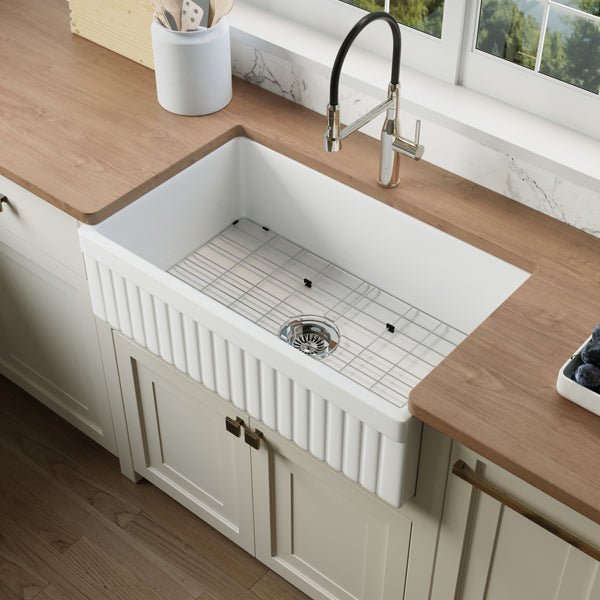
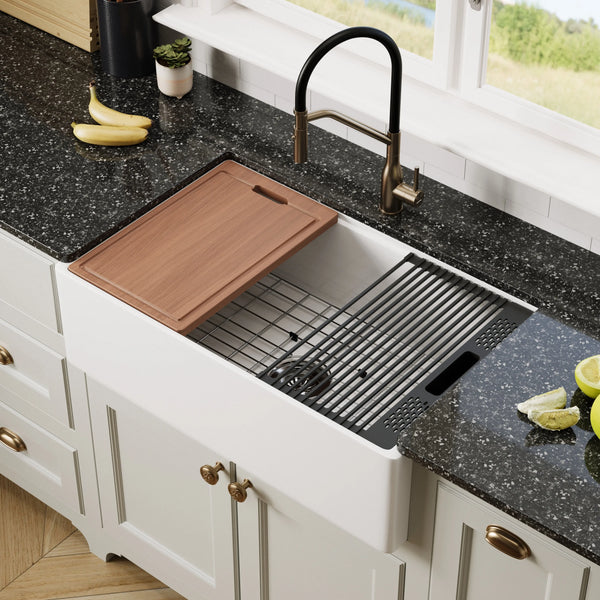
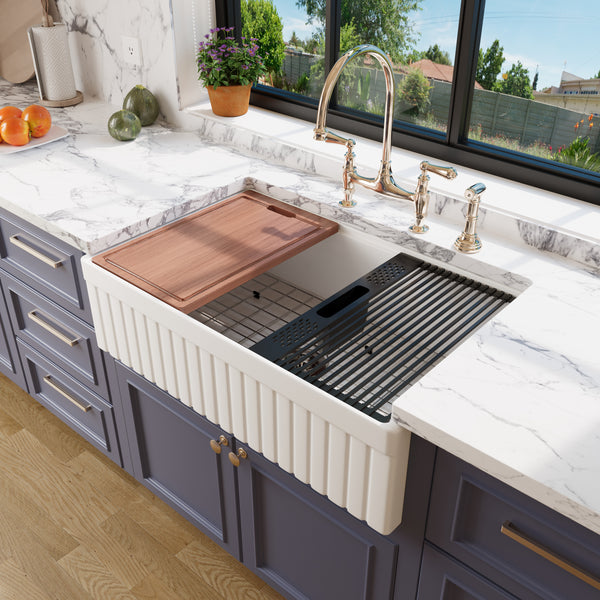
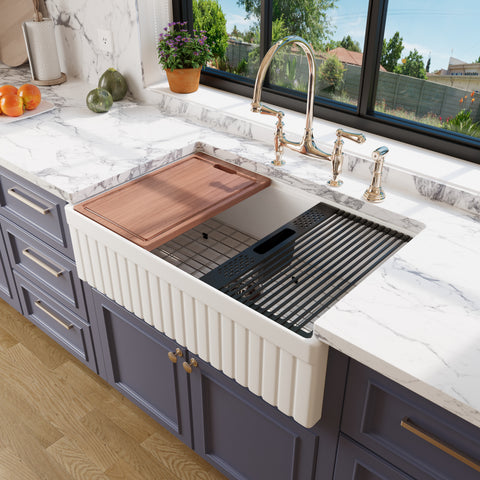
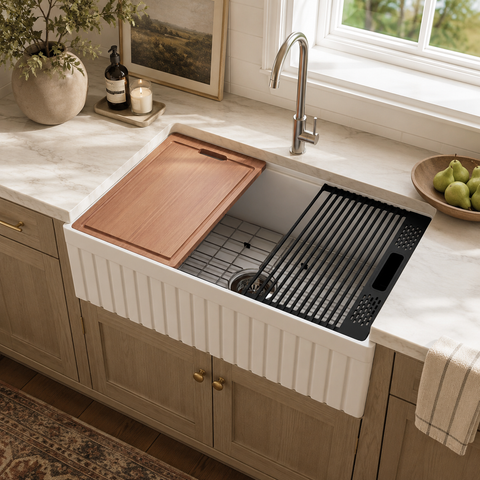
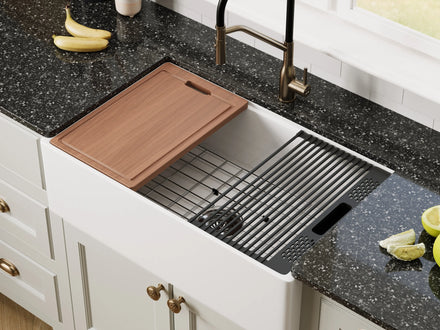
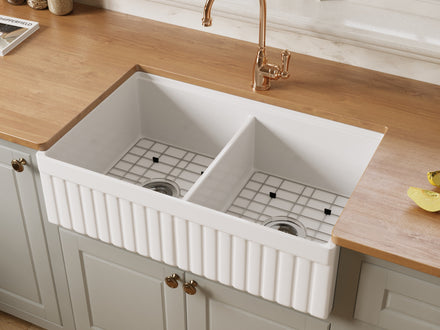
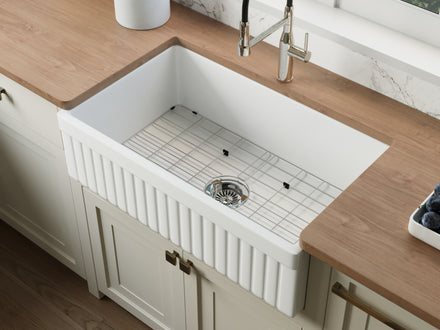
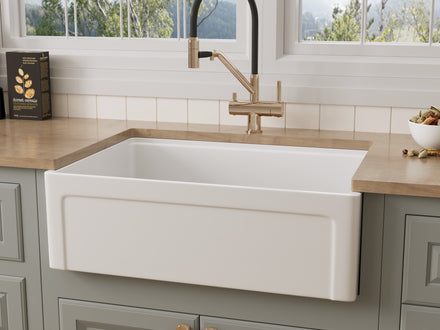
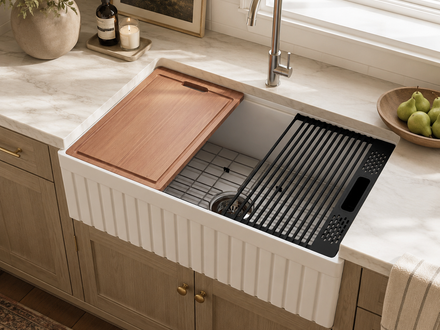
Neither material wins every category. If the changing copper finish is the attraction, buy the exact finish and construction you understand. If you prefer a white glazed apron-front, review the broader fireclay sink pros and cons and fireclay buying guide. The product below is glazed fireclay, not copper.

The NZ-103W3320 interior depth is measured vertically from the rim to the lowest point at the centered drain, not at a side wall. Fireclay is hand-finished, so use the delivered sink for final cabinet and countertop work.
Do Copper Sinks Disinfect Themselves?
No unspecified copper sink should be marketed that way. The EPA protocol for registered antimicrobial copper-containing surfaces limits claims to qualifying products maintained according to approved directions and says their use supplements rather than replaces normal hygiene. Alloy, finish, coating, contact time, registration, and intended use matter.
The EPA distinguishes products that clean, sanitize, and disinfect and directs users to the approved label use. A copper-colored basin still needs ordinary cleaning, and any sanitizer or disinfectant must be approved for the exact finish and used according to its label.
Frequently Asked Questions
Are copper kitchen sinks a good idea?
Yes for a buyer who values evolving color and accepts finish-specific care. No for someone who expects a perfectly uniform, permanently bright surface. Construction, seams, thickness, drain, support, and warranty matter as much as appearance.
Will copper sinks turn green?
They can develop green or blue-green compounds, but that is not the only or inevitable indoor outcome. Copper may first darken or develop brown and black tones, and a sealed surface behaves differently. Do not diagnose a green area from color alone; check for trapped residue, coating damage, and the maker's guidance.
Will bleach ruin a copper sink?
It can alter bare copper or damage some patinas and coatings, so never assume compatibility. Check the exact sink care guide and the cleaner label. This article does not provide a universal bleach dilution because copper finishes are not interchangeable.
How long will a copper sink last?
There is no reliable material-only lifespan. Sheet thickness, seams, drain construction, support, water chemistry, finish, care, and repairability all affect service life. Ask what the warranty covers and excludes rather than relying on a generic number.
Why would someone want a copper sink?
Usually for warmth, artisan texture, and a living finish that records use. It is a design choice with maintenance consequences, not a shortcut to a maintenance-free or self-sanitizing kitchen.
Is copper better than fireclay?
Not universally. Copper suits buyers who welcome changing color and possible dents rather than brittle chipping. Glazed fireclay suits buyers who prefer a stable white surface and substantial apron-front form, while accepting heavy weight, independent support, and the possibility of severe-impact chips.
How We Checked This Guide
NOZLOO reviewed the live Google US result mix and People Also Ask questions on August 23, 2026. We separated repeated seller and forum claims from EPA antimicrobial-copper and cleaning-product conditions, National Park Service finish definitions, and U.S. Bureau of Standards gauge references. NZ-103W3320 dimensions use current owner-approved product data. The exact sink specification, finish instructions, delivered product, accepted fabrication plan, and applicable requirements take priority over this general guide.