How to Clean a Kitchen Sink by Material

Reviewed: August 23, 2026 · Scope limited to identifying common kitchen sink materials and choosing a safe routine-cleaning baseline. Model-specific care instructions always control.
Quick answer: Identify the sink material before choosing a cleaner. If its current care guide permits it, start with warm water, a small amount of mild dish soap, and a soft non-scratch cloth or sponge. Remove loose food, wash without forcing grit across the surface, rinse away all cleaner, and dry if water spots matter. Do not assume vinegar, baking soda, bleach, steel wool, or a melamine sponge is safe for every sink.
A kitchen sink can look simple while hiding very different surfaces: glazed fireclay, stainless steel, enameled cast iron, engineered composite, copper, natural stone, or acrylic-based solid surface. The best way to clean a kitchen sink therefore begins with one question: what is this surface?
This guide owns the cross-material routine-cleaning decision. For detailed stain treatment on a NOZLOO basin, use the fireclay sink cleaning guide. If raw meat or poultry contacted the sink, routine cleaning is only the first step; switch to a dedicated clean-then-sanitize workflow.

First Decide What Job You Are Doing
| Job | What it addresses | Where to go next |
|---|---|---|
| Routine cleaning | Loose food, grease, soap film, and visible soil | Use the material matrix below |
| Stain or mark diagnosis | Mineral scale, metal transfer, rust-colored marks, or an altered finish | Identify the mark before escalating the cleaner |
| Sanitizing or disinfecting | A defined germ-risk event, such as raw poultry juices | Clean first, then follow the sanitizer or disinfectant label |
| Drain maintenance | Slow flow, odor from the drain, or a blockage below the basin | Treat it as a plumbing/drain task, not a surface-cleaning task |
The EPA distinguishes cleaning from sanitizing and disinfecting: cleaning removes dirt and organic matter with soap or detergent. That is the correct lane for regular sink care.
How to Identify Your Kitchen Sink Material
Color alone is not proof. A glossy white basin could be fireclay, vitreous china, porcelain enamel over metal, or another ceramic surface. A dark matte bowl could be one of several engineered composites with different binders and care limits.
- Find the paperwork first. Check the order confirmation, model label, installation manual, or product page.
- Inspect a hidden edge or underside. An exposed metal edge may indicate enamel over metal; a consistently glazed ceramic body may point to fireclay or vitreous china. Do not chip or scratch the surface to test it.
- Look at finish and construction. Stainless typically has a visible brushed grain. Copper changes color as a patina develops. Composite often has a uniform matte or finely speckled body.
- Ask before experimenting. If the material or finish is uncertain, use the mildest maker-approved option or contact the seller. A magnet test, tap sound, or internet photo is not conclusive.

A Safe Daily Cleaning Baseline
Once the material's care guide confirms that mild dish soap is acceptable, this short routine handles ordinary food and grease without turning every cleanup into a deep clean:
- Remove dishes, scraps, and any removable grid or strainer basket.
- Rinse loose grit toward the drain so it is not dragged under the sponge.
- Put a small amount of approved mild dish soap on a damp soft cloth or non-scratch sponge.
- Wipe the bowl, corners, rim, drain surround, and faucet splash zone with light pressure.
- Rinse until no cleaner or loosened soil remains.
- Dry with a clean soft cloth when dried droplets or mineral spots are a concern.
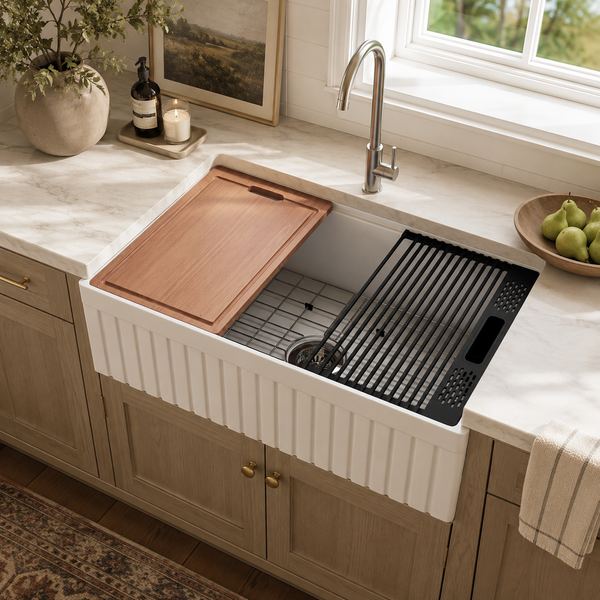
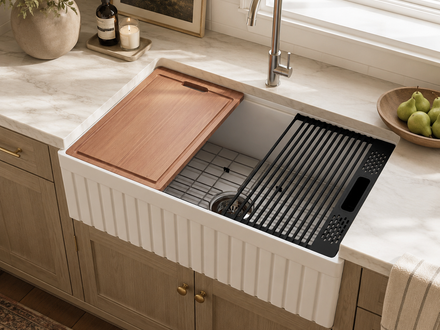
Clean a sink grid separately, including its feet and wire intersections, then rinse beneath it before replacing it. The complete accessory procedure remains in the farmhouse sink accessories guide.

Kitchen Sink Cleaning by Material
| Material | Routine starting point | Pause before using |
|---|---|---|
| Glazed fireclay | Maker-approved mild dish soap, soft sponge, complete rinse, optional dry | Steel wool, hard impact, concentrated bleach, acids, or abrasives not approved for the glaze |
| Stainless steel | Mild soap and soft cloth; wipe with the visible grain when the finish has one | Steel wool, scrubbing across the grain, or leaving chloride-containing chemicals on the surface |
| Porcelain enamel or enameled cast iron | Mild soap and a non-scratch sponge; rinse and dry around chips | Impact, metal scouring pads, and aggressive abrasives that can dull or breach enamel |
| Quartz or granite composite | The exact maker's approved mild cleaner and soft pad | Assuming every “granite composite” formula has the same heat, acid, bleach, or abrasive limits |
| Copper or brass | Mild soap, soft cloth, prompt rinse, and a care plan that respects the intended patina | Acidic polish, abrasive paste, or patina removal unless that finish is intentional and approved |
| Natural stone | A pH-neutral cleaner approved for the exact stone and sealer | Vinegar, lemon, generic descaler, or prolonged soaking without fabricator approval |
| Solid surface or acrylic | Mild soap and a non-scratch cloth; rinse fully | High heat, harsh solvents, or abrasive restoration methods not authorized for that product |
This is a conservative starting matrix, not permission to override a manual. Finishes, coatings, composite recipes, sealers, and warranty conditions vary within the same material family. If you are still choosing a sink rather than cleaning one you already own, the kitchen sink materials comparison owns the purchase tradeoffs.
How Often Should You Clean a Kitchen Sink?
| Timing | Practical action | Reason |
|---|---|---|
| After messy use | Remove scraps, rinse, and wipe visible grease or sauce | Stops soil from drying into a harder film |
| At the end of the day | Wash contact areas, rinse under accessories, and dry if needed | Resets the bowl without aggressive weekly scrubbing |
| Weekly, or as use requires | Lift accessories and inspect corners, drain surround, rim, and seal | Finds trapped moisture and buildup early |
The right frequency follows actual use. A prep sink used once a day and a family workstation used for every meal do not need identical schedules. The University of Georgia Cooperative Extension recommends prompt spill cleanup and rinsing sinks after use to reduce buildup; it also notes that coarse abrasives can scratch surfaces.
Do Not Turn Every Mark Into a Scrubbing Contest
If the mild routine does not remove a mark, stop and identify it. Pale crust may be mineral deposit; gray lines on a white basin may be metal transfer rather than a stain; orange or dark marks can point to water quality or plumbing rather than ordinary food soil. Deposit visibility and cleaner compatibility are separate questions, so do not assign one treatment to every surface.
Escalating pressure can convert a removable mark into permanent finish damage. Do not mix cleaning products; follow the product label and the current care guide for every surface it can touch.
Where Fireclay Fits
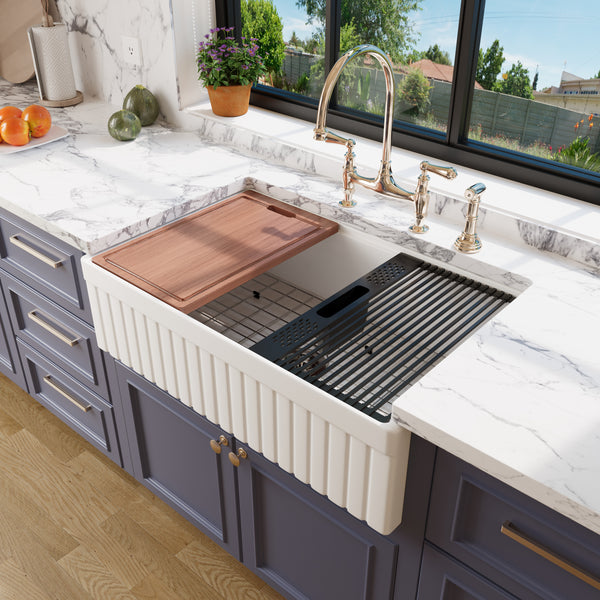
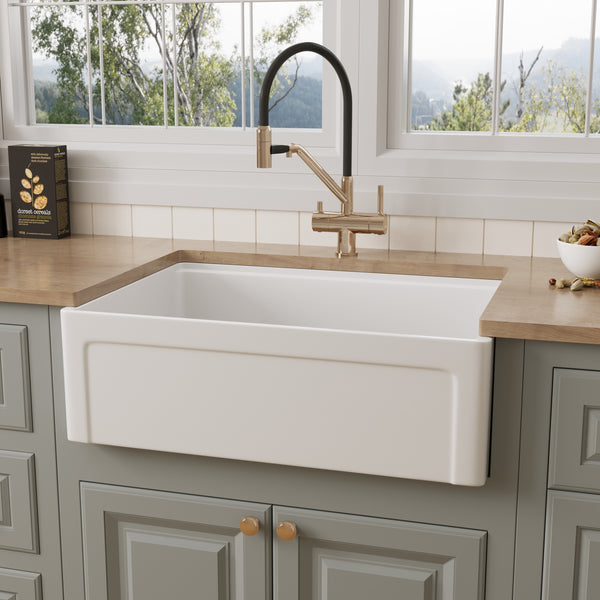
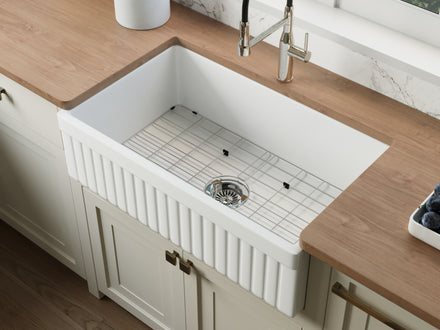
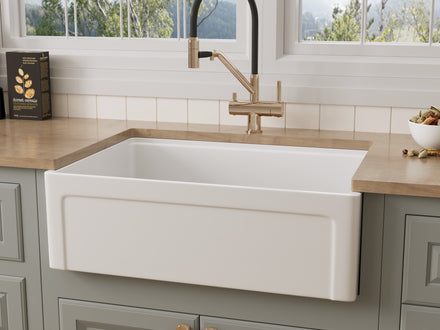
A smooth glazed fireclay sink can use the mild daily baseline when its care guide approves it. That does not make every ceramic-looking sink identical, and it does not make fireclay immune to metal transfer, mineral marks, chips, or unapproved chemicals.
The NOZLOO NZ-103W3320 measures 33″ × 20″ × 10″ overall with a 31″ × 17¾″ interior. Its 9-inch interior depth is measured vertically from the rim to the lowest point at the centered drain—not at a side wall. It has a centered 3.5-inch drain, requires a 36-inch minimum cabinet, and weighs about 105 pounds. Its apron sits above the lower cabinet doors; the basin requires independent, cabinet-tied support and is never installed inside a drawer.
Those dimensions describe fit and workflow, not a cleaning advantage. For exact cleaner and mark-removal limits, return to the NOZLOO fireclay care owner.

Five Checks Before You Use a Stronger Cleaner
- Can you name the exact material, finish, and model?
- Does the current care guide approve the cleaner and applicator?
- Is the issue ordinary soil, mineral scale, metal transfer, biological contamination, or damage?
- Are the drain, caulk, countertop, faucet finish, and accessories compatible too?
- Is there a chip, crack, exposed substrate, changing texture, or moving seam that needs repair instead?
If any answer is unclear, pause. A modest cleaning delay is usually less costly than dulling a finish, stripping a patina, attacking a sealer, or hiding a structural problem. For cracks, chips, or crazing concerns, use the fireclay sink problems guide.
How This Guide Was Checked
NOZLOO reviewed Google US search results and related questions on August 23, 2026, then limited the answer to routine surface cleaning. EPA guidance distinguishes cleaning with soap or detergent from sanitizing and disinfecting. University of Georgia Cooperative Extension supports prompt cleanup, rinsing, and caution with coarse abrasives. Material-specific approvals remain with the current sink manufacturer or fabricator.
Frequently Asked Questions
What is the best thing to clean a kitchen sink with?
There is no single best cleaner for every sink. Once you confirm the material and care guide, warm water, approved mild dish soap, and a soft non-scratch cloth are a sensible routine starting point for many common surfaces. Use a specialty product only when the maker approves it for that exact finish.
Can I use dish soap to clean my sink?
Often, yes—but check the model's care instructions. Use a small amount, avoid an abrasive applicator, and rinse completely. Soap residue left to dry can become part of the film you are trying to remove.
Do baking soda and vinegar clean a kitchen sink?
They can affect some soils, but neither is universally safe or necessary. Vinegar is acidic; baking soda is alkaline and mildly abrasive; combining them does not create blanket approval for stone, composite, metal, enamel, sealant, or fireclay. Follow the sink maker's current instructions.
How do I deep-clean a kitchen sink?
Start by removing accessories and repeating the approved routine across the bowl, rim, corners, drain surround, and underside of the grid. If visible residue remains, identify the residue and use only the material-specific method. “Deep clean” should not mean applying more chemicals at random.
Can I use the same cleaner on the sink, faucet, drain, and countertop?
Not automatically. Those parts may be stainless steel, plated metal, silicone, stone, quartz, wood, or another finish with different limits. Treat the sink bowl, faucet, drain hardware, sealant, and countertop as separate surfaces unless every maker approves the same product.
How often should I clean my kitchen sink?
Remove visible food and grease after messy use, then give a frequently used sink a brief end-of-day wash and rinse. Lift accessories and inspect corners, the drain surround, rim, and seal weekly or as use requires. A lightly used prep sink may need less attention than a family workstation used for every meal.