Farmhouse Sink Apron Styles: Smooth, Fluted, Grooved and Reversible

Most sink photos are taken from above, where the bowl gets nearly all the attention. Once a farmhouse sink is installed, however, the front is what remains visible across the kitchen.
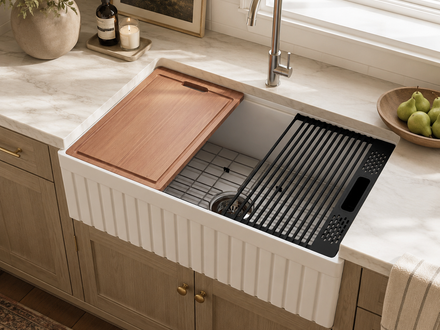
That exposed apron sits between the countertop and lower cabinetry, so its lines affect the entire cabinet wall. A smooth face can settle into the background. Fluting creates a stronger pattern of light and shadow. A grooved front adds detail more selectively, while a reversible sink lets you choose between two finished faces before installation.
At a glance: Smooth aprons create the least visual interruption. Fluted aprons use repeated vertical ribs to produce stronger texture and shadow. Grooved aprons use fewer lines for a more restrained architectural effect. Reversible models offer two finished faces, with the selected side positioned outward during installation.
Farmhouse Sink vs Apron Sink: Same Sink, Different Word
In most kitchens, a farmhouse sink and an apron sink are the same sink. The two words describe two different things about it.
"Farmhouse" is the style: a deep, wide basin with a front face that shows below the countertop. "Apron" is that front face itself. The apron is the panel that replaces part of the cabinet front, so an "apron-front sink" is any sink built that way.
Retailers use both names for one product because shoppers search both ways. A listing called "farmhouse sink," "apron sink," or "apron-front farmhouse sink" usually points at the same design.
The name tells you the look. It does not tell you whether the sink fits. Two sinks with the same label can still differ in:
- Overall width and bowl depth
- Apron height
- Material and weight
- Cabinet base size and support needs
Compare those specs, not the label. Cabinet fit is the usual trouble spot, so read our fireclay farmhouse sink cabinet size guide before you pick an apron style.
What Is the Apron Face of a Farmhouse Sink?
The apron face is the visible front wall of an apron-front sink. It replaces the false drawer area found above many conventional sink cabinets and extends forward beneath the countertop edge.
Because the apron is exposed, it should be considered alongside the cabinet doors, drawer fronts, faucet, backsplash, and stone pattern—not judged as an isolated product detail.
A quiet row of slab or Shaker cabinets can support a more decorative front. When natural stone, patterned tile, dark hardware, and detailed cabinetry are already competing for attention, a flat apron may provide better balance.
Smooth, Fluted and Grooved Aprons at a Glance
|
Apron style |
What the front looks like |
Effect in the kitchen |
Often works well with |
Cleaning access |
|---|---|---|---|---|
|
Smooth |
One uninterrupted glazed surface |
Quiet, broad and low-shadow |
Slab cabinets, Shaker doors and strongly veined countertops |
Easiest to wipe in one pass |
|
Fluted |
Repeated vertical channels or raised ribs |
More rhythm, shadow and visible texture |
Inset cabinets, restrained Shaker fronts and traditional millwork |
Requires wiping along repeated channels |
|
Grooved |
A small number of structured lines |
More detail than smooth, less repetition than fluted |
Transitional cabinetry and restrained modern farmhouse kitchens |
Fewer recesses than a fully fluted face |
These apron front sink styles do not change the basic purpose of the sink. Their main difference is how much visual activity they introduce below the counter.
Smooth vs Fluted Farmhouse Sink: What Changes Visually?
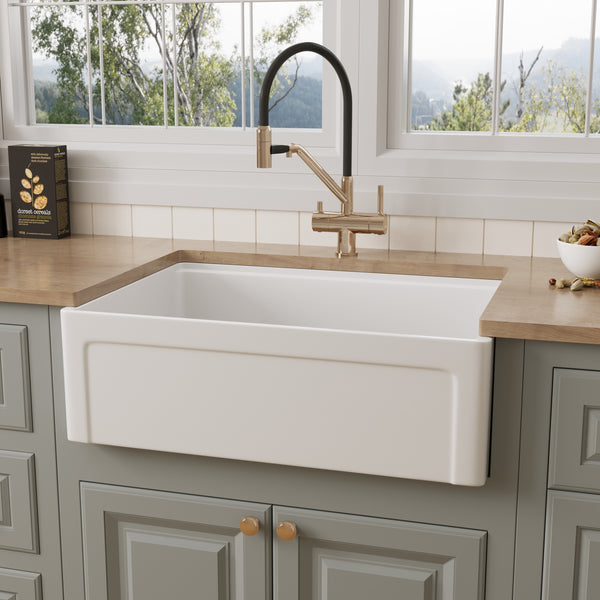
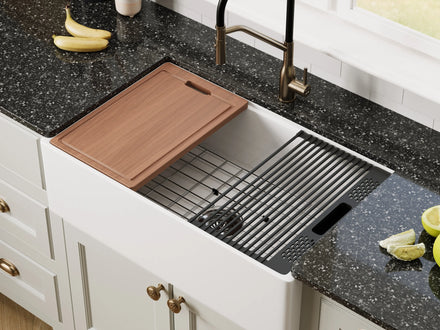
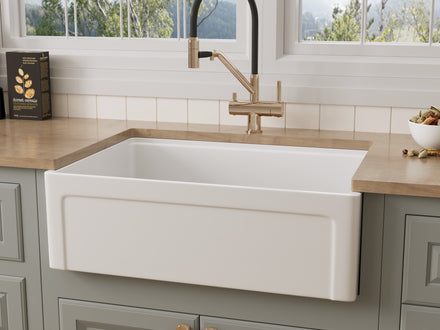
A smooth apron farmhouse sink presents one continuous surface. Light moves across it without being divided by ribs or channels, so the front tends to sit more quietly within the cabinet run.
That can be useful in a modern kitchen with dramatic granite or marble, a patterned backsplash, or prominent hardware. Instead of becoming another decorative element, the smooth face gives the surrounding materials more room.
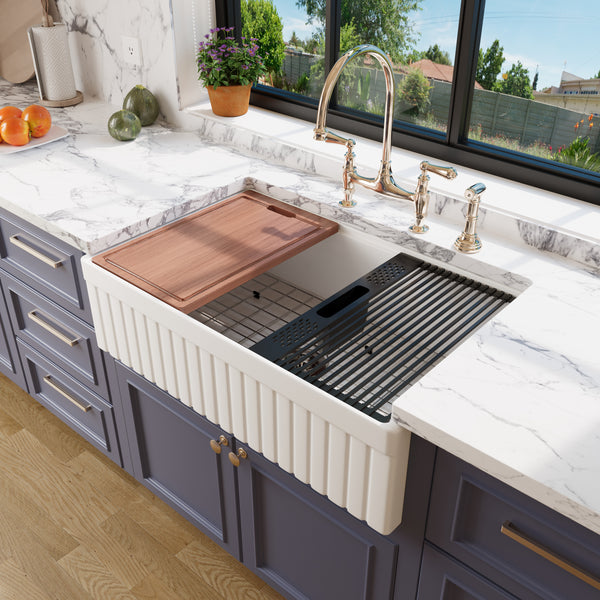
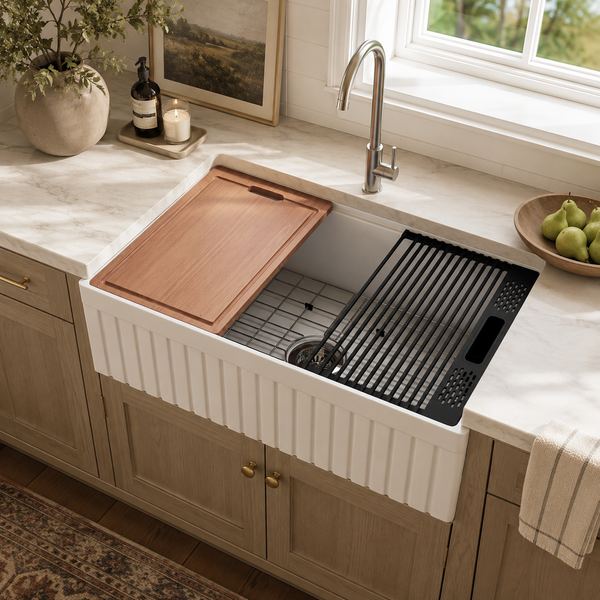
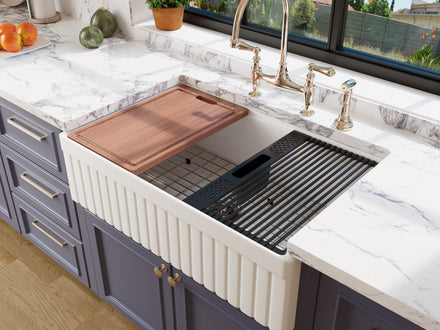
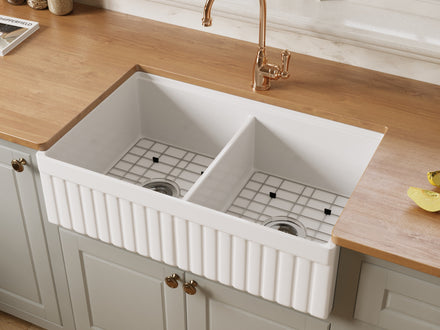
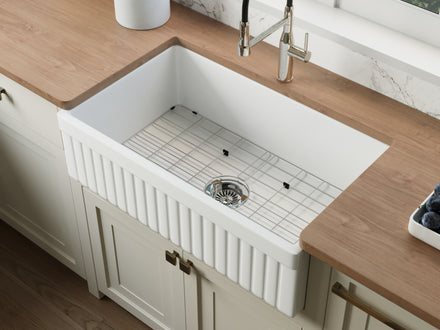
A fluted apron front sink behaves differently. Each vertical rib catches light on one side and creates a narrow shadow on the other. The result remains visible from farther away, particularly when daylight or under-cabinet lighting reaches the sink from an angle.
The National Kitchen & Bath Association explains that lighting influences how color, texture and scale are perceived. That is why the same white fluted apron may look fairly subtle in flat, even lighting but much more defined beside a window.
The effect is not limited to sinks. Better Homes & Gardens describes how fluted surfaces create dimension through repeated grooves and light-and-shadow variation. On an apron front, that repetition can echo Shaker rails, inset cabinet panels or reeded glass.
Neither option belongs to only one kitchen style. Smooth does not automatically mean contemporary, and fluted does not automatically mean rustic. The better choice depends on how much pattern already exists around the sink.

A straight-on installed comparison should show enough of the cabinets and countertop to reveal scale. In the smooth-apron image, the front should read as one broad white plane. In the fluted image, directional light should make the vertical ribs visible without relying on an extreme close-up.
Where Does a Grooved Farmhouse Sink Fit?
A grooved farmhouse sink falls between a completely smooth face and continuous fluting.
The current NOZLOO grooved apron uses one horizontal groove and two vertical grooves. These lines divide the front into broad, open sections rather than covering it with repeated ribs.
From close range, the pattern gives the sink a clear architectural shape. From across the farmhouse kitchen, the horizontal line remains the strongest detail, while the two vertical lines frame the center without producing a striped effect.
This makes a grooved apron useful when a smooth face feels too plain but full fluting would repeat too much detail. It can complement simple rails and stiles, transitional cabinetry, or a restrained modern farmhouse sink apron without becoming the dominant feature.

Use a straight-on installed image in which all three grooves are clearly visible. Avoid angles that make the front appear to have only one horizontal line or a continuous rectangular border.
What Does a Reversible Farmhouse Sink Mean?
A reversible farmhouse sink has two finished apron faces on the same sink body. One face may be smooth while the other is fluted or grooved.
The installer positions the preferred side toward the room before the sink is secured and the countertop is finalized. Reversible describes the two apron designs; it does not refer to the number of bowls.
This choice should be made during dry fitting. Once the sink is supported inside the cabinet and the counter is in place, changing the visible side normally requires removing and reinstalling the sink and may involve additional countertop or cabinetry work.
A reversible apron is most useful when you want to compare the actual sink against cabinet samples, hardware and countertop material before committing to the outward-facing design.

Show the same reversible apron sink from the front with each finished face outward. Keep the cabinet color, camera angle and lighting consistent so the apron—not the surrounding room—is the only meaningful difference.
Why Most Fireclay Farmhouse Sinks Are White, and What Colored Sinks Change
White is the traditional fireclay finish and, for most kitchens, the easiest color to live with. Some manufacturers also offer gray, black, and other colored glazes on fireclay, but they change how the sink looks, shows marks, and gets touched up.
In a fireclay sink, the glaze and the clay body fuse into one piece at about 2,200°F. White has been the standard finish for generations, and it is still what most manufacturers stock. It also stays neutral, so the apron usually still works if you repaint the cabinets later.
What to check before choosing a gray, black, or colored apron-front sink
- Contrast: a dark glaze becomes the strongest tone on the cabinet wall, so make that choice on purpose. Gray beside gray cabinets can blend into the cabinet run, which may or may not be what you want.
- Marks: scuffs and pan marks tend to stand out more on a dark or colored glaze. Many are metal deposits on the glaze rather than scratches, as our fireclay sink problems guide explains.
- Touch-ups: white touch-up glaze is typically easy to find, while matching a gray or black is harder. Confirm that a color-matched touch-up kit exists for that glaze before ordering.
NOZLOO makes white-glazed fireclay farmhouse sinks only, so all six models share one glaze. If you want a colored sink, you will be shopping another manufacturer's line. If white is the plan, start with the fireclay farmhouse sink collection.
Short-Apron and High-Back Farmhouse Sinks: Two Variations Worth Knowing
Short-apron and high-back sinks keep the same bowl as a standard farmhouse sink. One changes what you cut in the cabinet; the other changes where the faucet goes.
A short-apron farmhouse sink shows a shorter front panel below the countertop edge. Many manufacturers design it for retrofits, so you cut less cabinet front. Measure the apron height from the rim to the bottom of the front face. Compare it with the false drawer panel on your base, then read our retrofit guide before you cut.
A high-back farmhouse sink has a rear wall that rises above the rim, so the sink brings its own backsplash. It typically sits tight against the wall, so the counter stops at each side. You see it most on vintage-style sinks, though some modern models offer it too.
| What changes | Short apron | High back |
|---|---|---|
| Cabinet opening | Shorter front cutout | Same as standard |
| Countertop | Same as standard | Usually stops at each side |
| Faucet | In the countertop | Usually through the raised back; count its holes first |
All six NOZLOO sinks have a standard-height apron and no raised back. The counter runs behind the sink and holds the faucet, as in our installation guide.
Match the Apron to the Kitchen, Not Just a Style Label
|
Existing kitchen details |
Apron direction to consider |
Why |
|
Slab cabinets with bold stone veining |
Smooth |
Keeps the sink from competing with movement in the countertop |
|
White Shaker cabinets and a quiet backsplash |
Fluted or grooved |
Adds definition to an otherwise restrained cabinet wall |
|
Inset cabinetry and traditional millwork |
Fluted |
Repeats the vertical structure already present in the cabinet fronts |
|
Reeded glass or vertically detailed doors |
Smooth or grooved |
Avoids covering every nearby surface with the same repeated rhythm |
|
Patterned backsplash and decorative hardware |
Smooth |
Creates a visual pause below the counter |
|
Transitional cabinets with simple rails and stiles |
Grooved |
Adds structure without continuous fluting |
|
Warm wood cabinets with minimal ornament |
Smooth or fluted |
Smooth emphasizes the wood; fluted makes the sink more prominent |
A traditional farmhouse sink apron does not need the maximum amount of decoration. Likewise, a contemporary or modern farmhouse kitchen does not require a perfectly smooth face.
Look at the entire elevation. The countertop edge, cabinet proportions, backsplash pattern, faucet finish and nearby hardware all affect how prominent the apron appears.
Are Textured Apron Fronts Harder to Clean?
A textured apron needs slightly more deliberate wiping, but the difference is limited to the exterior front.
A smooth apron has no channels to follow, making it the simplest option for easy maintenance. A fluted face has repeated edges and recesses where dust, water drips, fingerprints or occasional cooking residue may remain. Wiping along the direction of the ribs is usually more effective than moving across them.
The grooved design has only three main lines, so it requires some targeted cleaning but involves fewer recesses than full fluting.
Because the apron sits outside the bowl, routine cleanup is usually straightforward. Broader care for the bowl and glazed surface is covered in fireclay sink cleaning guide.
NOZLOO Farmhouse Sink Front Designs
The current NOZLOO range includes smooth, fluted, grooved and reversible apron options. Product names below are kept exactly as listed on the live pages; the comparison focuses only on the finished apron faces.
|
Current NOZLOO model |
Finished apron faces |
Visual character |
|
NOZLOO 33" Smooth Apron Fireclay Farmhouse Sink with Workstation Kit |
Smooth / smooth |
Broad, uninterrupted surface on either side |
|
NOZLOO 33" Reversible Fluted Apron Fireclay Farmhouse Sink with Workstation Kit |
Fluted / smooth |
Repeated vertical texture or a quieter flat face |
|
NOZLOO 30" Grooved Apron Fireclay Farmhouse Sink with Workstation Kit |
Grooved / smooth |
Restrained three-line pattern or an uninterrupted reverse |
|
Fluted / smooth |
Two distinct front treatments: textured or understated |
|
|
NOZLOO 30" Reversible Apron Fireclay Farmhouse Sink with Workstation Kit |
Fluted / smooth |
Vertical rhythm on one face and a clean reverse |
|
NOZLOO 33" Fireclay Double Bowl Farmhouse Sink with Workstation Kit |
Fluted / smooth |
A textured front with a reversible flat alternative |
See the full collection of fireclay farmhouse sinks to compare the apron designs in current product photography.


Which Farmhouse Sink Apron Should You Choose?
Choose a smooth apron when the countertop, backsplash or cabinetry already provides strong pattern and the sink should remain visually quiet.
Choose fluted when you want the exposed apron to read as a distinct design feature, especially under directional light. Choose grooved when a smaller amount of structured detail feels better suited to the room. Choose reversible when the model offers two finished faces and you want to make the final decision with the real cabinet, counter and hardware samples in view.
There is no universally best front. The right apron is the one that brings the cabinet wall into balance without repeating or competing with every other element around it.