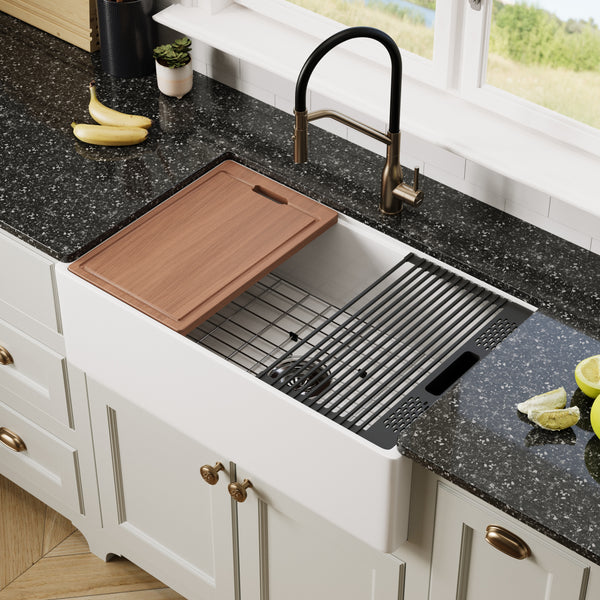
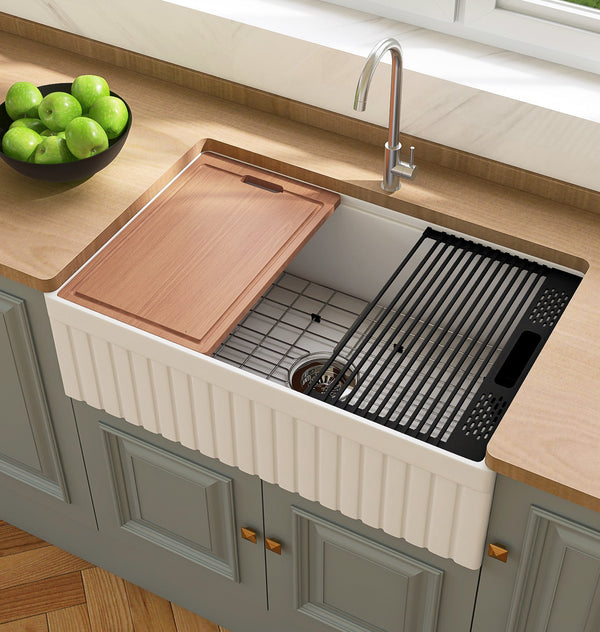
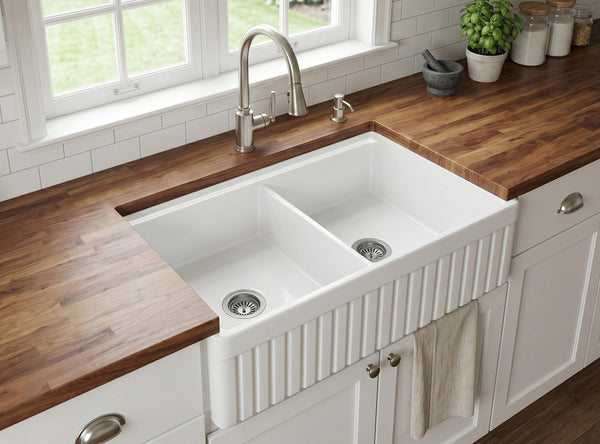
Fireclay Farmhouse Sink Cabinet Size Guide: 30", 33" and 36" Base Cabinets

A fireclay farmhouse sink does not fit like a standard drop-in sink. The sink width matters, but it is only one part of the installation plan.
Most cabinet-size problems happen when homeowners treat the sink width and the cabinet label as the same number. A 36" base cabinet does not always provide 36" of usable space inside. A 30" sink does not automatically fit a 30" cabinet. With a fireclay sink, the cabinet also needs to account for the apron front, support frame, drain location, plumbing space, and countertop template.
This guide explains how 30", 33", and 36" base cabinets usually work with fireclay farmhouse sinks, what to measure before ordering, and what your installer or cabinet maker should confirm before the cabinet is cut.
Fireclay Farmhouse Sink Cabinet Size: The Quick Answer
For most fireclay farmhouse sink installations, the base cabinet usually needs to be wider than the sink itself. The extra space helps the installer handle the sink body, side clearance, apron-front cutout, support framing, and small installation adjustments.
Use the table below as a planning guide, not as a cutting rule. The final fit depends on the exact sink dimensions, cabinet construction, and installer measurements.
|
Base cabinet size |
What it usually means |
Best fit direction |
What to confirm |
|
30" base cabinet |
Often tight for many fireclay farmhouse sinks |
Only works when the sink and cabinet are specifically compatible |
True inside opening, face frame, apron cutout, support space, plumbing position |
|
33" base cabinet |
Common planning size for many 30" fireclay farmhouse sinks |
Good option for smaller kitchens, older homes, and tighter layouts |
Interior width, side clearance, apron height, support-frame room, drain location |
|
36" base cabinet |
Common planning size for many 33" fireclay farmhouse sinks |
Strong planning direction for many full-size kitchens |
Sink specs, cabinet structure, countertop template, drain and disposal space |
Simple planning rule: many 30" fireclay farmhouse sinks are better planned around a 33" base cabinet, and many 33" fireclay farmhouse sinks are better planned around a 36" base cabinet. A 30" base cabinet needs the most careful review because there is very little room for adjustment.
Why Sink Width and Cabinet Width Are Not the Same
A farmhouse sink has an exposed apron front. That front panel usually replaces part of the cabinet face, so the cabinet must be prepared differently from a standard sink cabinet.
For kitchen planning in general, the NKBA Kitchen and Bath Planning Guidelines treat cabinetry, fixtures, equipment, counter bracing, and storage systems as connected parts of the same design plan. That is the right way to think about a fireclay farmhouse sink: the sink, cabinet, support, countertop, and plumbing have to work together.
There are three different measurements to separate before ordering:
· Cabinet label size: the outside cabinet width, such as 30", 33", or 36".
· Usable inside opening: the actual space inside the cabinet after side panels, face frames, front rails, and cabinet construction are considered.
· Installation opening: the front apron cutout and the internal support area needed for the sink body.
This is especially important with fireclay. Fireclay farmhouse sinks are heavy, and the cabinet should not rely on the countertop edge to carry the sink. A support frame or reinforced platform should carry the sink from below.
30" Base Cabinets: Usually a Tight Fit
A 30" base cabinet is the most restrictive scenario for a fireclay farmhouse sink. The outside cabinet width may be 30", but the usable inside opening is almost always smaller. Cabinet walls, face frames, front rails, and support framing can all reduce the space available for the sink body.
A 30" base cabinet may work only when all of these points are true:
· The sink is designed for that exact cabinet opening.
· The inside cabinet width is wide enough after face-frame limits are considered.
· The front of the cabinet can be cut without weakening the remaining structure.
· There is still room for side clearance and a proper support frame.
· The drain, plumbing, and disposal plan do not interfere with the basin depth or support frame.
This is the cabinet size where professional measurement matters most. If your kitchen has a 30" base cabinet, confirm the fit with your installer before ordering the sink.
33" Base Cabinets: A Common Fit for 30" Fireclay Farmhouse Sinks
A 33" base cabinet is often a practical direction for a 30" fireclay farmhouse sink. It gives the installer more room than a 30" cabinet while still keeping the sink suitable for smaller kitchens, older homes, and tighter remodel layouts.
Before using a 33" base cabinet, check:
· The actual inside width of the cabinet, not only the outside label.
· Whether the cabinet has a face frame that narrows the front opening.
· How much of the front panel must be removed for the apron.
· Whether enough cabinet structure remains after the cutout.
· Where the drain will sit in relation to plumbing and under-sink storage.
· Whether the support frame has enough room below the basin.
A 33" base cabinet can be a good fit for compact kitchens, but the sink, cabinet, support frame, and countertop template still need to be checked together.
36" Base Cabinets: A Common Fit for 33" Fireclay Farmhouse Sinks
A 36" base cabinet is one of the most common planning sizes for a 33" fireclay farmhouse sink. This setup usually gives the sink enough room without taking over the entire cabinet run. It also leaves more flexibility for apron-front alignment, side clearance, and support framing.
A 36" cabinet still needs to be measured. Cabinet construction varies, and a cabinet labeled 36" does not always provide the same usable inside space across all cabinet styles.
Pay special attention to:
· Face-frame thickness.
· Interior cabinet width.
· Side-wall clearance.
· Apron-front height.
· Countertop overhang and reveal style.
· Drain and disposal space.
· Support-frame placement.
A 36" base cabinet gives you more flexibility than a smaller cabinet, but it is still part of the installation plan, not a guarantee by itself.
A Practical Measurement Example
Here is a simple way to think about the difference between a cabinet label and real installation space.
Suppose your kitchen has a cabinet sold as a 36" base cabinet, and you want to install a 33" fireclay farmhouse sink. The label sounds safe, but the installer still needs to open the cabinet and check the usable inside width, the face-frame opening, the apron height, and the support-frame location. If the inside opening is reduced by side panels or a thick face frame, the remaining clearance may be much tighter than the label suggests.
The same logic applies to a 30" sink in a 33" cabinet. The extra cabinet width gives more room, but it does not replace measurement. The cabinet front still needs to be cut cleanly, the sink needs to sit level, and the support frame has to carry the weight from below.
Existing Cabinet vs. Farmhouse Sink Base Cabinet
Some cabinets are built specifically for apron-front sinks. Others are standard base cabinets that need modification.
A farmhouse sink base cabinet usually has a front opening designed for the apron. That can make installation easier because less cabinet cutting is needed. A standard base cabinet may still work, but it usually requires more planning. The front panel may need to be cut, the cabinet may need reinforcement, and the support frame must carry the sink from below.
Before deciding whether to use an existing cabinet, ask your installer or cabinet maker:
· Can this cabinet be cut for an apron front?
· Will enough structure remain after the cutout?
· Can a support frame be installed inside?
· Will the cabinet doors still work after the false drawer front or upper rail is modified?
· Is the cabinet wide enough inside, not just outside?
· Will the sink position work with the countertop template and faucet layout?
Cabinet changes are easier before the countertop is templated, so this decision should happen early.
How to Measure Your Base Cabinet Before Ordering
Do not rely only on the cabinet label. Measure the cabinet itself and separate outside width from usable inside space.
1. Measure the outside cabinet width
Measure the full cabinet box from left to right. This is the number most cabinet companies use when they describe a 30", 33", or 36" base cabinet.
2. Measure the inside opening
Open the cabinet doors and measure the usable space between the interior side walls. This number is more important than the cabinet label because the sink body and support frame need real space inside the cabinet.
3. Check the face frame
If your cabinet has a face frame, it can reduce the front opening. That affects how the apron front will sit and how much cutting is needed. Frameless cabinets may offer more usable space, but they still need proper sink support.
4. Confirm apron-front height
The apron front is part of the sink body. The cabinet front needs to be cut to fit it cleanly. Do not cut from a product photo. Use the actual sink dimensions and, when possible, the physical sink.
5. Plan the support frame
The support frame should sit below the sink and carry the load evenly. It should not block the drain, disposal, or plumbing access. The frame height also affects whether the apron front aligns with the cabinet doors and countertop.
6. Confirm countertop planning
The countertop fabricator needs to know how the sink will sit before the final template is made. The Natural Stone Institute installation standards cover areas such as sink cutouts, overhangs, joint widths, and tolerances, which is why cabinet, sink, and countertop decisions should not be treated separately.
For fireclay farmhouse sinks, it is usually safer to have the sink on site before countertop templating. Undermount, flush, and slight-reveal installations can all affect the final cutout.
7. Leave room for plumbing and disposal
If you plan to use a garbage disposal, confirm the space below the sink. Fireclay farmhouse sinks are deep, and the support frame can change the space available under the basin. For more detail, see NOZLOO’s guide on using a garbage disposal with a fireclay sink.
Why Fireclay Farmhouse Sinks Need Proper Support
Fireclay farmhouse sinks are solid and heavy. NOZLOO fireclay farmhouse sinks are around 100-115 lbs depending on the model. Once the sink is installed and filled with water, dishes, or cookware, the cabinet has to carry even more load.
This is why support matters. This Old House also notes that farmhouse sink installation often involves cutting the cabinet front, reinforcing the structure, and coordinating the sink, cabinet, countertop, and faucet installation.
The sink should not hang only from the countertop. A support frame or reinforced platform should carry the sink from below. This support should be level, stable, and planned before the countertop is installed.
A proper support plan should account for:
· Sink weight.
· Extra load from water, dishes, and cookware.
· Cabinet structure after the apron cutout.
· Apron-front alignment.
· Drain and plumbing access.
· Countertop cutout and reveal style.
· Long-term cabinet stability.
This is one of the main reasons professional installation is recommended for fireclay farmhouse sinks.
What to Confirm With Your Installer or Cabinet Maker
Before ordering a fireclay farmhouse sink, send the product specs to the person handling the cabinet, countertop, or installation. Use this checklist:
· Exact sink dimensions.
· Recommended minimum base cabinet size.
· Actual inside cabinet opening.
· Apron-front width and height.
· Cabinet front cutout plan.
· Support-frame design.
· Drain location.
· Garbage disposal compatibility, if needed.
· Countertop template timing.
· Reveal style: undermount, flush, or slight reveal.
· Whether the physical sink should be on site before templating.
If you are still deciding between sink types, use this cabinet guide together with NOZLOO’s fireclay farmhouse sink guide. Keep the decisions separate: first choose the right type of sink, then confirm the exact cabinet fit.
Common Cabinet Sizing Mistakes to Avoid
Assuming the sink width equals the cabinet width
This is the most common mistake. A 30" sink does not automatically fit a 30" cabinet. The cabinet needs enough usable space for the sink body, apron front, and support frame.
Measuring only the outside cabinet width
The outside width is useful, but the inside opening determines the real fit. Always measure both.
Forgetting the face frame
Face-frame cabinets can reduce the usable front opening. This matters for apron-front installation because the apron must sit cleanly in the modified cabinet face.
Ignoring cabinet doors
A farmhouse sink can change the upper front area of the cabinet. In some retrofits, the false drawer front is removed and the cabinet doors may need to be shortened, replaced, or adjusted.
Cutting the cabinet before the sink arrives
Fireclay sinks can have small dimensional variation. The safer approach is to use the actual sink and the spec sheet before final cutting.
Ignoring support
Fireclay is heavy. The support frame is not optional planning; it is part of the installation.
Waiting until countertop templating to decide
By the time the countertop is templated, the sink decision should already be made. The cabinet, support frame, and sink position need to be ready first.
Final Takeaway
The right farmhouse sink cabinet size is not based on sink width alone.
For a fireclay farmhouse sink, confirm four things before ordering:
1. The sink’s exact dimensions.
2. The cabinet’s usable inside opening.
3. The apron-front cutout.
4. The support frame and countertop template plan.
A 33" base cabinet is often a practical direction for many 30" fireclay farmhouse sinks. A 36" base cabinet is often a practical direction for many 33" fireclay farmhouse sinks. A 30" base cabinet needs more careful review because the fit can be tight.
The safest approach is simple: measure the cabinet, check the product specs, confirm support, and bring your installer into the decision before anything gets cut. That is how you get the fireclay farmhouse sink look without turning cabinet fit into a late-stage installation problem.
FAQ
What size cabinet do I need for a fireclay farmhouse sink?
It depends on the sink size, cabinet construction, and installation method. As a general planning rule, many 30" fireclay farmhouse sinks use a 33" base cabinet, and many 33" fireclay farmhouse sinks use a 36" base cabinet. Always confirm the exact product specs before ordering.
Can a fireclay farmhouse sink fit in a 30" base cabinet?
Sometimes, but it should not be assumed. A 30" base cabinet is usually tight for many fireclay farmhouse sinks because the usable inside space is smaller than the outside cabinet width. Measure the cabinet and ask your installer before choosing the sink.
What size cabinet is usually used for a 30" fireclay farmhouse sink?
A 33" base cabinet is commonly used for many 30" fireclay farmhouse sinks. This gives more room for the sink body, apron front, side clearance, and support frame.
What size cabinet is usually used for a 33" fireclay farmhouse sink?
A 36" base cabinet is commonly used for many 33" fireclay farmhouse sinks. The final fit still depends on the inside cabinet opening, face frame, apron cutout, and support plan.
Do fireclay farmhouse sinks need a special cabinet?
Not always. Some installations use a farmhouse sink base cabinet, while others modify a standard base cabinet. Either way, the cabinet must allow for the apron front and include proper support for the sink’s weight.
Can I install a fireclay farmhouse sink in an existing cabinet?
Yes, in some cases. The existing cabinet must be wide enough, strong enough, and suitable for an apron-front cutout. A professional installer or cabinet maker should inspect it before you order the sink.
Should the sink arrive before the countertop is templated?
Yes, that is usually the safer approach. Having the physical sink on site helps the countertop fabricator confirm the cutout, reveal, apron alignment, and final placement before the countertop is made.