Is a Fireclay Farmhouse Sink Worth It?

Quick answer: is a fireclay farmhouse sink worth it?
Yes, if you are planning a remodel, your base cabinet can carry the weight, and you want a sink that stays put for the life of the kitchen. No, if you need a quick drop-in swap, a light sink for a rental, or the lowest possible upfront price. The material is the easy part; fit, support, and timing decide whether you end up happy with it.
This guide answers the questions that usually come next: what it really costs, which size fits, how to spot good quality, what to check before you order, and whether it helps at resale.
What you actually pay: sink, install, and extras
Expect three costs, not one: the sink, the installation, and the price of choosing wrong. The sink is the part you can price today. The other two depend on your kitchen.
The sink
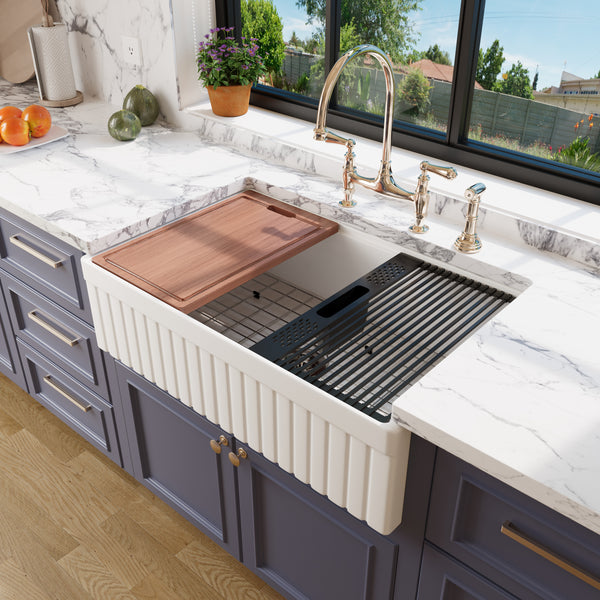
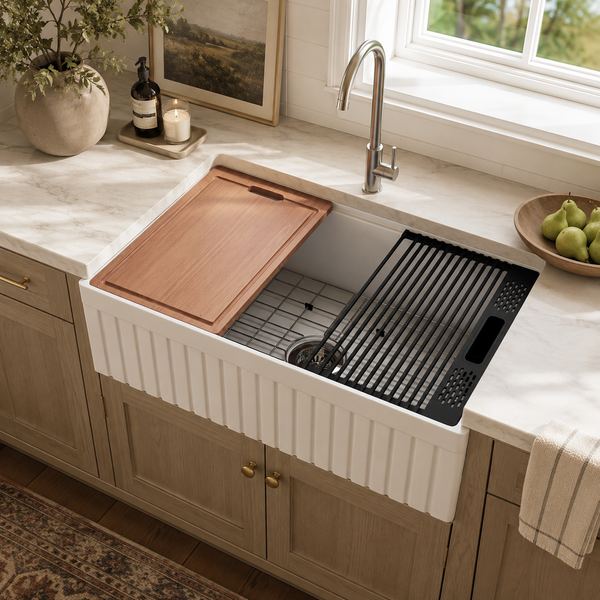
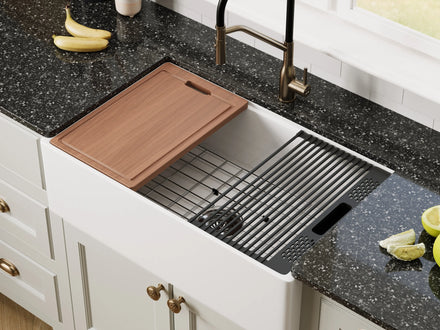
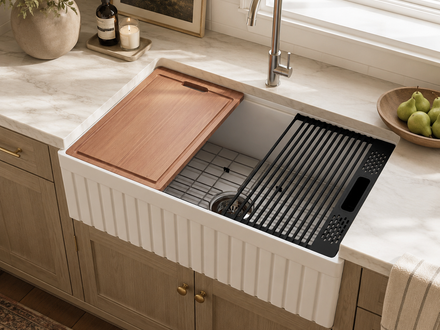
Our six fireclay farmhouse sinks run $479 to $599. All are white-glazed, 33" x 20" x 10" or 30" x 20" x 10", in single-bowl or double-bowl layouts. The $479 33" Thick-Edge Standard is not a workstation model. The other five include a cutting board, drying rack, and bottom grid that ride on the rim.
Installation
Installation cost varies more than the sink price does, so get a written quote before you order. Labor depends on three things: whether your cabinet was built for an apron front or needs its face cut down, whether a support frame must be added, and how the countertop is templated (measured against the sink and cabinet before the slab is cut). Then add the faucet, a disposal if you want one, and any plumbing changes for a deeper bowl. Our sinks weigh 100 to 115 lbs (45 to 52 kg), so plan on two people to carry and set one.
The cost of choosing wrong
This is the cost most buyers skip. A faucet can be swapped in an afternoon. A farmhouse sink sits in the cabinet and under the countertop, so replacing a cracked, mis-sized, or wrong-style sink can mean touching the countertop, cabinet, and plumbing again. An hour spent on the checks later in this guide is the cheapest insurance you can buy.
When is it worth it, and when is it not?
It comes down to whether the kitchen is ready for the sink, not whether the sink is good.
Worth it when
- You are doing a full remodel, so cabinet, countertop, plumbing, and support get planned together.
- You cook most nights and rinse sheet pans, stockpots, and roasting pans that do not fit a standard bowl.
- You want the sink to be a visible design element, not a hole in the countertop.
- You plan to stay in the house for years and would rather buy once.
- You want a glazed, non-porous surface that wipes clean with dish soap and a soft cloth.
Not worth it when
- You are replacing the sink only, and the existing cabinet and countertop cannot be modified.
- The base cabinet cannot be reinforced to carry 100 to 115 lbs of sink plus water and dishes.
- You want the lightest sink, or the one that is easiest to swap out later.
- It is a rental, or a kitchen you plan to gut in a few years.
- Your budget is set by the sink price alone, with nothing left for support and templating.
For the full list of tradeoffs, read our guide to fireclay sink pros and cons.
Size and fit: 30 vs 33, single vs double, cabinet width
Start with the cabinet, not the sink. The base cabinet has to be wider than the sink itself, and each product page lists the minimum cabinet width for that model. If your sink base is already set, that number picks the sink for you.
30 inch vs 33 inch
Both sizes share the same 20" front-to-back and 10" overall height, so bowl width is the real difference. The 33" gives room for a sheet pan and a drying rack side by side. The 30" is the answer when the run is tight or a wider sink base would crowd the dishwasher. Bowl depth is 8¾ to 9 inches on every model, deep enough to hide a stack of dishes without making you stoop; our farmhouse sink depth guide explains how depth changes the feel at the counter.
Single bowl vs double bowl
Pick a single bowl if you wash large cookware. Pick a double bowl if you hand-wash and like to keep soaking separate from rinsing. A single 33" bowl takes a stockpot and a roasting pan at the same time.
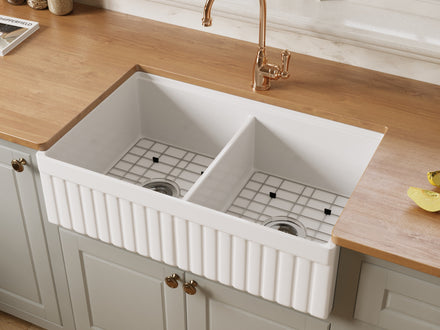
A double bowl splits that width, so each side is narrower, but it keeps dirty dishes out of the rinse water. The 33" Double Bowl Workstation ($599) is the one double in our line; the other five are single bowls.
Apron style
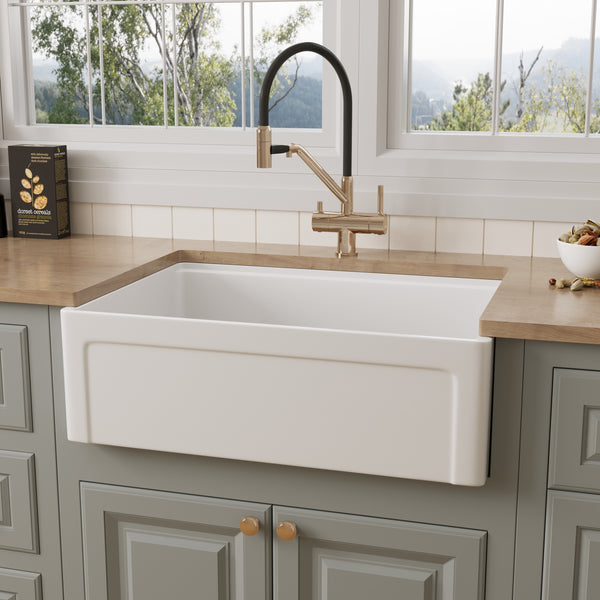
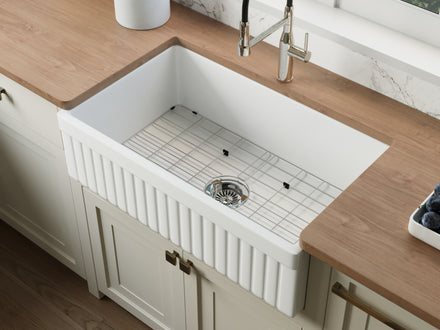
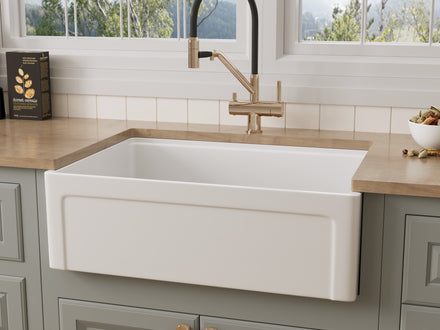
The apron changes the look, not the fit. Smooth reads modern, fluted (ribbed) reads traditional, and grooved sits in between. Some models are reversible, with a different profile on each face, so you can decide after the cabinets are in.
Before you choose, measure the cabinet interior width, the cabinet face height, the countertop overhang, and the space under the sink for the drain and disposal. Our fireclay farmhouse sink cabinet size guide walks through each measurement.
How to tell a good-quality fireclay sink
Good fireclay shows quality in five places at once: weight, glaze, edges, apron, and warranty. Photos show none of them. Specs and a hands-on check do.
Weight and wall thickness
Weight is the first signal because it reflects the body. Our 30" and 33" sinks weigh 100 to 115 lbs (45 to 52 kg) and have a 1-inch (22 to 25 mm) fireclay wall, and that thickness is what makes the basin feel solid and stay put under daily use. Whatever brand you compare, look for the product weight and wall thickness stated as plain numbers. If a listing gives only the shipping weight, ask for the product weight before you decide.
Glaze
The glaze should be smooth, even, and glossy everywhere you can see. Fireclay glaze is fused to the clay body at about 2,200°F, so glaze and body fire into one piece rather than a finish applied on top. A good glaze is non-porous, which is why everyday food stains wipe off instead of soaking in.
Inspect under side lighting, not straight down. Look for pinholes, dull or cloudy patches, gritty spots, uneven color, and glaze pooling near the drain. Slight variation is normal for a fired product. Rough or patchy glaze is not.
Edges, rim, and apron
Set the sink on a padded flat surface and sight along the rim. The rim should be level, the side walls even, and the apron flat across its full width. A twisted basin or a bowed apron shows up later as a gap against the cabinet face and a countertop that does not seat cleanly. Corners and the drain opening should be cleanly formed, with glaze carried all the way around.
Warranty and plain-number specs
Read the warranty terms, not just the headline. Ours covers the sink body with a Limited Lifetime Warranty for the original purchaser in residential use, and the workstation accessories (cutting board, drying rack, bottom grid) for one year. Thermal shock is not covered, which is a good reason not to pour boiling water into a cold basin. Look for a product page that states weight, dimensions, minimum cabinet, bowl depth, and warranty terms in plain numbers, so you have something to check.
Before you order: 6 checks
Do these six checks in order and most farmhouse-sink regrets disappear. The right time to order is after the sink base is planned and before the countertop is templated.
- Cabinet width. Confirm your base cabinet meets the minimum width listed on the product page for the model you want. If the cabinet was not built for an apron front, confirm the face can be cut down.
- Support. Plan a level support frame under the basin. The countertop should never carry the sink's 100 to 115 lbs on its own.
- Plumbing. Check where the drain lands, whether a disposal fits below a bowl that is 8¾ to 9 inches deep, and whether the supply lines need to move.
- Faucet holes. A farmhouse sink has no deck, so the faucet, sprayer, and soap dispenser mount in the countertop. Settle the hole count now so the fabricator can drill them.
- Countertop sequence. Have the physical sink on site before templating. Many fabricators want to measure the actual sink, and a fired product can vary slightly from the drawing.
- Inspect within 48 hours. Open the crate the day it arrives. Check corners, apron, underside, and drain under good light, and report any shipping damage within 48 hours and before installation. Our support team replies within 12 hours.
If a crack, chip, or crazing shows up later, our guide to fireclay sink problems explains what is normal, what is a defect, and what to do next.
Does a fireclay farmhouse sink add resale value?
A sink alone rarely moves an appraisal, but it does change how a buyer reads the kitchen. The apron front is one of the few details a buyer walks up to and touches. A glazed fireclay basin that still looks white and smooth after years of use tells them the kitchen was cared for.
That impression counts most in a mid-to-upper-range home where buyers expect a considered kitchen, and least in an entry-level home where price drives the decision. The sink also has to match the cabinets and counters around it; a good sink in a dated kitchen looks orphaned, not upgraded. If you are listing next month, a cosmetic refresh usually returns more per dollar than a sink swap that touches cabinets and plumbing. If you will live with the kitchen first, you get the daily use and the resale signal both.
The honest bottom line
A fireclay farmhouse sink is worth it when the kitchen is ready for it. On our sinks, the material side is straightforward: a 1-inch fireclay body, a glaze fused on at about 2,200°F, a non-porous surface that wipes clean, and a Limited Lifetime Warranty on the body. The buying side is where people go wrong, and every item on that list is fixable before you order: cabinet width, support, plumbing, faucet holes, countertop sequence, and a 48-hour inspection.
Check those boxes and the sink can be the last one the kitchen needs. Compare all six models, sizes, and apron styles in our fireclay farmhouse sink collection.
 In stock
- 33″ × 20″ × 10″ overall
- 36″ minimum cabinet
- Workstation kit · 4 pieces
Still weighing one maker against another? The brand-by-brand fireclay comparison puts the main options side by side so you can see where they actually differ.
FAQ
How much does a fireclay farmhouse sink weigh?
Our 30" and 33" fireclay farmhouse sinks weigh about 100 to 115 lbs (45 to 52 kg), depending on the model. That weight comes from the 1-inch fireclay walls, and it is the reason the sink needs a support frame in the cabinet rather than resting on the countertop. Plan for two people to carry it, and open the crate near the kitchen rather than in the garage.
What size cabinet does a fireclay farmhouse sink need?
The base cabinet has to be wider than the sink, and each of our product pages lists the minimum cabinet width for that model. The extra width leaves room for the cabinet sides and the support frame. The cabinet face also has to be cut down for the apron unless it was built as a farmhouse sink base, so confirm both the width and the face height with your cabinet installer before you order.
Do fireclay farmhouse sinks crack easily?
Not under normal kitchen use, as long as the sink is properly supported and installed. Cracks usually trace back to something around the sink: shipping damage missed at delivery, a weak or uneven support frame, a countertop pressing on the rim, or a heavy pot dropped on a corner. Sudden extreme temperature swings can stress any fired ceramic, so run the tap first instead of pouring boiling water straight into a cold basin.
What does a fireclay sink warranty usually cover?
Ours covers the sink body with a Limited Lifetime Warranty for the original purchaser in residential use, and the workstation accessories for one year. Thermal shock is not covered. Shipping damage has its own 48-hour reporting window, which is why opening the crate on delivery day matters. Whatever brand you choose, read the full terms and confirm they are in writing before the sink goes in.