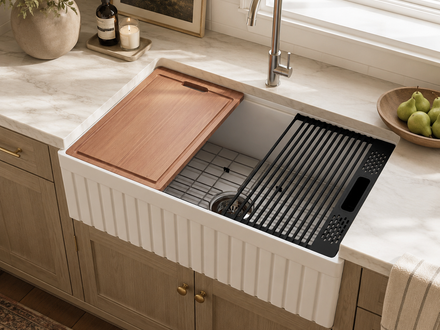
How Long Do Fireclay Farmhouse Sinks Last? A Realistic Lifespan Guide

If you are weighing a fireclay farmhouse sink, the honest answer to "how long will it last?" is reassuring: measured in decades, not years. A well-made fireclay sink routinely outlives the countertops, cabinets, and appliances around it. It is common for the sink to be the one fixture you keep through a full kitchen remodel, simply because there is nothing wrong with it. So the more useful question is not whether it lasts, but what determines whether yours sees ten good years or forty, and how that longevity changes the real cost of owning one.
The realistic lifespan: decades, often longer than the kitchen
We manufacture fireclay sinks, and the pattern we see is consistent. Treated with ordinary kitchen care, a fireclay farmhouse sink holds its surface and structure for a very long time. There is no mechanism of normal use that "wears it out" the way a coating peels or a finish dulls. It does not rust, it does not corrode, and its color does not fade with sun or time. The most common reason a fireclay sink leaves a kitchen is that the homeowner gutted the room for a new look, not that the sink failed.
For a homeowner-facing style perspective, The Inspiration Edit's white farmhouse sink edit is a useful companion to the lifespan discussion because it shows why fireclay remains a long-term design choice rather than a short-lived trend.
That durability is not marketing. It is a direct result of how the material is made, which is worth understanding because it explains both the strengths and the few genuine weak points.
Why it lasts: vitrification in plain words
A fireclay sink lasts because it is fired into one solid piece, body and glaze together. There is no coating to wear through and no metal underneath to rust. That one fact explains why a well-kept sink still looks white decades later.
What happens in the kiln
In the kiln, the clay particles melt into each other and become one dense, glass-like body with almost no open pores. That is vitrification. Fireclay starts as a blend of clay and minerals: kaolin for whiteness, quartz for hardness, and feldspar to help the mix melt and fuse. The shaped sink is dried, glazed, and fired at about 2,200°F.
Think of packed sand next to a glass bottle. Same mineral, but only one holds water without soaking it up.
Why the glaze is not a coating
The glaze goes on before firing, not after. In the kiln it melts and fuses into the body, so the two become one piece. A coating applied after production is a separate layer with an edge that can lift. A fused glaze has no edge to lift, so under normal use there is no separate layer to peel away.
What that means at your sink
- Stains stay on top. The non-porous glaze gives coffee, wine, and tomato sauce nothing to soak into.
- No rust. There is no metal in the sink body, so a chip exposes more fireclay, not a base that corrodes.
- The white holds. The color is part of the fired glaze, not a finish on top of it, so daily dishwashing is not what wears it down. Only abrasive scrubbing wears the shine.
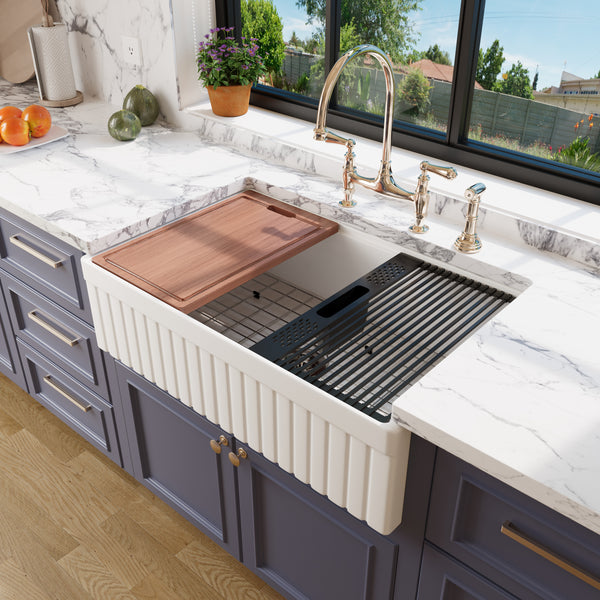
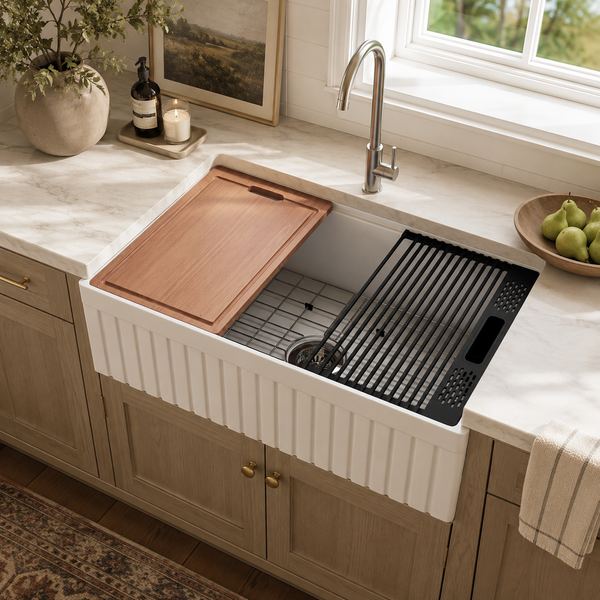
- Strength runs the full depth. NOZLOO sinks use a 1-inch (22–25 mm) fireclay body, solid all the way through. That density is why a sink weighs 100–115 lbs and needs a support frame under the basin.
Vitrification does not make the sink unbreakable. Hard is not the same as tough, so a sharp, heavy impact can still chip the glaze, and a cold basin should not get boiling water poured straight into it. The next section covers those few risks. To see how this differs from a standard ceramic sink, read our guide on fireclay vs ceramic sink differences.
What actually shortens a fireclay sink's life, and what doesn't
Because the body is so durable, the failure modes that do exist are specific and avoidable. It helps to separate the real risks from the myths.
The real risks
- Impact at the drain and corners. The glazed surface is hard, but hardness is not the same as toughness. A sharp, concentrated impact, most often from a heavy item dropped onto the drain opening or a corner, is the one thing that can chip the glaze. This is the genuine vulnerability, and it is mechanical, not gradual.
- Dropped cast iron and stoneware. A cast-iron pan or a heavy ceramic mixing bowl dropped from height onto the basin concentrates a lot of force on a small point. That is the classic cause of a chip. Setting heavy cookware down gently, rather than dropping it the last few inches, eliminates most of this risk.
- Abrasive cleaners and scouring pads, over time. The glaze resists scratching from normal use, but repeated scrubbing with gritty powders or steel wool can eventually dull a high-gloss finish. This is slow and preventable rather than catastrophic.
The myths
- "Hot pans will crack it." Fireclay is fired far hotter than any cooktop produces, so the heat of a pan is not the issue. The caution with very hot cookware is about thermal shock from extreme, sudden temperature swings, which is easy to avoid and rarely a real-world problem.
- "The glaze wears off like a coating." The glaze is fused into the body, not painted on, so there is no coat to wear through under normal dishwashing.
- "It stains permanently." Because the surface is non-porous, most marks, including the gray metal marks left by cookware, lift with a gentle cleaner. They look alarming but are surface deposits, not damage.
Chipping is the question most buyers actually worry about, and it deserves a straight answer rather than reassurance. We address exactly how, when, and why it happens in our guide on whether fireclay sinks crack or chip easily, which is the right place to dig into that single concern.
Care habits that preserve the glaze for the long run
None of this requires special products or a maintenance routine. Protecting a fireclay sink's lifespan comes down to a few easy habits:
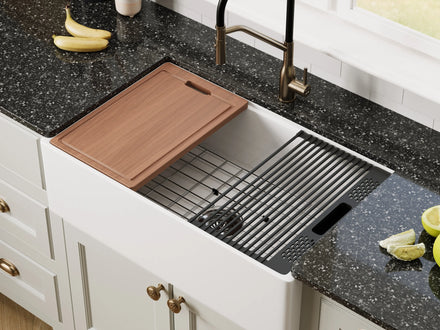
- Use a bottom grid or rack in the basin. This is the single most effective protection, because it keeps pots, cast iron, and dropped utensils off the glaze and absorbs the impacts that would otherwise reach the surface.
- Clean with mild dish soap or a gentle non-abrasive cleaner and a soft cloth or sponge. Save scouring powders and steel wool for cookware, not the sink.
- Rinse away anything gritty, and wipe up metal marks promptly rather than letting them set as a habit.
- Set heavy cookware down deliberately instead of dropping it, especially near the drain.
That is genuinely the whole list. There is no sealing, no resurfacing, and no annual treatment, which is part of why the material ages so well. General kitchen and bath material guidance from the NKBA echoes the same principle across surfaces: matching the cleaning method to the material is what keeps finishes looking new over a long service life.

How lifespan changes the real cost
Here is where longevity stops being a spec and starts being a money question. A cheaper sink that you replace every several years carries a hidden recurring cost: the new unit, the plumber, the disruption, and sometimes countertop or cabinet work to fit the replacement. A fixture you buy once and keep for decades spreads its price across so many years that its effective cost per year drops well below that of repeated replacements.
This is increasingly how thoughtful kitchen design is framed. Design writers now build premium kitchens around fixtures chosen to last rather than pieces that photograph well only on day one, and a recent feature on The Pinnacle List is a good example of that thinking. A sink you never have to think about again is worth more than its sticker suggests, and that durability tends to read as quality to future buyers too; we look at that angle in our guide on whether a fireclay farmhouse sink adds resale value.
People often want to put fireclay's lifespan side by side with stainless steel, which is a fair comparison but a separate one with its own trade-offs around dent resistance, noise, and look. Rather than repeat all of it here, we keep that analysis in one place: our full fireclay versus stainless steel comparison walks through the differences so you can match the material to how you actually cook and clean.
The honest bottom line
A fireclay farmhouse sink is a buy-it-once fixture for most kitchens. Its lifespan is measured in decades, the failure modes are few and avoidable, and the care it asks for is minimal. The trade-off is real and worth stating plainly: the same hardness that resists scratches and stains means a sharp, heavy impact can chip the glaze, so a bottom grid and a little care around the drain are the price of that longevity. For most homeowners that is an easy trade, and it is why the sink so often outlasts everything around it.
If a sink you can stop thinking about sounds right for your kitchen, it is worth seeing the shapes and sizes in person. Take a look through our fireclay farmhouse sink collection when you are ready, and choose the one that fits how you actually live in your kitchen.