Fireclay vs Stainless Steel: Key Differences Explained

Short answer: fireclay is the better pick if you care about looks and low maintenance. Stainless steel wins on budget and flexibility. The rest comes down to how you use your kitchen.
We've installed both, lived with both, and heard plenty of opinions from homeowners who feel strongly about their choice. Below is everything that actually matters when you're deciding between these two — no filler, no fluff.
Fireclay vs Stainless Steel Sink at a Glance
| Fireclay | Stainless Steel | |
|---|---|---|
| Scratch resistance | High — glaze holds up to daily use | Low — visible scratches within months |
| Stain resistance | Excellent — non-porous, nothing soaks in | Good — resists stains but shows water spots |
| Heat resistance | Kiln-fired at 2,200°F; handles hot pans easily | No warping or discoloration from heat |
| Chipping risk | Possible on heavy impact (rare) | Not a concern |
| Daily maintenance | Minimal — quick rinse, done | Frequent wiping needed for water spots and fingerprints |
| Weight | 80–100 lbs; may need cabinet reinforcement | Lightweight; standard install |
| Price (sink only) | $479 – $1,800+(mid-tier DTC around $500; showroom brands $1,200+) | $200 – $600 |
| Style | Classic, warm, farmhouse-forward | Neutral, industrial, blends in |
| Color options | White, off-white, limited black | Steel only |
| Best for | Forever kitchens, design-focused remodels | Rentals, flips, tight budgets |
How Each Material Is Made (And Why It Matters)
Fireclay starts as a high-kaolin clay, molded by hand, then fired in a kiln at roughly 2,200°F. That process fuses the clay and glaze into a single non-porous piece. The result is dense, hard, and resistant to chemicals, stains, and heat.
Stainless steel is a chromium-nickel alloy pressed into shape by machine. Thickness is measured in gauges — 16-gauge is the quality benchmark for home kitchens. Anything thinner than 18-gauge tends to dent easily and amplify noise.
The practical takeaway: fireclay is heavier, denser, and more artisanal. Stainless steel is lighter, more uniform, and easier to manufacture in a wide range of shapes.
Durability and Scratches
This is the deciding factor for a lot of people, so let's be specific.
Stainless Steel
Scratches are inevitable. Within a few months of regular use, you'll see a pattern of fine lines across the basin. Brushed finishes mask them better than polished ones, but they're always there. The upside: stainless steel almost never cracks or chips. You can drop a cast iron pan into it and the worst case is a small dent.
Fireclay
The fired glaze resists scratches far better than steel. After a year of daily kitchen use — scraping pots, sliding baking sheets, washing cast iron cookware — a quality fireclay sink typically still looks new. The tradeoff: a hard enough impact at the wrong angle can chip the glaze. This is uncommon in practice, and most reputable brands include repair kits or cover chips under warranty. But it's a real possibility, not a zero-risk material.
In plain terms: stainless steel can take abuse without breaking, but it shows every bit of it. Fireclay hides wear beautifully, but isn't invincible against heavy impact.
Maintenance: What Day-to-Day Actually Looks Like
Stainless Steel
Soap and water — that's all you need to clean it. Simple. The problem isn't the cleaning itself; it's how often you have to do it. Water spots appear almost immediately. Hard water leaves mineral buildup. Fingerprints show on every polished surface. If you want it to look good, you're wiping it down multiple times a day.
Fireclay
The glossy, non-porous surface doesn't hold onto water spots or stains the way steel does. Most days, a rinse after dishes is enough. No special cleaners needed. The one rule: avoid abrasive scrub pads that could dull the glaze over time.
One homeowner we spoke with summed it up: she went from wiping her stainless sink three times a day to barely thinking about her fireclay. That tracks with what we've heard from dozens of others.
Heat Resistance
Both handle hot pans without issues. Fireclay was born in a kiln at temperatures far beyond anything your stovetop produces. Stainless steel won't warp or discolor from heat either.
The only edge case worth noting: thermal shock (pouring ice water into a sink that just had boiling water). Stainless steel handles this without any concern. Fireclay does too in practice, though some manufacturers recommend against extreme swings. We've never seen it cause a problem.
Verdict: call it a tie. Neither material will fail you here.
Style and Visual Impact
About 70% of kitchen sinks in American homes are stainless steel. They blend in. They work with granite, quartz composite, butcher block — any countertop material, any cabinet color. That versatility is a strength, but it also means stainless steel rarely adds anything to a kitchen's design.
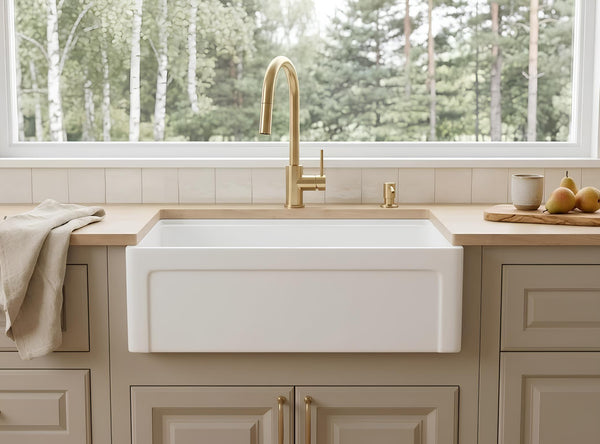
Fireclay is the opposite. An apron front farmhouse sink in white or off-white becomes a visual anchor. The smooth, glossy finish reads as warm and intentional in a way that metal doesn't. It works especially well in farmhouse, transitional, and traditional kitchens — but modern spaces can pull it off too, depending on the design.
The limitation: fireclay comes in very few colors. If you want something beyond white, off-white, or black, you'll need to look at other materials entirely.
Cost and Installation
Upfront Cost
Stainless steel: $200–$600 for a quality 16- to 18-gauge sink. Fireclay: $600–$1,400+ depending on size and brand.
Installation
Stainless steel is lightweight and fits standard cabinet cutouts. Most installs take under an hour.
Fireclay farmhouse sinks weigh 80–120 pounds and often require cabinet reinforcement or a custom support structure — especially for apron front styles. Expect higher labor costs and a longer install window.
Long-Term Value
Here's where the cost picture shifts. A stainless steel sink that looks visibly worn after 4–5 years may push you toward an earlier replacement. A fireclay sink that still looks clean at year 10 doesn't. Factor in one potential replacement cycle, and the lifetime cost gap narrows.
Single Bowl vs Double Bowl
Stainless steel comes in nearly every configuration: single bowl, double bowl, one-and-a-half, undermount, drop-in, workstation.
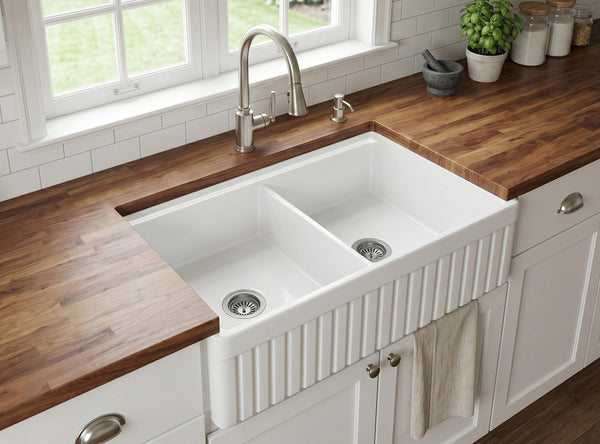
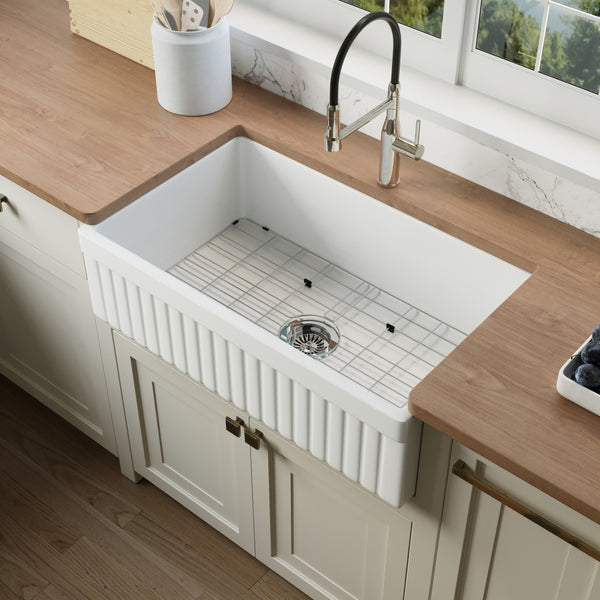
Fireclay leans heavily toward single bowl apron-front designs. That's not a limitation for most people — a deep single bowl handles large pots, sheet pans, and batch cooking better than a divided layout. But if a double bowl is non-negotiable for you, stainless steel gives you more options.
For a sense of what's available in fireclay at the most common size, Nozloo's 33-inch fireclay farmhouse collection is a useful reference — it shows the style range from clean-lined to textured apron designs like the ribbed workstation model.
How Does Fireclay Compare to Other Sink Materials?
Since you're researching materials, you've probably seen cast iron, porcelain, and granite composite come up too.
Cast iron has a similar enamel look to fireclay but is heavier and more prone to rust if the coating chips. Maintenance is higher. If you're choosing between fireclay and cast iron, fireclay is generally the easier material to live with.
Porcelain and ceramic sinks fire at lower temperatures than fireclay, making them softer and more susceptible to staining and chips. They look similar when new but don't age as gracefully.
Granite composite is a strong option if you want a dark, matte sink. Different aesthetic, good durability, moderate maintenance.
The Bottom Line: Which Should You Choose?
Choose fireclay if:
- You're remodeling a kitchen you plan to keep for 5+ years
- Scratch resistance and low daily maintenance are priorities
- You want your sink to be a design feature, not just a utility
- You prefer the warmth of a farmhouse or apron front style
- You're comfortable with a higher upfront investment
Choose stainless steel if:
- Budget is the primary driver
- You need a specific size or double bowl configuration
- You're outfitting a rental, flip, or short-term kitchen
- You want a neutral look that blends into modern kitchens
- Impact resistance matters more than scratch resistance
Neither choice is wrong. They're answers to different questions.
FAQ: Fireclay vs Stainless Steel Sink
Is fireclay more durable than stainless steel?
It depends on what kind of durability you mean. Fireclay resists scratches and stains far better than stainless steel and maintains its appearance over years of use. Stainless steel is more resistant to cracking and chipping from heavy impact. For everyday kitchen use, fireclay tends to look more durable over time, even if stainless steel is technically tougher against blunt force.
Do fireclay sinks scratch easily?
No. The kiln-fired glaze is hard enough to resist scratches from normal kitchen activity — pots, pans, utensils, and dish-washing. Stainless steel scratches much more easily by comparison.
Are fireclay sinks hard to maintain?
The opposite. Because the surface is non-porous, stains and water spots don't stick the way they do on stainless steel. A quick rinse after use is usually enough. Just avoid abrasive scrubbers.
Can you put hot pans in a fireclay sink?
Yes. Fireclay is fired at approximately 2,200°F during manufacturing, so household cooking temperatures won't cause damage. The same applies to stainless steel.
Why are fireclay sinks so expensive?
The manufacturing process is more labor-intensive — each sink is molded from clay and fired in a kiln at extreme heat. The raw material, craftsmanship, and weight (which affects shipping) all contribute to the higher price point compared to machine-pressed stainless steel.
Which sink is better for a farmhouse kitchen?
Fireclay is the classic choice for farmhouse-style kitchens. The apron front design and warm white finish are defining elements of the farmhouse look. Stainless steel farmhouse sinks exist, but they lean more industrial than rustic.
About the Author: NOZLOO is a fireclay-only kitchen brand. That means our team spends every day on one product category — fireclay farmhouse sinks. We've talked to installers about cabinet cuts, watched the kiln fire at 2,200°F, and inspected sinks before they ship. When we write these guides, we're writing about the only thing we know deeply. Have a question we didn't cover? Reach us at info@nozloo.com.