
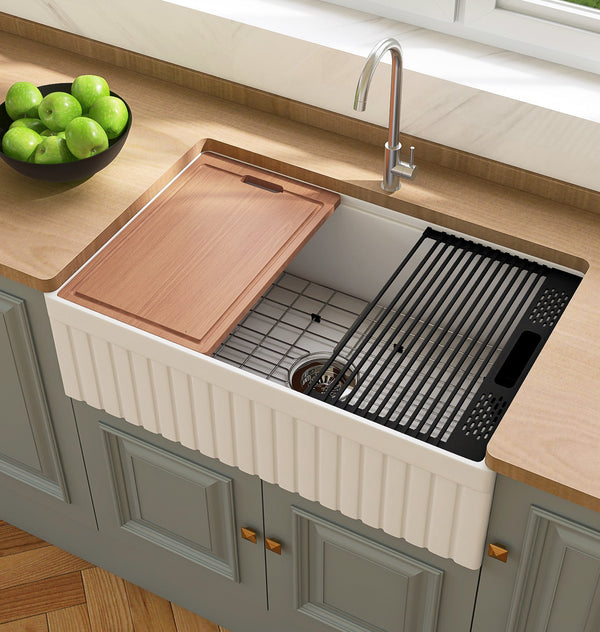

Fireclay vs Cast Iron vs Porcelain Sink: Which Material Wins?

You've probably narrowed your kitchen sink search to three materials: fireclay, cast iron, and porcelain. Good — those are the serious contenders. But the differences between them aren't as obvious as they should be, and most comparison articles online just rehash the same vague points without telling you anything useful.
We've done the homework. Here's an honest, detailed comparison that covers how each material is actually made, where each one performs well, and where each one falls short — so you can pick the right sink for your kitchen, not just the most popular one.
A Quick Overview: What Sets These Three Apart
Before we get into the details, here's the high-level picture.
All three materials — fireclay, enameled cast iron, and porcelain — can produce a white, glossy finish that looks beautiful in a kitchen. But the way they're made, the way they age, and the way they handle daily use are very different.
Fireclay is natural clay fired at extremely high temperatures until it vitrifies — meaning the clay particles fuse into a dense, glass-like structure. The glaze bonds permanently to the body during firing. It's one solid, integrated piece.
Enameled cast iron is a two-part system: a heavy iron core coated with porcelain enamel. The metal beneath gives it weight and strength, but the enamel layer is what you see and touch — and it's also where this material is most vulnerable.
Porcelain sinks (sometimes labeled vitreous china for bathroom sinks, or porcelain enamel on steel for kitchen sinks) are clay-based or steel-based with a glazed ceramic finish. They're typically fired at lower temperatures than fireclay, which affects density and long-term durability.
Each material takes a different approach to the same problem — making a surface that's strong, easy to clean, and good-looking over time. Understanding those approaches is what makes the comparison useful.
Durability: How Each Material Handles Real Kitchen Life
This is where the fireclay vs cast iron sink debate gets interesting, because durability means different things depending on what you're worried about.
Impact Resistance
Let's be upfront: if you drop a heavy object — a cast iron skillet, a glass jar, a ceramic plate — into any of these sinks, something might chip. No sink material is indestructible.
That said, fireclay sinks tend to absorb impact better than porcelain because of their density and wall thickness. The material is fired at extremely high temperatures, which creates a rigid, solid body that distributes force more evenly. A dropped dish might chip the glaze on a porcelain sink relatively easily. With fireclay, it takes a sharper or heavier object to cause real damage.
Enameled cast iron sinks are heavy and feel substantial — and the iron core itself is very strong. Cast iron won't crack from a dropped pot the way a thinner material might. The vulnerability is specifically in the enamel coating: one chip from a sharp or heavy object and you've exposed the metal beneath, which can lead to rust over time (more on that below). The iron structure underneath, though, is extremely resilient.
Heat Resistance
Fireclay handles high temperatures very well. The kiln firing process means it's already been through temperatures far beyond anything a kitchen will produce. Hot pans, boiling water, thermal shock from temperature swings — fireclay is well-suited for all of it.
Cast iron sinks also handle heat well — the iron core is naturally heat-tolerant, which is one of its genuine strengths. The concern is more about the enamel coating: rapid temperature changes can stress the glaze over time, potentially leading to hairline cracks. In practice, this is a gradual issue rather than a sudden failure.
Porcelain sinks are the most vulnerable here. They're fired at lower temperatures during manufacturing, and the material can crack or craze when exposed to extreme temperatures — pouring boiling pasta water into a cold porcelain sink is a common way to find that out the hard way.
Scratches
All three materials will show surface marks under heavy use — that's unavoidable. But there's a meaningful difference in degree.
Fireclay's glazed surface is hard and smooth, and minor scratches from dishes and utensils tend to stay superficial. The glaze is fused to the clay body, so there's no separate layer to wear through.
Cast iron's porcelain enamel finish can scratch, and deeper scratches expose the metal underneath. Dark-colored enameled cast iron sinks show scratches more visibly than white ones.
Porcelain sinks scratch too, and because the material is generally less dense, scratches can feel more pronounced over time. The finish may also dull faster in a busy kitchen.
Stain Resistance and Cleaning: How Each Sink Material Holds Up
If you cook regularly — and especially if you cook with turmeric, beets, coffee, or red wine — stain resistance matters.
Fireclay
Fireclay is a non-porous material, which means stains sit on the surface rather than soaking in. Coffee, wine, tomato sauce — wipe them off and they're gone. For tougher stains, a paste of baking soda and water is usually enough. Daily cleaning is simple: mild soap and a soft cloth. That's the whole routine.
This is one of the reasons fireclay sinks are extremely durable in practice — not just structurally, but cosmetically. The surface doesn't yellow, doesn't absorb odors, and doesn't require sealing.
Enameled Cast Iron
Cast iron sinks are fairly stain resistant when the enamel coating is intact. But here's the catch: if the enamel chips, even a small chip exposes the raw iron. And once iron is exposed to water, it rusts. One chip can lead to a rust stain that spreads beneath the enamel surface over time.
Cleaning is similar — mild soap and a non-abrasive sponge. But you need to be more careful about what cleaners you use, since harsh chemicals can dull or damage the enamel.
Porcelain
Porcelain sinks can stain more easily than the other two, especially lighter-colored models. The surface isn't always as dense or as non-porous as fireclay, which means stains from tea, coffee, or food dye may need more aggressive scrubbing.
Hard water deposits are also more visible on porcelain, and the finish can yellow over the years — something you rarely see with fireclay.
The Enamel Question: Chipping and Rust on Cast Iron Sinks
This topic deserves its own section because it's the most common concern buyers raise about enameled cast iron — and it's worth addressing honestly rather than overstating.
An enameled cast iron sink looks great on day one. The porcelain enamel coating is thick, smooth, and has a deep glossy finish. The concern is what happens if that enamel gets damaged — whether from a dropped pan, a sharp or heavy object, or gradual wear. A chip in the enamel can expose the metal beneath the coating.
And iron, when exposed to moisture, can rust.
If rust does develop at a chip site, it can gradually spread under the surrounding enamel, causing discoloration. Repairing enamel chips is possible with touch-up kits, and many homeowners manage chips successfully for years — but it's fair to say the repair won't be invisible, and it does require ongoing attention.
That said, plenty of cast iron sinks last decades with proper care. The enamel on a quality cast iron sink is thick and reasonably durable — this isn't a fragile surface. The point isn't that cast iron will inevitably fail, but rather that it has a specific vulnerability that fireclay doesn't share.
Fireclay's structure is different: there's no metal core and no separate coating. The glaze and the body are fused into one piece during kiln firing, so there's no hidden layer that can corrode. That structural simplicity is a genuine advantage — but it doesn't mean cast iron is a bad choice. It means the two materials age differently, and it's worth knowing how before you commit.
Fireclay vs Porcelain Sink: Why They're More Different Than They Look
This comparison trips people up because fireclay and porcelain sinks can look almost identical at first glance. Both are typically white or off-white. Both have a smooth, glazed surface. Both feel solid.
But the similarities stop at the surface.
The core difference is in how they're made. Fireclay is fired at much higher temperatures, which triggers vitrification — a process that fuses the clay into a dense, non-porous material. Porcelain is generally fired at lower temperatures and doesn't achieve the same level of material transformation.
What does that mean in practice?
Porcelain is generally more prone to chipping and staining. It's also more susceptible to thermal shock — crazing (fine cracks in the glaze) and surface dulling are more common with porcelain over time. None of these issues make porcelain a bad material, but they do show up faster and more visibly than with fireclay under similar use conditions.
Fireclay costs more upfront, and for lower-traffic applications — a guest bathroom, a bar sink — porcelain may be perfectly adequate. But for a primary kitchen sink that sees daily use — dishes stacked in the basin, hot pans set down, large pots filled with water — the long-term performance difference is real.
If you want a deeper dive into how fireclay compares to standard ceramic materials, our guide to fireclay vs. ceramic differences covers the material science, firing process, and real-world performance differences in detail.
What About Granite Composite and Stainless Steel?
Since we're comparing sink materials, it's worth briefly touching on two other materials you'll run into: granite composite and stainless steel sinks.
Granite Composite
Granite composite sinks — a mix of crushed granite and acrylic resin — are a popular material for modern kitchens. They're stain resistant, come in a range of colors, and tend to be more budget-friendly than fireclay.
The trade-off? The resin component can degrade over time with exposure to extreme temperatures. And granite composite doesn't have the same farmhouse style aesthetic appeal — if you're going for an apron front look, fireclay and cast iron are your primary options.
Are fireclay sinks better than granite? In terms of structural durability, heat resistance, and long-term surface integrity, fireclay generally has the edge. But granite composite is a solid, practical choice if you want color options and a lower price point.
Stainless Steel Sinks
Stainless steel is the workhorse of kitchen sinks. It's affordable, lightweight, easy to install, and virtually immune to cracking. But it scratches easily, shows water spots, dents from dropped pans, and lacks the timeless appeal that draws people to fireclay or cast iron.
For a high-traffic commercial kitchen, stainless steel makes sense. For a home kitchen where aesthetics matter as much as function, it's usually not the first choice.
Full Comparison: Fireclay vs Cast Iron vs Porcelain (and More)
The best sink material depends on your use case, budget, and installation priorities. This table is meant to give you a clear side-by-side view — but keep in mind that each material has trade-offs, and no single column is "the winner" for everyone.
|
Feature |
Fireclay |
Enameled Cast Iron |
Porcelain |
Granite Composite |
Stainless Steel |
|---|---|---|---|---|---|
|
Structure |
Solid clay body + fused glaze |
Iron core + enamel coating |
Clay or steel + glazed finish |
Granite dust + resin |
Solid metal |
|
Chip Risk |
Low |
Moderate (enamel chips) |
Higher |
Low |
Very low (dents instead) |
|
Rust Risk |
None |
Yes (if enamel chips) |
None |
None |
None |
|
Stain Resistance |
Excellent (non-porous) |
Good (until chipped) |
Moderate |
Good |
Good |
|
Heat Resistance |
Excellent |
Good |
Moderate |
Moderate |
Excellent |
|
Scratches |
Minor surface marks |
Visible on dark colors |
Shows over time |
Moderate |
Scratches easily |
|
Weight |
Heavy |
Very heavy |
Moderate |
Moderate |
Light |
|
Maintenance |
Mild soap, soft cloth |
Watch for chips |
Regular cleaning |
Occasional resealing |
Frequent wipe-down |
|
Farmhouse / Apron Front |
Yes |
Yes |
Rare |
No |
Rare |
|
Price Range |
Mid-to-high |
Mid-to-high |
Budget to mid |
Budget to mid |
Budget |
So Which Kitchen Sink Material Should You Choose?
There's no single "best" — it depends on what you care about most. But here's our honest read:
Choose fireclay if you want a durable sink with strong all-around performance — stain resistance, heat resistance, structural durability, and a classic aesthetic — without the chip-and-rust concern that comes with cast iron. Fireclay is an extremely durable option that tends to maintain its appearance over years of use. For farmhouse sinks and apron front styles, it's one of the strongest contenders.
Choose enameled cast iron if you value heft, solidity, and a deep glossy finish that feels substantial the moment you touch it. Cast iron sinks are a classic for good reason — they absorb sound well, feel permanent in a kitchen, and the enamel finish on a quality model is thick and durable. You'll want to be mindful of chips over the years, but many homeowners find the trade-off worthwhile for the look and feel.
Choose porcelain if you want a clean look at a lower price point and your sink won't be under heavy daily stress. Porcelain sinks work well for bathroom sinks, guest baths, or kitchens where the sink isn't the primary workstation. They're also a reasonable match alongside porcelain toilets and other ceramic bathroom fixtures where the aesthetic consistency matters more than extreme durability.
Choose granite composite if you want color options and a more modern look at a lower price. Just keep in mind the heat limitations.
Choose stainless steel if you need something affordable, lightweight, and easy to replace. Stainless steel works with most countertops, can be installed as undermount or drop-in, and won't crack — but it won't give you that elegant farmhouse look either.
If you're still in the research phase, our guide to fireclay sink material and process breaks down exactly what fireclay is, how it's made, and what makes it different — it's a good starting point if you want to understand the material before comparing.
The Bottom Line
The fireclay vs cast iron sink question doesn't have a universal answer — it depends on what you prioritize. Cast iron offers heft and a classic feel, but it relies on its enamel to protect the iron underneath. Porcelain is accessible and clean-looking, but less dense and more prone to showing wear. And fireclay is a single, fused structure — clay and glaze bonded together — which gives it a durability profile that's different from anything with a separate coating or a softer body.
None of these materials is perfect for every kitchen. But if long-term performance, low maintenance, and structural simplicity are high on your list, fireclay is worth a serious look.
If you're planning a kitchen remodel and want something that earns its place in the room for the long run, take a look at our fireclay farmhouse sink collection. Every model ships free and comes inspected before it leaves the warehouse.
About the Author: The NOZLOO team specializes in premium fireclay farmhouse sinks. We test, refine, and obsess over sink quality so you don't have to.
See the difference in person
Every NOZLOO sink is inspected before it ships. Free U.S. shipping and a lifetime warranty included.
View All Sinks